










ABB India targets 13%-15% EBITDA margin from backlog
Key highlights
- ABB India expects EBITDA margin of 13%-15% as backlog is executed over the next six to eight quarters.
- ABB India’s nine-month operating profit margin was 12.2%, down from 14.8% in the previous-year period.
- Management said scale and fixed-cost absorption recovered a couple of percentage points, but material and other costs remain unrecovered.
- ABB India cited 43% growth in base orders and said planned capacity is focused primarily on local demand.
powered by IRIS
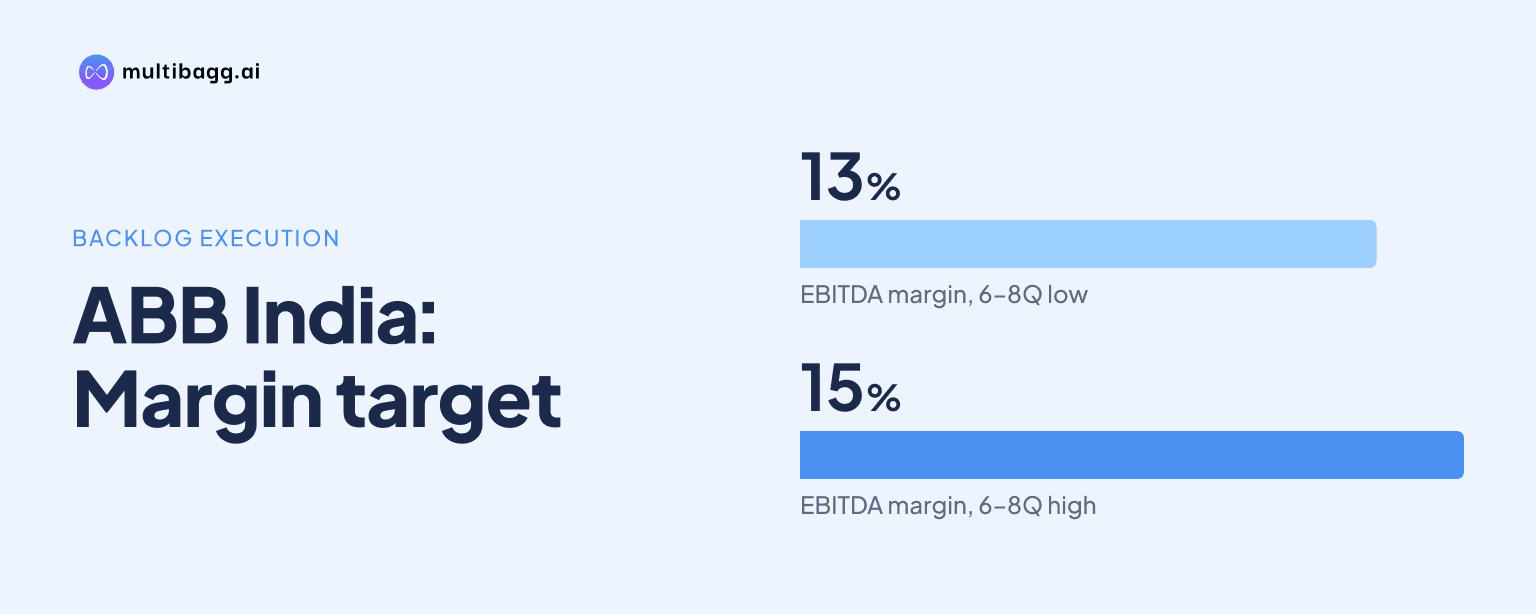
ABB India Limited said it expects EBITDA margin of 13%-15% as it executes backlog over the next six to eight quarters, subject to specified cost and market conditions. The outlook follows a nine-month operating profit margin of 12.2%, compared with 14.8% in the previous-year period, as management said some cost pressures remain unrecovered.
Know ABB India inside out
Results, valuation, peers and who's buying, in one view.
What EBITDA margin does ABB India expect from backlog execution?
ABB India expects EBITDA margin of 13%-15% over the next six to eight quarters as backlog is executed, management said. The outlook is conditional on material costs, commodity prices, geopolitical developments, foreign-exchange volatility and tax rates remaining constant.
The range was management’s response to an analyst question about whether returning volume growth could improve margins through operating leverage and more effective price transmission. Management said the company still needs to offset all material-cost increases and scale-related fixed costs, despite recovery from higher production scale.
Management cited operating profit margin, rather than EBITDA margin, when describing the nine-month result. The transcript does not define or reconcile the two measures, so the 13%-15% EBITDA range is management’s forward-looking indication and is not a directly comparable restatement of the reported 12.2% operating profit margin.
Why did ABB India’s nine-month margin decline?
ABB India’s nine-month operating profit margin declined 2.6 percentage points to 12.2% from 14.8% in the previous-year period. Management said scale and operational absorption of fixed costs accounted for a couple of percentage points of recovery, but material costs and other expenses linked to volume had not been fully recovered.
Fixed costs also remain an unresolved part of the recovery, according to management. It said the company had not yet offset all material-cost increases and scale-related costs, making the margin path dependent on both higher execution volumes and further cost recovery.
ABB India described price pass-through as a continuing process because there is usually a lag before cost increases can be passed to customers. Management said each business applies its own approach depending on the market, customer segment and strategy, while localisation is also part of the company’s response to cost pressures.
How can backlog execution improve ABB India’s margins?
ABB India said execution of backlog over six to eight quarters could lift EBITDA margin into the 13%-15% range through greater scale and fixed-cost absorption. The company’s explanation links margin improvement to turning orders into production and revenue, rather than solely to securing fresh orders.
Management said material costs and other volume-related expenses still require recovery after the 2.6-percentage-point decline in nine-month operating profit margin. This means the stated range relies on both execution volumes and the ability to recover prior cost increases through pricing, sourcing and operational actions.
The company did not forecast a sustained decline in raw-material costs. When asked whether raw-material pressures had eased, management said it did not have a “crystal ball” on future prices and was taking a short-term view, while describing its method for addressing cost movements as robust.
Got a follow-up? Ask IRIS
Which businesses could support ABB India’s backlog execution?
ABB India said its demand base is broad rather than dependent on data centres alone, and management cited 43% growth in base orders. It referred to Electrification, Motion and Automation businesses, as well as faster growth in Tier 2 and Tier 3 cities, as contributors to its market coverage.
Data centres are one developing opportunity because customers seek energy-efficient and optimised systems. Management said technology-led segments with a high degree of differentiation, including data centres, can generate reasonably better margins than established segments, but it did not quantify data-centre orders or their contribution to profitability.
ABB India has launched the Infinitus direct-current solution globally and said direct-current equipment had previously been used in marine applications. Management said medium-voltage direct-current technology, which is being used with hyperscalers globally, will take time to reach India, and data centres will continue to use a mix of alternating current and direct current.
What could delay ABB India’s margin recovery?
ABB India said its 13%-15% EBITDA outlook depends on stable material costs, commodity prices, geopolitical developments, foreign-exchange volatility and tax rates. These are conditions set by management, not outcomes confirmed in the call, and each could affect the pace of cost recovery.
Automation is also a variable in the execution outlook. Management said growth in the segment had been tepid at 4% relative to previous quarters, although it described the pipeline as strong and said decisions on projects would determine when that pipeline becomes reported results.
The Automation business serves oil and gas, power, water, specialty chemicals, metals, minerals, mining, cement, marine and ports. Management reported consistent movement in offshore and midstream oil-and-gas projects, sluggish downstream activity, newly announced greenfield power projects, and stable investment in specialty chemicals and pharmaceuticals.
When will ABB India’s new capacity become available?
ABB India said its planned factory capacity is principally intended to meet local demand rather than to serve exports. The investments cover mainly Motion and Electrification products, with a smaller Automation component, while management said some products could also support export expansion.
Management described local demand as robust and said it should absorb the planned capacity. This positions the factory programme as a response to domestic-market growth, rather than as the main mechanism for achieving the six-to-eight-quarter EBITDA margin range.
Construction, installation and commissioning of new factories normally take eight to 10 quarters end to end, management said. It indicated that the earliest completion could be at the end of 2027, with some capacity becoming available later in 2028, placing that programme beyond the immediate backlog-execution period.
Conclusion
ABB India’s 13%-15% EBITDA margin outlook is based on backlog execution, improved absorption of fixed costs and further recovery of material and volume-related costs. The nine-month operating profit margin of 12.2%, down from 14.8% a year earlier, shows that management does not consider the recovery from previous cost pressures complete.
The next factors to watch are execution of backlog during the stated six-to-eight-quarter period, movements in commodities and foreign exchange, and the conversion of Automation’s pipeline after its reported 4% growth. Management’s capacity plan is scheduled to begin completing from the end of 2027 and extend into 2028, with local demand expected to be its primary driver.