










Abha Power and Steel says sand processing rose 35-fold
Key highlights
- Abha Power and Steel increased moulding and sand-processing capacity from 1,000 kg/hour to 35,000 kg/hour, a 35-times rise.
- Abha Power and Steel’s 7,200 MT steel foundry was operating at about 20–30% utilisation, against a target above 90%.
- Abha Power and Steel’s SG iron foundry had 7,200 MT annual capacity and about 80–90% utilisation in H1 FY27.
- Abha Power and Steel reported a Rs 22 crore order book as of 30 September 2026.
powered by IRIS
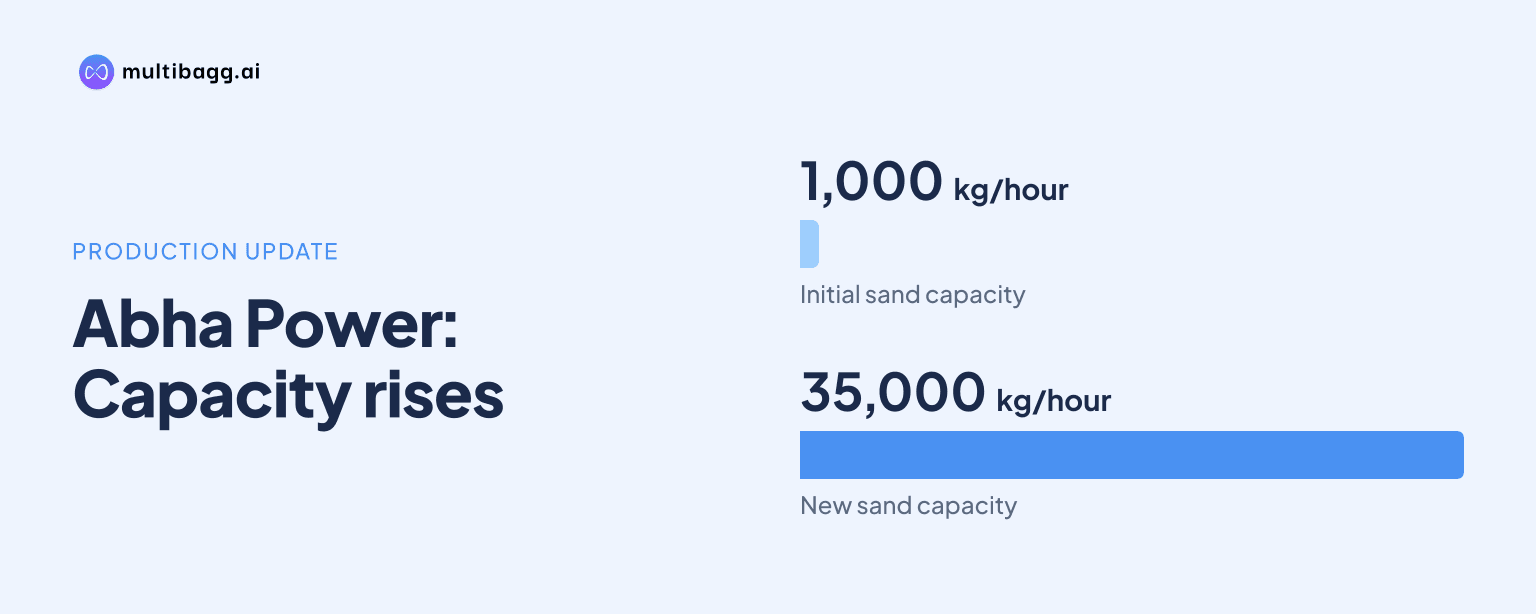
Abha Power and Steel Limited says its plant upgrade raised moulding and sand-processing capacity from 1,000 kg an hour to 35,000 kg an hour, a 35-fold increase intended to remove a bottleneck at its 7,200 metric-tonne steel foundry, where current utilisation was about 20–30% in H1 FY27.
Know Abha Power and Steel inside out
Results, valuation, peers and who's buying, in one view.
How did Abha Power and Steel raise sand-processing throughput 35-fold?
Abha Power and Steel raised moulding and sand-processing capacity to 35,000 kg an hour from 1,000 kg an hour by upgrading moulding and downstream processing infrastructure. The company identifies the shift as a 35-times increase, intended to provide greater throughput, operational flexibility and capacity to handle larger volumes.
Before the upgrade, manual downstream moulding and sand processing restricted the manufacturing chain after melting. Abha Power and Steel says sand and additives were prepared batch by batch, lengthening mould-preparation cycles despite adequate melting capacity. The constraint therefore limited the movement of castings from melting into heat treatment, finishing, machining and ready-casting stages.
The upgraded flow places moulding and sand processing between melting and heat treatment, with an automated moulding line designed to make mould preparation faster and more consistent. The presentation does not disclose monthly output, casting production or post-upgrade utilisation. It says the 35,000 kg-an-hour processing rate removes the bottleneck and supports higher throughput potential.
Which Abha Power and Steel foundry has the largest utilisation opportunity?
Abha Power and Steel’s steel foundry has the largest stated utilisation opportunity, with 7,200 metric tonnes per annum of installed capacity and current utilisation of about 20–30%, against a target above 90%. Management describes this foundry as the primary utilisation opportunity and links upgraded processing infrastructure to unlocking underused furnace capacity.
The SG iron foundry has the same 7,200 metric tonnes per annum installed capacity but was operating at about 80–90% utilisation, with a target of about 95%. Abha Power and Steel describes that operation as relatively mature and well utilised, with incremental scope to improve throughput and efficiency. The difference makes the steel foundry, rather than the SG iron operation, the central capacity-utilisation lever in the presentation.
At the group level, Abha Power and Steel reports combined installed casting capacity of 14,400 metric tonnes. The presentation frames growth as improved use of the existing installed base rather than greenfield capacity addition. It does not state a timetable for taking steel-foundry utilisation from about 20–30% to above 90%.
Got a follow-up? Ask IRIS
What equipment is Abha Power and Steel commissioning?
Abha Power and Steel says its electric arc furnace and a heat-treatment furnace are already operational, while the automated moulding line, 20 MT heat-treatment furnace and additional processing infrastructure are in commissioning. The company says these plant upgrades were funded by initial public offering proceeds.
The automated moulding line addresses manual mould preparation, while the 20 MT heat-treatment furnace is intended to handle larger batches and support higher production volumes. Additional processing bays are intended to expand post-casting processing capacity and allow smoother movement through finishing operations. These projects address stages beyond melting, which the company identifies as the prior production constraint.
Abha Power and Steel also refers to an electric arc furnace and a 6 MT heat-treatment furnace as infrastructure supporting production scale-up. Its project-status table labels the electric arc furnace as “EAP”, while its capability description uses “EAF”. The presentation does not provide commissioning dates, capital costs or production volumes for the projects still under commissioning.
Pneumatic sand reclamation forms another part of the upgrade programme. Abha Power and Steel says it recovers and reconditions used moulding sand, enabling 75–80% sand reuse and reducing the requirement for fresh sand. This reuse mechanism is separate from the increase in processing capacity from 1,000 kg an hour to 35,000 kg an hour.
What demand could use Abha Power and Steel’s added capacity?
Abha Power and Steel’s steel foundry product list includes hammers, screen plates, crushing rings, grate plates, coke-bucket liners, clamping flanges, blow bars, grate bars and clinker-grinder rolls. The presentation does not allocate the 7,200 MT steel-foundry capacity among these products or identify which products will absorb the incremental output enabled by the upgraded process.
The company describes itself as a railway-focused casting platform with more than 20 product categories and more than 1,000 stock-keeping units. As of 30 September 2026, Abha Power and Steel reported an order book of Rs 22 crore, while 8–9 railway products were at various stages of qualification with the Research Designs and Standards Organisation, or RDSO.
Abha Power and Steel says it can manufacture custom iron and steel castings from approximately 500 g to 10,000 kg, supported by a National Accreditation Board for Testing and Calibration Laboratories, or NABL, accredited in-house laboratory. Its testing covers chemical, mechanical and metallurgical properties. These capabilities support product qualification and validation, but the presentation gives no product-specific volume forecast.
The company also cites engagement with a defence public-sector undertaking for critical prototype castings. It describes a route from prototype casting to validation and potentially larger commercial opportunities, without disclosing a defence production order, revenue contribution or volume in H1 FY27. That disclosure remains separate from the Rs 22 crore order book reported on 30 September 2026.
Conclusion
Abha Power and Steel’s disclosed operational change is a 35-fold increase in moulding and sand-processing capacity, aimed at removing a manual downstream constraint that had limited its steel foundry. The significance lies in the gap between steel-foundry utilisation of about 20–30% and its above-90% target, compared with the SG iron foundry’s existing 80–90% utilisation.
The next issue to watch is commissioning of the automated moulding line, 20 MT heat-treatment furnace and additional processing infrastructure. Abha Power and Steel also needs to convert its Rs 22 crore order book as of 30 September 2026 and 8–9 railway products under RDSO qualification into disclosed utilisation, output or revenue gains.