










Abha expects coach components to add 10–12% of FY27 revenue
Key highlights
- Abha expects two newly commercialised railway coach components to contribute 10–12% of FY27 revenue.
- Abha has submitted 8–9 railway products to RDSO, and 1 additional railway product is already approved.
- Abha reported a Rs 22 crore order book in H1 FY27 with Railway relevance.
- Abha’s upgrade plan includes a 35-times increase in sand-processing throughput and a 20-metric-tonne heat-treatment furnace.
powered by IRIS
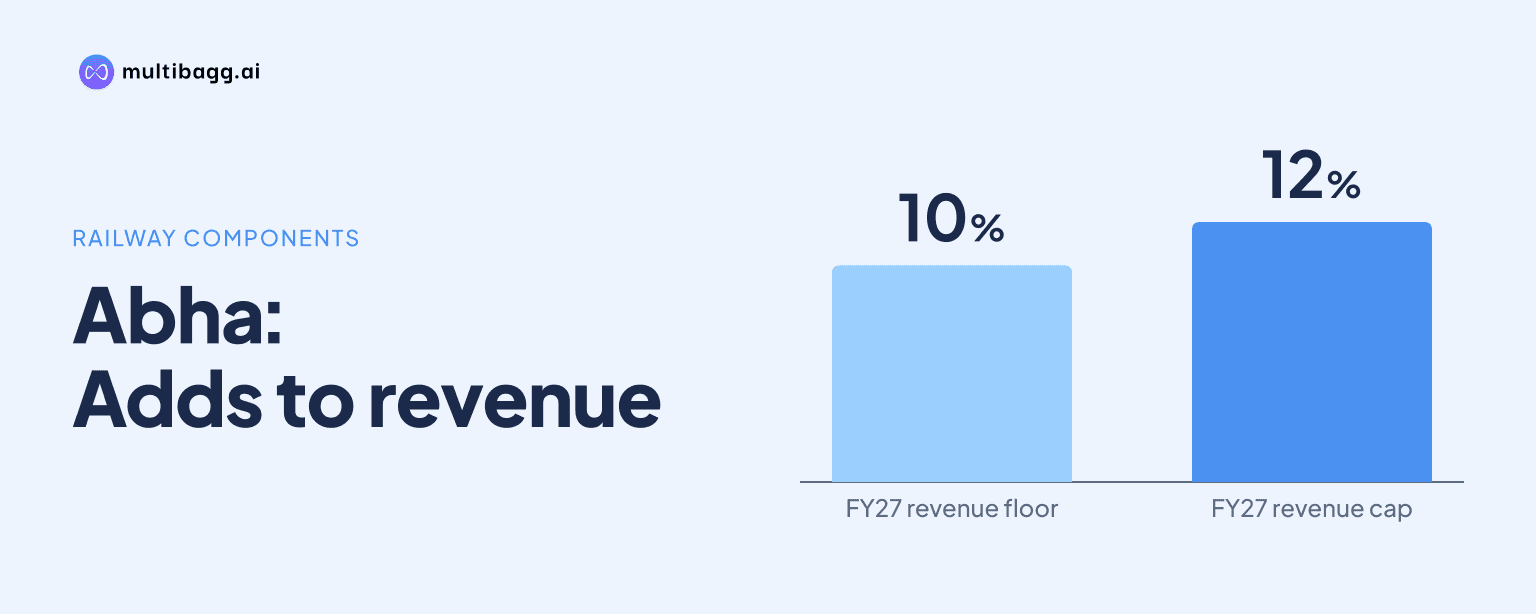
Abha says two critical railway coach components that have entered commercial production are expected to contribute 10–12% of financial year 2027 (FY27) revenue. The estimate is supported by long-term or standing orders from a major Railway original equipment manufacturer (OEM), while 8–9 additional products have been submitted for RDSO approval.
Know Abha Power and Steel inside out
Results, valuation, peers and who's buying, in one view.
What will Abha’s two coach components contribute to FY27 revenue?
Abha expects the two newly commercialised critical coach components to generate 10–12% of its FY27 revenue. This is the presentation’s specific revenue outlook for the products, which have progressed from development into commercial production and are described as creating a new revenue stream. The source does not disclose the names of the two components, their selling prices, volumes or the absolute rupee value of the expected FY27 contribution.
The range gives the new products a defined role in FY27 revenue rather than identifying railways only as a future opportunity. A 2-percentage-point range separates the lower and upper ends of the estimate, and delivery depends on commercial ramp-up after product qualification. Abha links that ramp-up to standing or long-term orders from a major Railway OEM and engagement with additional OEMs, but it does not state order quantities or a timetable for component deliveries.
Abha disclosed an order book of Rs 22 crore in H1 FY27, with Railway relevance identified as part of its next growth phase. That figure provides wider order visibility, but Abha does not say how much of the Rs 22 crore relates to the two coach components. The 10–12% projection is therefore a share of total FY27 revenue expected from the newly commercialised products, not a stated share of the order book.
How has Abha moved from railway development to commercial production?
Abha has moved two critical coach components from development into commercial production, marking the operating transition behind its FY27 revenue expectation. Its stated scale-up sequence is RDSO approval, product qualification, OEM engagement, commercialisation and then higher volumes. The sequence indicates that approval and customer engagement precede volume expansion rather than automatically guaranteeing it.
The presentation places this railway work within casting capability covering components weighing approximately 500 grams to 10,000 kilograms. Abha also says it can provide machined cast components, rather than raw castings alone, and has in-house chemical, mechanical and metallurgical testing through a National Accreditation Board for Testing and Calibration Laboratories (NABL)-accredited laboratory. These capabilities are relevant to qualification-led applications, although the source does not assign a particular test, casting weight or machining process to the two commercialised coach components.
Abha’s railway position extends beyond the two new products. It says it already manufactures critical railway components for infrastructure and coach applications and is expanding from established railway castings into a wider portfolio of qualified and commercialised components. The change disclosed is from product development to commercial scale for two coach applications, alongside continuing work to qualify more specialised railway products.
Got a follow-up? Ask IRIS
What is in Abha’s RDSO approval pipeline?
Abha has submitted 8–9 railway products for RDSO approval, with approvals advancing through stages and one additional railway product already RDSO-approved. The presentation does not define RDSO or identify the individual products, their submission dates or their precise approval stages. It does state that a recent approval has strengthened Abha’s railway pipeline.
The categories describe different points in Abha’s development and qualification process, and the source does not say whether the commercialised components are included in the 8–9 submitted products. That distinction matters because submission, approval and commercial production are separate milestones in Abha’s stated pathway. Approval creates a route to OEM engagement, while commercialisation and higher volumes remain later stages.
The pipeline is also tied to import substitution. Abha says Indian Railways has achieved 99.42% indigenous sourcing of railway stores purchases, while specialised or high-technology components can still be imported where domestic availability, quality or scale is constrained. Abha is targeting specialised components where technical development, testing and approval create entry barriers, but it does not quantify the import market available to its products or forecast revenue from the additional approved item.
How does Abha plan to scale its railway opportunity?
Abha plans to scale railways by pursuing RDSO approvals, commercialising critical components and deepening OEM relationships, while ramping an upgraded facility. Its H1 FY27 strategic snapshot identifies a capacity programme including automated moulding, a 20-metric-tonne heat-treatment furnace, additional processing bays, sand reclamation and a 35-times increase in sand-processing throughput.
The facility work is intended to remove an operational bottleneck and raise utilisation potential. Management’s stated next steps are to stabilise operations, improve throughput and progressively increase capacity utilisation. This connects manufacturing execution to the railway plan because Abha’s scale-up path ends with higher volumes, but the presentation gives no plant capacity figure, utilisation rate, capital-spending value or date for the upgrade’s completion.
Abha also reports existing captive solar capacity of about 3 megawatts and a planned expansion of about 2.5 megawatts. The presentation links that expansion to energy efficiency, cost optimisation and sustainability rather than specifically to railway production. Its wider plan includes developing domestic alternatives for specialised, import-dependent railway requirements, scaling defence prototypes and moving towards higher-value engineered and complex castings; no revenue target is disclosed for those other initiatives.
Conclusion
Abha’s key disclosure is that two critical coach components have crossed into commercial production and are expected to supply 10–12% of FY27 revenue. The estimate is supported by standing or long-term engagement with a major Railway OEM, while the 8–9-product RDSO submission pipeline and one additional approved product provide further qualification-led routes beyond the initial two components.
The next points to watch are the ramp-up of the commercialised components, progress of RDSO approvals and conversion of OEM engagement into higher volumes. Abha also plans to stabilise its upgraded facility and progressively raise utilisation, while pursuing approximately 2.5 megawatts of additional captive solar capacity on top of about 3 megawatts already installed.