










Abha Power’s H1 FY27 loss follows revenue and margin reversal
Key highlights
- Abha Power reported a Rs 2.36 crore PAT loss in H1 FY27, versus a Rs 2.03 crore PAT profit in H1 FY26.
- Operating revenue fell to Rs 29.59 crore in H1 FY27 from Rs 34.57 crore in H1 FY26.
- EBITDA margin changed to negative 2.59% in H1 FY27 from 12.22% in H1 FY26.
- Capital work in progress increased to Rs 28.71 crore at H1 FY27 from Rs 22.65 crore at FY26.
powered by IRIS
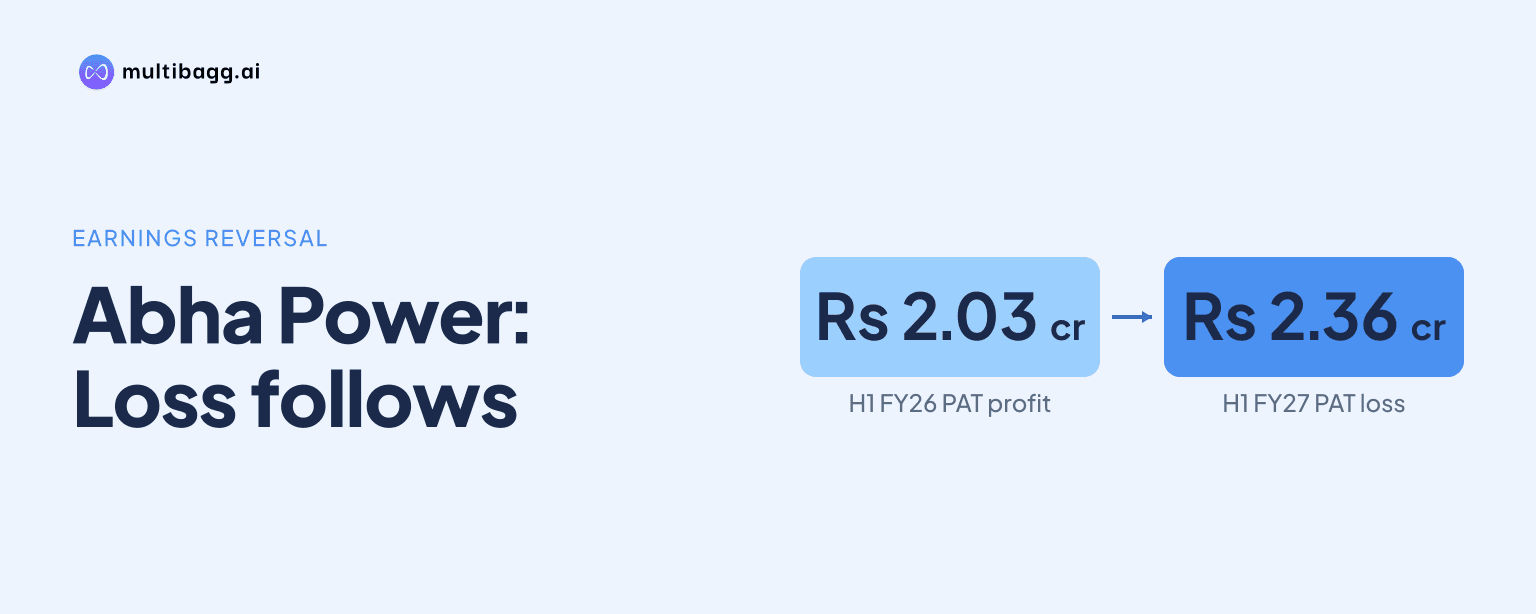
Abha Power and Steel Limited reported a Rs 2.36 crore loss after tax in the first half (H1) of fiscal year (FY) 2027, reversing a Rs 2.03 crore profit in H1 FY26, as operating revenue fell to Rs 29.59 crore and earnings before interest, taxes, depreciation and amortisation (EBITDA) margin turned negative 2.59% from 12.22%.
Know Abha Power and Steel inside out
Results, valuation, peers and who's buying, in one view.
What drove Abha Power’s H1 FY27 loss?
Abha Power’s H1 FY27 loss resulted from revenue falling below total expenses after operating profitability turned negative. Revenue from operations declined to Rs 29.59 crore from Rs 34.57 crore in H1 FY26, while total expenses decreased by a smaller amount to Rs 31.88 crore from Rs 32.43 crore. Profit before tax therefore moved to a Rs 2.23 crore loss from a Rs 2.79 crore profit a year earlier.
The result also reversed the preceding half’s profitability. Abha Power recorded profit after tax (PAT) of Rs 42.76 lakh in H2 FY26, compared with a Rs 2.36 crore loss in H1 FY27. Basic earnings per share moved to negative Rs 1.27 in H1 FY27 from Rs 0.23 in H2 FY26 and Rs 1.09 in H1 FY26.
Total revenue, including other income, was Rs 29.64 crore in H1 FY27, down from Rs 35.22 crore in H1 FY26 and up from Rs 27.88 crore in H2 FY26. Other income was Rs 5.10 lakh, compared with Rs 65.51 lakh a year earlier and Rs 23.89 lakh in H2 FY26, leaving the operating-revenue movement as the main component of the year-on-year decline.
How did Abha Power’s revenue and margins change?
Abha Power’s EBITDA moved to a Rs 76.73 lakh loss in H1 FY27 from profits in both comparison periods. EBITDA had been Rs 4.22 crore in H1 FY26 and Rs 2.02 crore in H2 FY26. The EBITDA margin consequently changed to negative 2.59%, versus 12.22% a year earlier and 7.32% in the preceding half.
PAT margin fell to negative 7.98% in H1 FY27 from 5.88% in H1 FY26 and 1.55% in H2 FY26. Tax was Rs 12.71 lakh in H1 FY27, versus Rs 75.74 lakh in H1 FY26 and Rs 15.54 lakh in H2 FY26. These reported margins show that the revenue decline was accompanied by a larger deterioration in operating and net profitability.
Depreciation and amortisation increased to Rs 72.36 lakh in H1 FY27 from Rs 49.53 lakh in H1 FY26, while financial expenses fell to Rs 74.37 lakh from Rs 93.75 lakh. Against H2 FY26, depreciation increased from Rs 67.69 lakh and financial expenses decreased from Rs 76.31 lakh, but those changes did not prevent negative EBITDA in H1 FY27.
What changed in Abha Power’s balance sheet?
Abha Power’s total assets and total equity and liabilities increased to Rs 86.78 crore at H1 FY27 from Rs 85.56 crore at FY26. The principal asset movement was capital work in progress, which rose to Rs 28.71 crore from Rs 22.65 crore. Tangible assets were broadly unchanged at Rs 22.29 crore, compared with Rs 22.33 crore at FY26.
Short-term borrowings increased by Rs 5.14 crore to Rs 17.23 crore during the half, while long-term borrowings decreased by Rs 7.10 lakh to Rs 7.47 crore. Reserves and surplus declined by Rs 2.36 crore to Rs 32.35 crore, and share capital remained Rs 18.59 crore at both H1 FY27 and FY26.
Working-capital balances showed mixed changes. Inventories remained near flat at Rs 25.07 crore, while trade receivables declined to Rs 7.53 crore from Rs 10.70 crore and short-term loans and advances fell to Rs 1.22 crore from Rs 2.47 crore. Cash and bank balances were Rs 9.56 lakh at H1 FY27, compared with Rs 8.33 lakh at FY26.
Got a follow-up? Ask IRIS
Why did Abha Power’s profitability decline?
Abha Power attributed the profitability decline to lower selling prices of Striker and other key products, which reduced overall realisations. Management also cited industry-wide pricing pressure that affected selling prices. These factors were disclosed alongside the fall in revenue from operations to Rs 29.59 crore in H1 FY27 from Rs 34.57 crore in H1 FY26.
Management additionally said expansion increased cash-flow requirements and added pressure on profitability. Capital work in progress increased by Rs 6.06 crore from FY26 to H1 FY27, while short-term borrowings increased by Rs 5.14 crore. The presentation does not quantify the respective contribution of pricing, realisations or expansion cash-flow demands to the Rs 2.36 crore PAT loss.
The reported cost pattern included a Rs 22.83 lakh year-on-year increase in depreciation and amortisation, alongside a Rs 19.38 lakh reduction in financial expenses. EBITDA nonetheless shifted from a Rs 4.22 crore profit in H1 FY26 to a Rs 76.73 lakh loss in H1 FY27, indicating that lower finance costs did not offset the reduction in operating revenue and selling-price realisations.
What does Abha Power expect in H2 FY27?
Abha Power management expects the order book to recover in H2 FY27 and performance to improve towards H2 FY26 levels. The stated comparison period delivered Rs 2.02 crore of EBITDA, a 7.32% EBITDA margin and Rs 42.76 lakh of PAT. Management did not provide a numerical H2 FY27 target for revenue, EBITDA, margin, PAT or order-book value.
Abha Power’s plan includes ramping up its upgraded facility, stabilising operations, improving throughput and progressively increasing capacity utilisation. The presentation does not disclose the facility’s capacity, current utilisation, a target utilisation level or a timetable for the ramp-up, leaving those operating measures unresolved as H2 FY27 approaches.
The company also plans to pursue Railway Design and Standards Organisation approvals, commercialise critical components and deepen original equipment manufacturer relationships. Its product strategy includes developing domestic alternatives for specialised, import-dependent railway requirements and increasing the share of engineered, complex and value-added castings, but no revenue contribution or approval schedule was disclosed.
Conclusion
Abha Power’s H1 FY27 reversal combined a fall in operating revenue to Rs 29.59 crore, negative EBITDA of Rs 76.73 lakh and a Rs 2.36 crore PAT loss. Management attributed the deterioration to lower Striker and other product realisations, industry-wide pricing pressure and expansion-led cash-flow demands, while capital work in progress rose to Rs 28.71 crore and short-term borrowings reached Rs 17.23 crore.
The next disclosed marker is management’s expectation that the H2 FY27 order book will recover and performance will move towards H2 FY26 levels. Progress in ramping the upgraded facility, increasing utilisation, obtaining Railway Design and Standards Organisation approvals, commercialising critical components and expanding higher-value castings will be the stated plan’s key operating measures.