










Freshara adds Spanish olive processing and about 3 million kg capacity
Key highlights
- Freshara’s Sarasa platform includes approximately 3 million kg of olive reception, fermentation, storage and processing capacity.
- Sarasa’s Almendralejo facility can pit and slice up to 10,000 kg of olives per day.
- The Andosilla hub has loading capacity of up to 25 trucks per day.
- Global table-olive production is estimated at 2.99 million metric tonnes in 2025/26, versus 3.32 million metric tonnes in 2024/25.
powered by IRIS
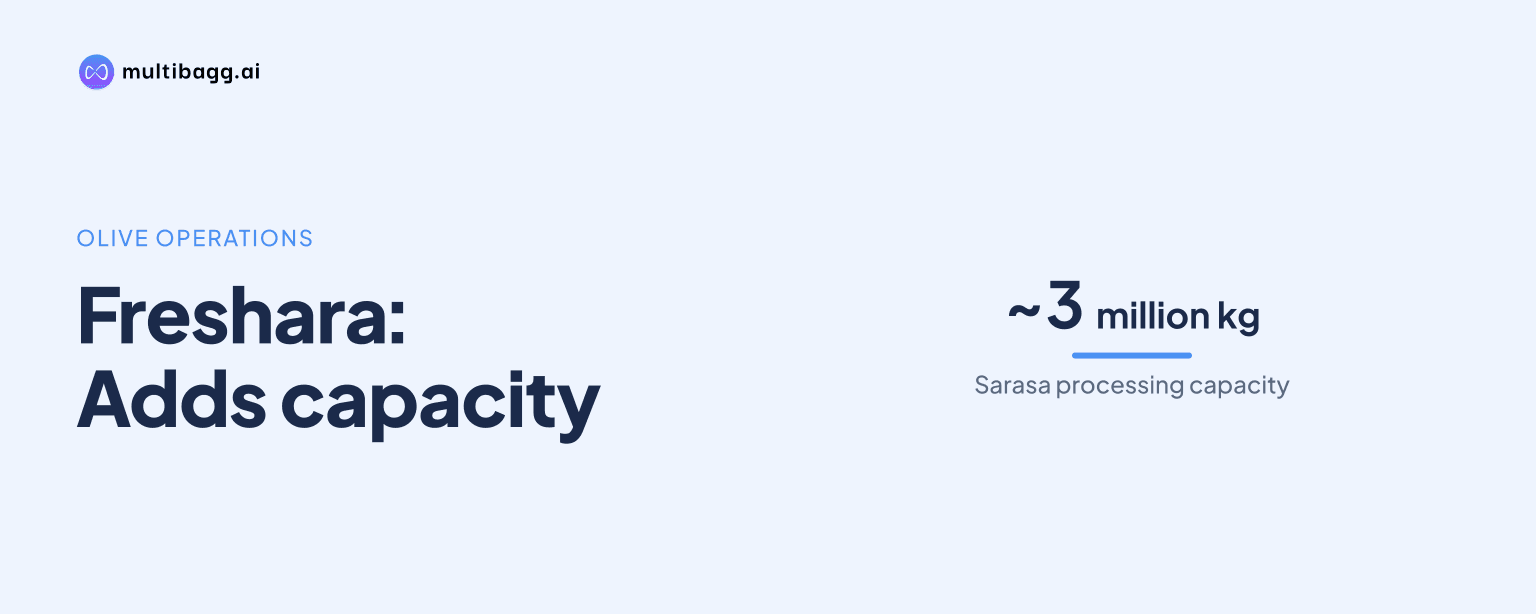
Freshara Agro Exports Limited’s acquisition of Conservas Selectas Españolas S.L., operating under Sarasa, adds a Spanish olive platform centred on approximately 3 million kg of reception, fermentation, storage and processing capacity at Almendralejo, alongside pitting and slicing capability of up to 10,000 kg per day and listed European retail relationships.
Know Freshara Agro Exports inside out
Results, valuation, peers and who's buying, in one view.
What did Freshara acquire in Spain?
Freshara acquired Conservas Selectas Españolas S.L., a Spanish company operating under Sarasa, as part of its entry into the European olives market. The presentation describes the transaction as a strategic step toward a diversified global preserved-foods platform and identifies the acquired olive business as dating to 1968.
Conservas Selectas Españolas S.L. was established as a subsidiary to acquire the business of Aceitunas Sarasa S.A.U., according to the presentation. Sarasa therefore brings more than five decades of olive-category experience, with its heritage producer founded in 1968 and its operations based across three Spanish locations.
The presentation identifies Sarasa as an integrated platform covering sourcing, processing, packaging, regulatory compliance and dispatch. It does not disclose an acquisition price, close date, revenue contribution, profit contribution or financial target for the three-site Sarasa business, making the disclosed evidence operational rather than financial.
The acquisition expands Freshara’s preserved-food offering beyond its Freshona pickle range, which includes pickled gherkins, banderillas, jalapeños, babycorns and chillies. Sarasa adds traditional olives, prepared vegetables, seasonings and cocktail products, extending Freshara into Spanish olive processing and associated retail formats.
What processing and logistics assets does Sarasa add?
Sarasa adds three Spanish operating locations, including a specialised Almendralejo facility in Extremadura with approximately 3 million kg of olive reception, fermentation, storage and processing capacity. The site also has integrated pitting and slicing capability of up to 10,000 kg per day, supporting processed olive formats in addition to whole products.
The other two sites are in Navarre. Andosilla is an integrated olive processing, packaging, administration and logistics hub supporting product preparation and dispatch, with loading capacity of up to 25 trucks per day, while Cárcar is a logistics platform for storage and distribution operations.
Together, the three locations cover olive reception, fermentation, storage, processing, packaging, quality control and dispatch. This differs from Freshara’s two existing processing facilities, which have stated combined processing capacity of 125 to 150 metric tonnes per day and are presented separately from Sarasa’s Spanish olive infrastructure.
Freshara’s first processing facility operates at approximately 100% capacity utilisation, while its second facility operates at approximately 60%, according to the presentation. Sarasa adds a separate European processing and logistics system, although the presentation does not state Sarasa’s utilisation rate, annual output or site-level production volumes.
Got a follow-up? Ask IRIS
Which products can Sarasa process and sell?
Sarasa can process and sell traditional olives, pickles, ready-for-cooking vegetables, seasonings and cocktail products. Its olive range includes green Manzanilla, Gazpacha, Gordal, Arbequina, black, anchovy and pepper olives, showing a portfolio that spans multiple olive varieties and preparations.
The ready-for-cooking range includes sliced green olives, sliced black olives, sliced gherkins, sliced red onion, grated carrot, grated beetroot, sliced jalapeños, capers and olive pâté tapenade. Almendralejo’s capacity to pit and slice up to 10,000 kg per day is relevant to these products because it supports processing beyond whole olives.
Sarasa also lists Piparra, red onion, banderillas, small onions, gherkins, curry gherkins, spicy peppers, stuffed peppers and sweet-and-sour gherkins in its original pickles range. Its seasonings include Receta Cortijo, Hechizos Sur, La Picoloma, Morrones en su Jugo and Reina C/ Aceituna, alongside cocktail products.
This assortment broadens the product set shown beside Freshara’s Freshona retail jars, which have a net weight of 350 g and a drained weight of 200 g. The presentation does not provide Sarasa sales by product, brand share, pricing, export volumes or the proportion of business supplied under private-label arrangements.
Which European retail relationships does Sarasa bring?
Freshara presents Sarasa as having established relationships with major European retail and private-label customers, listing Carrefour, Costco Wholesale, E.Leclerc, EROSKI, El Corte Inglés, Alcampo, DIA, Makro and Consum. These logos appear in the Global Retail & Supermarket Partnerships section following the Sarasa operating-platform and product pages.
The listed groups also include Covirán, Caprabo, Vegalsa EROSKI, Gadis, Family Cash, BonÀrea, Alimerka, Lupa, Plusfresc, Unide, Fragadis, Maskom Supermercados and Masymas Supermercados. The presentation does not specify contract duration, countries served, annual sales or the status of each customer relationship.
Sarasa’s stated European credibility is based on more than 50 years of operating experience, a recognised presence in the European olive-processing industry and adherence to applicable European food-safety requirements and relevant certification standards. The presentation does not name individual certifications, so it supports the presence of compliance processes but not a specific certification claim.
The acquisition enters a table-olive category where global production was 3.32 million metric tonnes in the provisional 2024/25 crop year. The presentation cites estimated production of 2.99 million metric tonnes for 2025/26, approximately 10% lower year on year, highlighting the relevance of Sarasa’s reception, fermentation and storage infrastructure to supply-chain management.
Conclusion
Freshara’s Sarasa acquisition adds an operating Spanish platform rather than only a new brand, combining three sites, approximately 3 million kg of specialised olive capacity, up to 10,000 kg per day of pitting and slicing capability, and a portfolio covering olives, sliced products and pickles. The listed supermarket and wholesale relationships are the presentation’s evidence of established European commercial access.
The next point to watch is how Freshara integrates Sarasa’s sourcing-to-dispatch system with its broader preserved-food platform while global table-olive output is estimated at 2.99 million metric tonnes in 2025/26. The presentation provides no timetable, acquisition consideration, utilisation target, revenue forecast or profitability target for Sarasa, leaving those measures unresolved.