










Freshara Agro Exports Limited has ₹160 crore order book
Key highlights
- Freshara reports a management-estimated ₹160 crore order book and expects a further ₹80 crore to close in FY27.
- Freshara’s Facility 2 operates at approximately 60% capacity, while Facility 1 operates at approximately 100%.
- Freshara’s two facilities provide combined processing capacity of 125–150 MT per day.
- Freshara reported FY26 total income of ₹353.06 crore, compared with ₹260.55 crore in FY25.
powered by IRIS
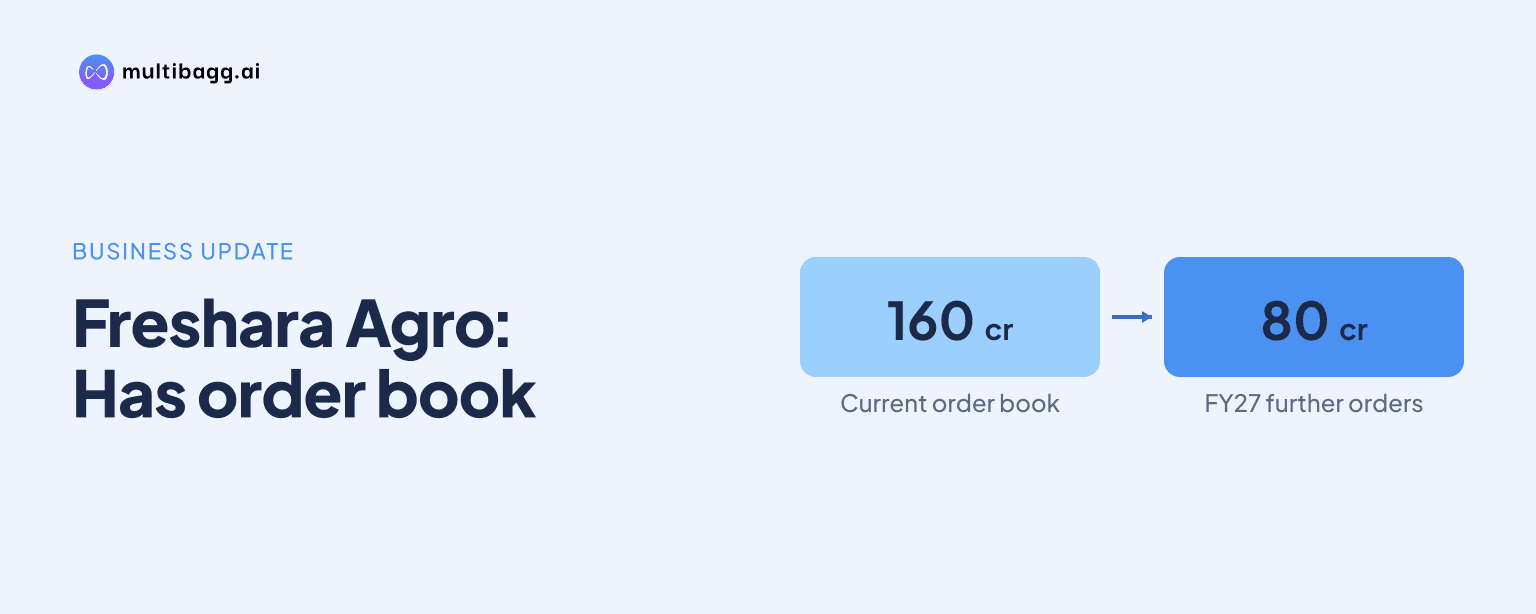
Freshara Agro Exports Limited has a management-estimated ₹160 crore order book, while its second processing facility operates at approximately 60% capacity versus approximately 100% at the first facility. Freshara’s two facilities have combined processing capacity of 125–150 metric tonnes (MT) per day, providing disclosed room to increase output at Facility 2.
Know Freshara Agro Exports inside out
Results, valuation, peers and who's buying, in one view.
How large is Freshara’s current order book?
Freshara’s current order book is ₹160 crore, and the presentation explicitly identifies this figure as a management estimate. Management also expects a further ₹80 crore of orders to close in FY27, although the presentation does not disclose customers, product mix, delivery dates or contractual terms for either the existing book or expected orders.
The ₹160 crore figure sits alongside operations spanning more than 40 export markets and more than 100 global customer relationships. Freshara serves retail chains, private-label brands, distributors and hotel, restaurant and catering customers with processed vegetables, including gherkins, baby corn, banderillas and mixed vegetables.
The presentation separates the management-estimated ₹160 crore order book from the further ₹80 crore expected in FY27. Accordingly, the ₹80 crore is a stated expected pipeline amount, rather than part of the disclosed current order book.
How much processing capacity can Freshara still use?
Freshara can increase utilisation at Facility 2, which is operating at approximately 60% capacity, while Facility 1 is operating at approximately 100%. The presentation describes Facility 2 as offering growth potential through higher utilisation and efficient production scaling, without setting a utilisation target or timetable.
Facility 1 has processing capacity of 50 MT per day and Facility 2 has capacity of 75–100 MT per day. The resulting combined range of 125–150 MT per day reflects the stated range at Facility 2 rather than a fixed daily output level.
Facility 2 has advanced packaging lines and a 100 kilowatt solar power system, according to the presentation. Freshara does not disclose capital expenditure for the site, a plan for additional manufacturing facilities, or a date by which Facility 2 could move beyond its present approximate 60% utilisation.
What sourcing network supports Freshara’s production?
Freshara’s sourcing network includes more than 6,000 contract farmers across 22 districts in Tamil Nadu, Karnataka and Andhra Pradesh. The company reports farmer retention above 90% and attributes this to multi-year relationships, assured pricing and continuous engagement with its farming network.
Freshara’s farm-to-export model starts with demand-led crop planning, predefined pricing frameworks and certified seeds. Field teams monitor cultivation, crop health and harvesting schedules before Freshara procures produce directly at the farm gate, a process the company says supports traceability and supply-chain efficiency.
After procurement, Freshara sorts, grades, processes and quality-tests produce in-house before packing it to customer specifications for export delivery. This model links the 6,000-plus farmer base to the company’s gherkins, baby corn, banderillas and mixed-vegetable products and its 125–150 MT-per-day processing network.
Freshara lists IFS Food, BRCGS Food Safety, Food Safety and Standards Authority of India, Agricultural and Processed Food Products Export Development Authority, kosher, social-accountability and halal certifications. The presentation does not quantify the effect of these certifications on the ₹160 crore order book or on Facility 2 utilisation.
Got a follow-up? Ask IRIS
How did Freshara’s financial performance change in FY26?
Freshara reported total income of ₹353.06 crore in FY26, compared with ₹260.55 crore in FY25. Earnings before interest, tax, depreciation and amortisation, or EBITDA, increased to ₹61.07 crore from ₹46.24 crore, while profit after tax, or PAT, increased to ₹37.51 crore from ₹28.79 crore.
Reported margins declined despite the higher FY26 absolute figures. EBITDA margin was 17.84% in FY26, compared with 18.18% in FY25, while PAT margin was 10.96%, compared with 11.32% in the preceding year.
For H1 FY27, Chairman and Managing Director Junaid Ahmed said consolidated revenue rose 84.54% year on year to ₹260.01 crore. He said EBITDA rose 41.84% to ₹34.58 crore and PAT rose 40.61% to ₹20.97 crore, while describing the Spanish acquisition as part of Freshara’s global expansion.
How do Freshara’s products and Spain acquisition fit its capacity plans?
Freshara says it is moving from a single-category exporter towards a multi-category preserved-foods platform. Its retail range includes pickled gherkins, banderillas, jalapeños, baby corns, chillies, cherry tomatoes, red bell peppers and silver skin onions, with the listed packs carrying 350 grams net weight and 200 grams drained weight.
Gherkins remain Freshara’s flagship export category, while the company describes baby corn as a growing processed-vegetable category and banderillas and mixed vegetables as value-added offerings. The presentation does not allocate the 75–100 MT-per-day capacity at Facility 2 among these product lines.
Freshara has acquired Conservas Selectas Españolas S.L. in Spain, which operates under the Sarasa brand. The acquired business includes an Almendralejo facility with approximately 30 lakh kilograms of olive capacity and pitting and slicing capability of up to 10,000 kilograms per day, alongside sites in Andosilla and Cárcar.
Management presents the acquisition as a step towards a diversified global preserved-foods platform and an entry into the European olives market. Freshara’s Indian processing facilities and Sarasa’s Spanish olive operations are separate disclosed operating bases, and the presentation gives no production-transfer plan, integration target or expected financial contribution.
Conclusion
Freshara’s disclosed operating position combines a management-estimated ₹160 crore order book with available capacity at Facility 2, where utilisation is approximately 60%, compared with approximately 100% at Facility 1. FY26 income, EBITDA and PAT were higher than FY25, although the reported EBITDA and PAT margins were lower.
The next stated marker is management’s expectation that a further ₹80 crore of orders could close in FY27. The presentation leaves unresolved the timing of those orders, the pace at which Facility 2 utilisation may rise, and the financial contribution or integration targets for the Sarasa acquisition.