










Abhinava Rizel sells 300-400 motors monthly from July, targets 4,000
Key highlights
- Abhinava Rizel began selling 300-400 motors a month from July.
- AR targets 2,000-4,000 motors a month over the next few years.
- AR’s initial expansion could require Rs 10 crore to Rs 20 crore over the next few months.
- Management said a partnership-led passenger-car system opportunity could generate at least a couple of hundred crores of rupees in revenue.
powered by IRIS
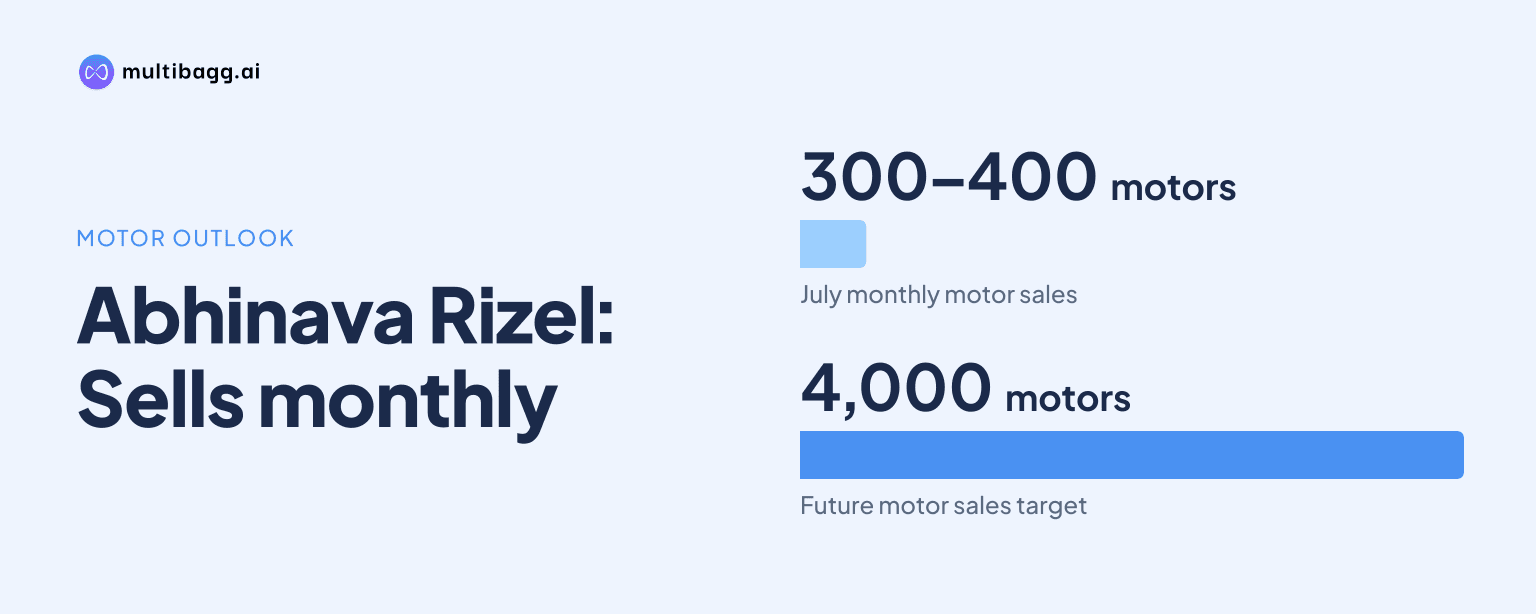
Abhinava Rizel began selling 300-400 motors a month from July and management is targeting 2,000-4,000 monthly motors over the next few years using existing technology. AR said this first scale-up could require up to Rs 20 crore over the next few months, while international partnerships could create a separate passenger-car systems opportunity.
Know M M Forgings inside out
Results, valuation, peers and who's buying, in one view.
How many motors is AR selling each month?
AR is selling 300-400 motors a month from July, according to management, which said the business had “opened its account.” The disclosed July start marks commercial off-take after earlier development work, although the call gave no motor revenue, customer names, selling prices or profitability figures.
Management’s first visible target is 2,000-4,000 motors a month over the next few years with existing technology. The target is five to more than 13 times the initial 300-400 monthly sales range, depending on the respective points within those ranges, but management did not present it as a fixed-date commitment or a customer order.
The motor activity is small beside the company’s established forging operations. MM Forgings Limited said its five largest product groups, axle arms, beams, crankshafts, connecting rods and spindles, account for more than 55% of revenue, with the first three groups contributing 44% of sales.
What investment does AR need for its first scale target?
AR may require Rs 15 crore to Rs 20 crore at most over the next few months to achieve 2,000-4,000 motors a month, management said. It added that about Rs 10 crore could itself be enough because the work is focused on capacity bottlenecks and process improvements rather than an entirely new technology platform.
The indicated Rs 20 crore ceiling is separate from MM Forgings’ broader capital-expenditure plan of about Rs 150 crore for the year. Management said it spent Rs 65 crore in the first half and planned Rs 75 crore to Rs 80 crore in the second half, without disclosing how much of that company-wide budget is allocated to AR.
Management also said overall debt was about Rs 1,200 crore, while debt net of cash was expected to stay between Rs 1,020 crore and Rs 1,070 crore. It said higher internal accruals from higher volumes would support repayments as term loans fund capital expenditure, but it did not identify a dedicated funding facility or return target for AR.
Can partnerships expand AR into passenger-car systems?
Management said AR is actively discussing international technology partnerships with several players, which could allow it to make three-in-one, five-in-one and seven-in-one systems for the passenger-car market. It described such agreements as the potential next jump after the 2,000-4,000 monthly motor objective, not as signed partnerships or awarded programmes.
Management said revenue from each of these larger systems opportunities could run into hundreds of crores of rupees, including at least a couple of hundred crores of rupees. That is management’s estimate of a possible opportunity rather than reported AR revenue, and the call did not disclose partner names, commercial terms, required investment, customer programmes or launch dates.
AR is pursuing both homegrown technology and bought-out technology, management said. It specifically referred to examining a few Chinese sources, saying Chinese companies are ahead in passenger-car electronics manufacturing; however, management said the arrangements still need to be made.
Got a follow-up? Ask IRIS
How does AR fit the wider diversification plan?
AR adds a newly commercialised line as MM Forgings seeks to broaden its exposure beyond commercial vehicles, or CVs. Management said MM Forgings is about 85% dependent on automotive markets and about 70% dependent on CVs globally, with the split varying by one or two percentage points between India and overseas operations.
Management expects expansion in non-CV and non-auto activities, alongside growth in heavy forgings outside India, to improve revenue predictability over the next two to three years. Its stated mechanism is diversification across geographies and sectors, so that weaker activity in one market could be offset by another rather than relying on a single economy.
The company’s export objective concerns forgings rather than AR motors. Management said annualised exports were heading towards about Rs 600 crore and that it should be looking at Rs 1,200 crore to Rs 1,500 crore by the end of the decade or earlier, a plan that should not be treated as an AR sales forecast.
What must AR execute to reach the target?
AR’s immediate task is to turn 300-400 monthly motors into 2,000-4,000 through selective spending on process improvements and capacity constraints. Management said it had started investing by addressing bottlenecks, but did not disclose installed motor capacity, utilisation, rejection rates or the schedule for completing the changes.
The second task is converting partnership discussions into technology access for three-in-one, five-in-one or seven-in-one passenger-car systems. Management identified potential revenue of at least a couple of hundred crores of rupees per larger opportunity, but disclosed no agreement, validation status, customer nomination or production order.
Management acknowledged that manufacturing systems across its plants still have “a long way to go” before they are homogenised. It also said other customer projects have faced validation delays, installation slippages and postponements, which are company-wide execution issues rather than disclosures specific to AR’s 300-400 monthly motor sales.
Conclusion
AR has moved from development into disclosed commercial sales of 300-400 motors a month since July. Its first-stage plan seeks 2,000-4,000 monthly motors using existing technology and up to Rs 20 crore of spending, while the more substantial passenger-car systems prospect remains dependent on external technology arrangements.
The next disclosures to watch are progress towards the 2,000-4,000 monthly target, actual spending within the indicated Rs 10 crore to Rs 20 crore range, and whether international discussions result in a named partnership. Management also expects its wider non-CV, non-auto and geographic diversification programme to show results over the next two to three years.