










M M Forgings Targets Over ₹2,000 Crore FY27 Turnover After Q2
Key highlights
- M M Forgings reported Q2 FY27 revenue from operations of ₹548.4 crore, up 42.8% year-on-year.
- Q2 FY27 net profit was ₹41.7 crore, up 125.4% year-on-year.
- H1 FY27 turnover was ₹978 crore on about 44,000 tonnes of sales.
- M M Forgings expects FY27 turnover above ₹2,000 crore and sales of 90,000 to 95,000 tonnes.
powered by IRIS
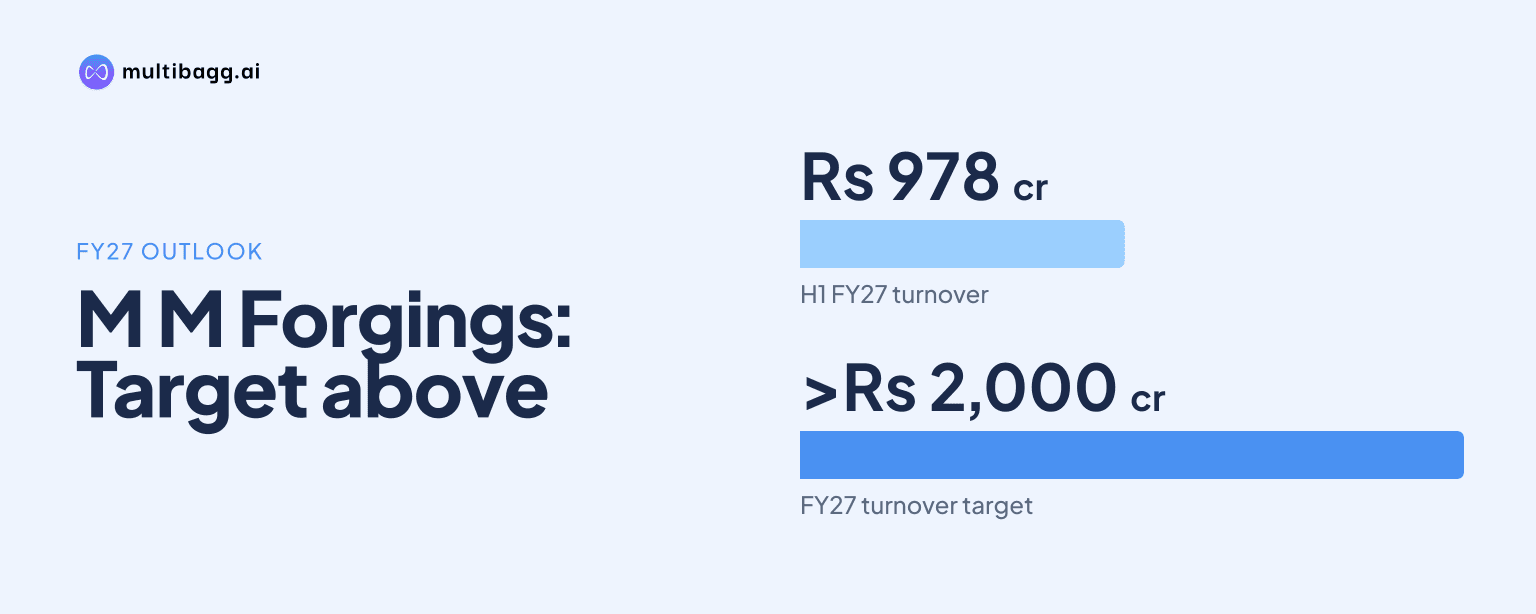
M M Forgings Limited is targeting FY27 turnover above ₹2,000 crore after reporting Q2 FY27 revenue from operations of ₹548.4 crore, up 42.8% year-on-year, while management cited higher volumes, exports and machining as growth drivers despite a six-month heavy-press delay and working-capital risks.
Know M M Forgings inside out
Results, valuation, peers and who's buying, in one view.
What did M M Forgings report in Q2 FY27?
M M Forgings reported Q2 FY27 revenue from operations of ₹548.4 crore and net profit of ₹41.7 crore, with revenue rising 42.8% and profit increasing 125.4% from a year earlier. The company's consolidated quarterly financial summary separately reported revenue of ₹537.45 crore and profit after tax of ₹41.75 crore, while management referred to Q2 turnover of ₹551 crore during the earnings call.
Management said sales volume increased to 24,200 tonnes in Q2 from 19,700 tonnes in the first quarter. H1 FY27 turnover stood at ₹978 crore on about 44,000 tonnes of sales. The company has merged DVS Industries into M M Forgings, and the reported results are consolidated following that merger.
Q2 EBITDA was stated at about ₹110 crore, or close to 20% of turnover. Management said roughly 0.5% to 0.7% of the quarterly EBITDA reflected price increases relating to earlier periods, and added that the Q2 margin level should therefore be mildly corrected. Overall EBITDA margin was reported at 19.7%.
What is M M Forgings' FY27 and FY28 guidance?
M M Forgings expects FY27 sales of 90,000 to 95,000 tonnes and turnover above ₹2,000 crore, subject to market conditions. Management forecast around 50,000 tonnes of sales in the second half, following H1 sales of about 44,000 tonnes.
For FY28, the company has outlined a target of 100,000 tonnes and turnover of ₹2,400 crore to ₹2,500 crore. It said visible orders support the FY28 plan, although the target remains dependent on prevailing market conditions and the company's ability to execute its capacity and product-expansion plans.
The growth strategy is focused on machining, exports, heavy forgings and wider customer and geographic coverage. Management indicated that better capacity utilisation and cost-reduction measures could support margin expansion, while higher-value machining is also an important part of the sales mix strategy.
What is driving M M Forgings' volume growth?
M M Forgings attributed the stronger volume trajectory to exports, heavy forgings, machining and broader end-market coverage. Management pointed to strong North American Class 8 truck demand and a steady European replacement market as sources of demand visibility.
The company is seeking to reduce dependence on a narrower set of markets and products by expanding its geographic and end-market reach. Its focus on machining is intended to increase value addition, while heavy forgings are expected to contribute to the growth programme as additional capacity becomes available.
Price realisation also contributed to the quarterly margin performance. Management said average sales realisation was about two, though the available call extract did not specify the unit or the relevant comparison period. The company also reported that finance costs fell to ₹19 crore from ₹21 crore despite higher working-capital utilisation linked to growth.
Got a follow-up? Ask IRIS
What risks did management identify for M M Forgings?
M M Forgings identified a six-month delay in its heavy-press project and rising working-capital and debt levels as key execution risks. The delayed press could affect the timing of planned heavy-forging capacity, while working-capital requirements are rising alongside sales volumes.
The company described management's stance as confident but cautious on debt and the project delay. Its finance cost declined in the reported period, but the growth plan requires continuing investment in capacity and operating capital. The available disclosures do not provide a quantified debt figure or a revised commissioning date for the heavy press.
Commercial-vehicle cyclicality remains another relevant factor. Demand visibility in North American Class 8 trucks and European replacement markets was described positively, but the FY27 and FY28 targets are explicitly subject to market conditions. This makes customer demand and project execution important variables for the company's volume and turnover plans.
How do the financial disclosures affect investors?
The reported results show that M M Forgings entered the second half with higher quarterly volume and turnover than in the first quarter. Q2 sales volume of 24,200 tonnes was 4,500 tonnes above the first-quarter level of 19,700 tonnes, and management expects about 50,000 tonnes in H2 to meet its full-year volume objective.
Investors will also need to distinguish between recurring operating performance and non-operating items in the half-year figures. Management said H1 included ₹64.29 crore from a land sale, with profit from that transaction of about ₹54 crore. That item is separate from the operational drivers of volume, export growth, machining and capacity utilisation.
The stated FY27 turnover target of above ₹2,000 crore is substantially above H1 turnover of ₹978 crore and depends on the planned H2 volume ramp-up. The company has not disclosed a new heavy-press timeline in the provided material, making progress on that project, working-capital needs and market demand central matters for shareholders to monitor.
Conclusion
M M Forgings has reported a stronger Q2 FY27, with revenue from operations of ₹548.4 crore, net profit of ₹41.7 crore and a 24,200-tonne sales volume. Its FY27 plan for turnover above ₹2,000 crore rests on higher second-half volumes, export demand, machining expansion and improving utilisation, while the reported land-sale gain should be assessed separately from operating performance.
The next disclosures to watch are progress on the heavy press after its reported six-month delay, H2 sales volumes against the roughly 50,000-tonne forecast, and the effect of higher working-capital requirements on debt and finance costs. Management's FY28 objective of ₹2,400 crore to ₹2,500 crore in turnover remains conditional on market conditions and execution.