










Airtel AI generates 10 billion actions, cuts network energy
Key highlights
- Airtel's AI decision engine generated more than 10 billion next-best actions by Q2 FY2027.
- Airtel's AI-enabled network orchestrated more than 14 million sleep hours each day in Q2 FY2027.
- Airtel delivered more than 1 billion personalised content items and recommendations using individual-level context.
- Airtel's anti-spam AI identified more than 100 billion calls, nearly 5 billion messages and blocked more than 1.7 million fraudulent links since launch.
powered by IRIS
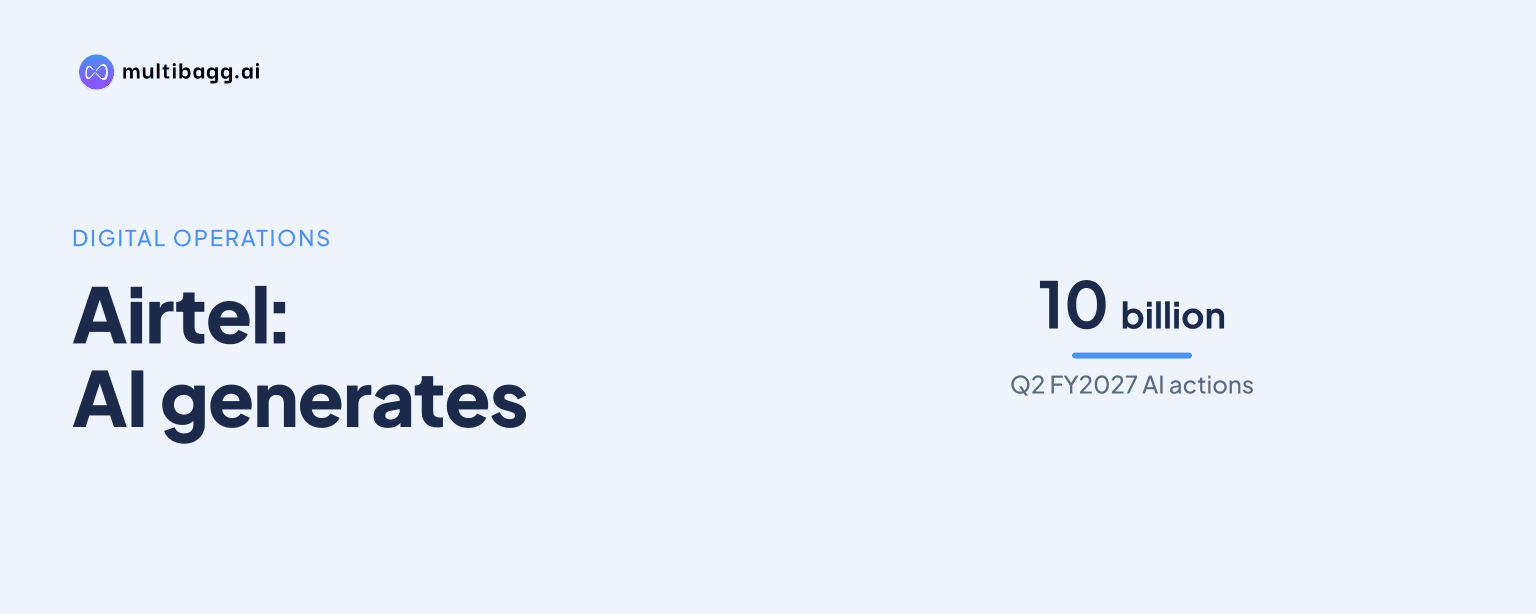
Bharti Airtel Limited said in Q2 FY2027 that its AI decision engine had generated more than 10 billion next-best actions, while AI-enabled network automation orchestrated more than 14 million sleep hours each day to reduce energy consumption and generate some cost savings across network sites.
Know Bharti Hexacom inside out
Results, valuation, peers and who's buying, in one view.
What did Airtel report about AI deployment in Q2 FY2027?
Airtel reported that AI was being used in customer-facing, network and internal processes in the quarter ended September 30, 2026. Its largest customer metric was more than 10 billion next-best actions generated by a real-time, context-led decision engine, while its network metric was more than 14 million sleep hours dynamically orchestrated each day during Q2.
Management said it had spent the preceding two quarters building the foundation to embed AI in Airtel's digital platforms. This included Agent Bridge, a homegrown agent platform, and additional graphics processing unit, or GPU, capacity across data centres. Airtel said these components enabled faster activation of AI use cases in customer-facing and internal journeys.
The 10 billion actions and 14 million daily sleep hours are not comparable measures. The customer figure counts recommendations or actions generated by the decision engine, while sleep hours measure periods in which network operations were dynamically managed for energy use. The two figures show AI being applied to both commercial interactions and network operations.
How is Airtel using AI for customer interactions?
Airtel is using individual-level context to produce more than 1 billion personalised content items and recommendations for customers. Management said its decision engine was scaled across key inventories and channels, with the intended result of anticipating customer needs and providing more relevant interactions at scale.
The decision engine operates with Airtel's unified customer data platform, which brings together customer journeys across channels and touchpoints into a single view. Airtel said its Converge Data Engine combines data, AI and analytics to add real-time context to interactions. The company linked this architecture to its broader customer-experience strategy across its service portfolio.
Airtel also cited AI-led workmanship tools on field engineers' handsets in its Homes operation. The tools are intended to standardise the quality of installation, service and field execution. This is a separate application from personalised recommendations, and it coincided with 670,000 Homes net additions in Q2.
Anti-spam is another customer-facing use case. Since launch, Airtel's AI-led anti-spam system has identified more than 100 billion calls for spam, nearly 5 billion messages, and blocked more than 1.7 million fraudulent links. These figures cover three different actions: identifying suspect calls, identifying messages and blocking links classified as fraudulent.
How is Airtel lowering network energy use with AI?
Airtel said its AI-enabled radio access network, or RAN, dynamically orchestrated more than 14 million sleep hours each day across network sites in Q2 FY2027. Management said the automation reduced energy consumption and generated some cost savings, but it did not disclose the energy reduction, cost savings or a percentage change in the November 6, 2026 earnings webinar.
The network use case is part of Airtel's effort to reduce fuel and power wastage while maintaining customer experience. Management said there was substantial headroom to optimise energy costs as the capability was expanded across the network. That is management's stated opportunity rather than a disclosed target, because Airtel gave no future sleep-hour, energy-saving or cost-saving objective.
AI-directed network operations sit alongside changes to the physical energy mix. Airtel said it had accelerated solarisation across the network over the last two years, with solar power operational at about 50,000 sites. It also cited lower diesel consumption and a greater share of alternative and renewable energy sources, making network sleep-hour automation one element of its wider efficiency programme.
Airtel distinguished its use of AI to manage the network from the effect of AI-related traffic on the network. In the analyst discussion, management said AI traffic remained very small in Q2 FY2027, although it expected traffic to grow and noted that such traffic needs higher uplink capacity. It said Airtel was building the capabilities and investments required, but current AI traffic was not substantial.
Got a follow-up? Ask IRIS
Where else is Airtel applying AI internally?
Airtel said AI-led processes were extending beyond call-centre bots, one of its earlier applications. It named quarterly financial book closure, recruitment, mass interview screening of candidates and video know-your-customer, or video KYC, for customer acquisition as internal areas where AI is changing processes.
Management did not provide productivity, cost, accuracy or processing-time figures for these internal applications in Q2 FY2027. Instead, it said Airtel had run AI experiments to redesign how work gets done and would focus on scaling use cases already creating value. This distinguishes the deployed examples from any unquantified future expansion.
The internal rollout includes safeguards for customer safety, privacy and data sovereignty, according to management. These guardrails apply as Airtel expands AI across operations involving customer information or operational data, including video KYC, recruitment screening and financial book closure.
AI is also part of Airtel's business-to-business delivery agenda. The company said it was applying digital platforms and AI to disciplined delivery, automated root-cause analysis and proactive fault resolution for enterprise customers. Airtel Business reported revenue of about Rs 5,800 crore in Q2, up 3.8% sequentially and 11.4% from the same quarter a year earlier, although management did not attribute that growth specifically to AI.
What does Airtel's AI rollout indicate about its operating model?
Airtel's Q2 evidence indicates that its AI programme has progressed beyond isolated trials into multiple operating domains. The company disclosed activity across personalisation, anti-spam, field workmanship, RAN energy management, financial processes, recruitment and enterprise fault resolution, supported by Agent Bridge and added GPU capacity.
The degree of disclosed measurement varies by use case. Airtel gave large activity figures for next-best actions, personalised recommendations, spam detection and daily sleep hours, but did not quantify energy savings, internal productivity gains or revenue attributable to AI. The reported scale therefore demonstrates deployment volume, while the financial outcome remains only partly disclosed.
Conclusion
Airtel's Q2 FY2027 disclosures show AI embedded across customer engagement, network management and internal functions. More than 10 billion next-best actions, more than 1 billion personalised content items and recommendations, over 14 million daily network sleep hours, and anti-spam detection spanning more than 100 billion calls provide operational evidence of scaled deployment rather than a programme limited to pilots.
The next issue to watch is whether Airtel quantifies the energy and cost effects of further network optimisation, where management sees substantial headroom but has set no public target. Management also said AI traffic was still very small but requires higher uplink capacity, while it continues to build the capabilities and investments needed as that traffic grows.