










Airtel Commits 400-500 MW Data-Centre Site Toward 1 GW Capacity
Key highlights
- Airtel said acquired land can support at least a 400-500 MW data-centre plant.
- Airtel outlined a data-centre build-out strategy from 200-250 MW to one gigawatt.
- Airtel is consolidating 56 edge data centres from more than 100 mobile switching centres.
- Airtel said the Vishakhapatnam build-out will require lumpy capital expenditure over the next 12 to 18 months.
powered by IRIS
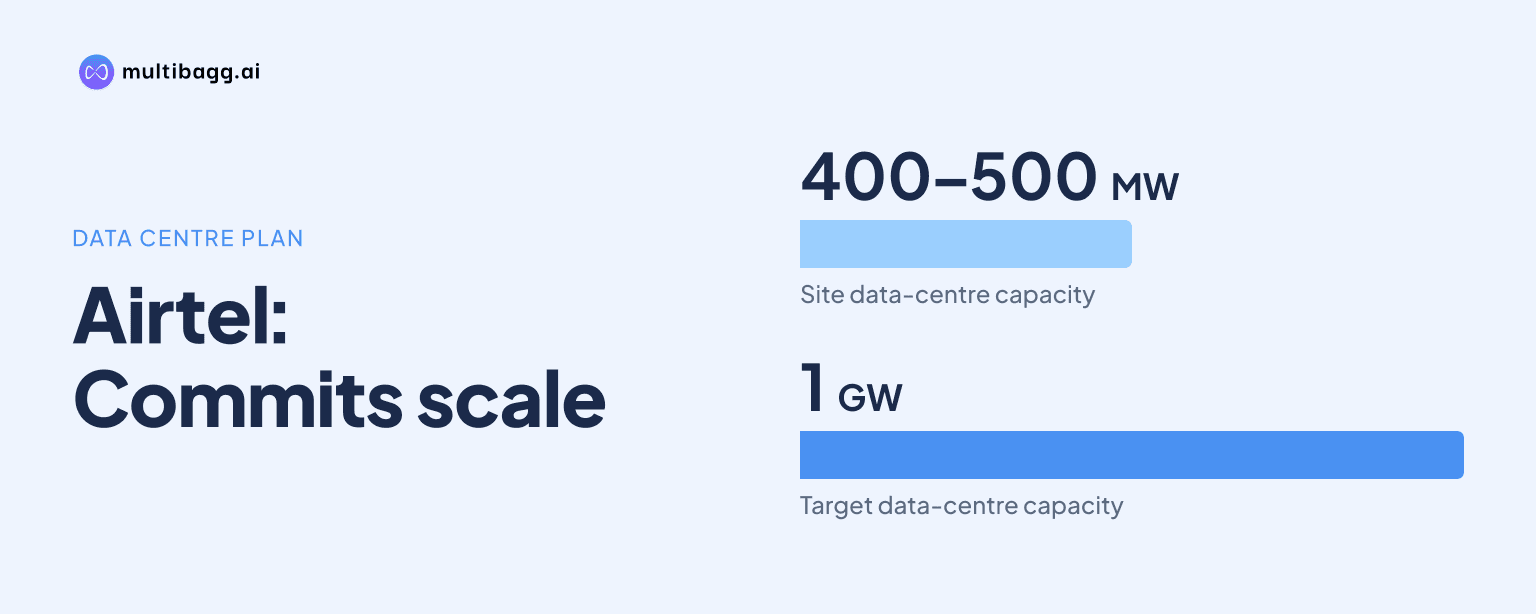
In the Q2 ended September 30, 2026 earnings webinar, Bharti Airtel Limited said newly acquired land could support at least a 400-500 megawatt data-centre plant, representing 40% to 50% of its stated one-gigawatt capacity ambition. Management also outlined modular construction and faster build plans for the programme.
Know Bharti Hexacom inside out
Results, valuation, peers and who's buying, in one view.
What data-centre capacity is Airtel targeting?
Airtel is pursuing a build-out strategy from 200-250 MW to one gigawatt, according to Group Chief Financial Officer Soumen Ray. One gigawatt equals 1,000 MW, while the acquired land could support at least 400-500 MW. The single site could therefore account for 40% to 50% of the stated capacity ambition, although management did not provide a timetable for reaching one gigawatt.
The plan places data centres and cloud among Airtel’s new growth investments rather than its established network spending. Ray said the core business would continue in line with guidance, while Airtel was increasing cloud capabilities as it works toward one gigawatt. He did not offer capital-expenditure guidance for the data-centre programme, but said management would invest in new businesses to support future growth.
Where will Airtel build its 400-500 MW data centre?
Airtel said the acquired land is a large tract in locations where demand appears high and gives it the option to install at least a 400-500 MW plant over time. Executive Vice Chairman Gopal Vittal did not disclose the location, land price, commissioning date or the share of the site that could be developed first. The disclosure establishes the land’s potential capacity rather than a committed construction phase of that size.
Management said Airtel would continue assessing other land and build-out options. Vittal said demand that cannot be served by new capacity in the United States could be directed to India, but described that as a possible market opportunity rather than contracted demand. Airtel did not disclose customer commitments, expected utilisation or an overseas order pipeline for the proposed site.
Airtel is separately consolidating 56 edge data centres from more than 100 mobile switching centres, or MSCs, into upgraded facilities. Management is also seeking larger parcels of land at the edge that could accommodate data centres. The programme therefore combines a potential 400-500 MW centralised campus with a distributed edge infrastructure footprint.
How will Airtel reduce data-centre construction time?
Airtel said it is developing a toolkit intended to reduce data-centre construction time through strategic partnerships for building work and equipment such as chillers. Vittal said the aim is to compress the construction cycle and create modular units that can be added as demand develops. Management did not disclose an existing construction period or a target reduction, so the timing benefit cannot yet be quantified.
The company did identify one near-term build timetable: the Vishakhapatnam facility will require lumpy capital expenditure over the next 12 to 18 months as it is built out. Ray said cloud investment beyond such large data-centre commitments would be more graded. That distinction means land acquisition and facility construction can produce uneven spending between periods, while cloud spending is expected to be phased.
Airtel’s plan also includes artificial-intelligence infrastructure for internal operations. Management said it has added graphics processing unit, or GPU, capacity across its data centres, enabling internal AI use cases. Airtel is studying GPU-as-a-Service and a full AI stack for enterprise customers, but said the area remains at an early stage and provided no commercial launch timetable.
Got a follow-up? Ask IRIS
What will the one-gigawatt plan mean for Airtel’s capital spending?
Airtel said data-centre projects can create differences between capital spending and capitalisation because land purchases and construction are large, discrete commitments. Ray said there is no divergence in the core business between capital work in progress, or CWIP, spending and actual capitalisation, but differences will continue on large data-centre projects. He did not provide a cost per MW because location, design and project specifications vary.
Management said Airtel completed an equity raise in June and July and had cash available at the time of the Q2 call. Ray said debt would certainly be part of financing for long-term infrastructure projects, while any additional equity raise in one or two years would depend on available cash and debt pricing. He did not commit Airtel to a further equity issue.
The financing comments mean Airtel does not expect to fund its data-centre programme solely through equity. They leave unresolved the allocation of borrowing between the 400-500 MW site, the Vishakhapatnam build-out and any additional land purchases. Management said the eventual funding mix would be a treasury decision made when appropriate, rather than a fixed debt-to-equity formula.
How does Airtel’s data-centre plan support its enterprise business?
Airtel positions data centres within its business-to-business, or B2B, agenda alongside cloud, cybersecurity and Internet of Things capabilities. In prepared remarks for Q2 ended September 30, 2026, management said B2B execution rests on strengthening infrastructure, tailoring products by industry and improving delivery through digital platforms and AI. Data-centre capacity is therefore intended to support a wider enterprise portfolio rather than operate as a stand-alone infrastructure activity.
The company said its GPU capacity supports internal workloads, including AI tools used across Airtel’s operations. Management is also hearing demand from enterprise customers for a full AI stack as part of a cloud offering. However, Airtel has not said it will sell GPU capacity at scale, has not disclosed enterprise contracts supporting the one-gigawatt plan and has not set an AI-infrastructure revenue target.
Conclusion
Airtel has given its data-centre strategy a defined scale: acquired land could host at least 400-500 MW, while management’s broader plan is to move from 200-250 MW toward one gigawatt. The proposed campus, consolidation of 56 edge data centres and modular construction approach indicate that Airtel is combining centralised capacity with distributed infrastructure and cloud capabilities.
The next disclosed milestone is the Vishakhapatnam build-out, which management said will involve lumpy capital expenditure over the next 12 to 18 months. Investors will also need to watch whether Airtel identifies further land, how quickly its modular construction plan is implemented and the eventual mix of debt, available cash and potential equity used to fund expansion.