










Bharti Airtel Limited makes fibre central to home broadband
Key highlights
- Airtel added 670,000 homes in Q2 FY2027 ended September 30, 2026.
- Airtel said FWA will be an interim solution until a particular area can be fibreized.
- India capital expenditure was Rs 7,430 crore in Q2 FY2027, with no separate fibre or FWA split disclosed.
- Digital TV lost more than 4 lakh customers in Q2 FY2027, while Airtel said IPTV adoption remained strong.
powered by IRIS
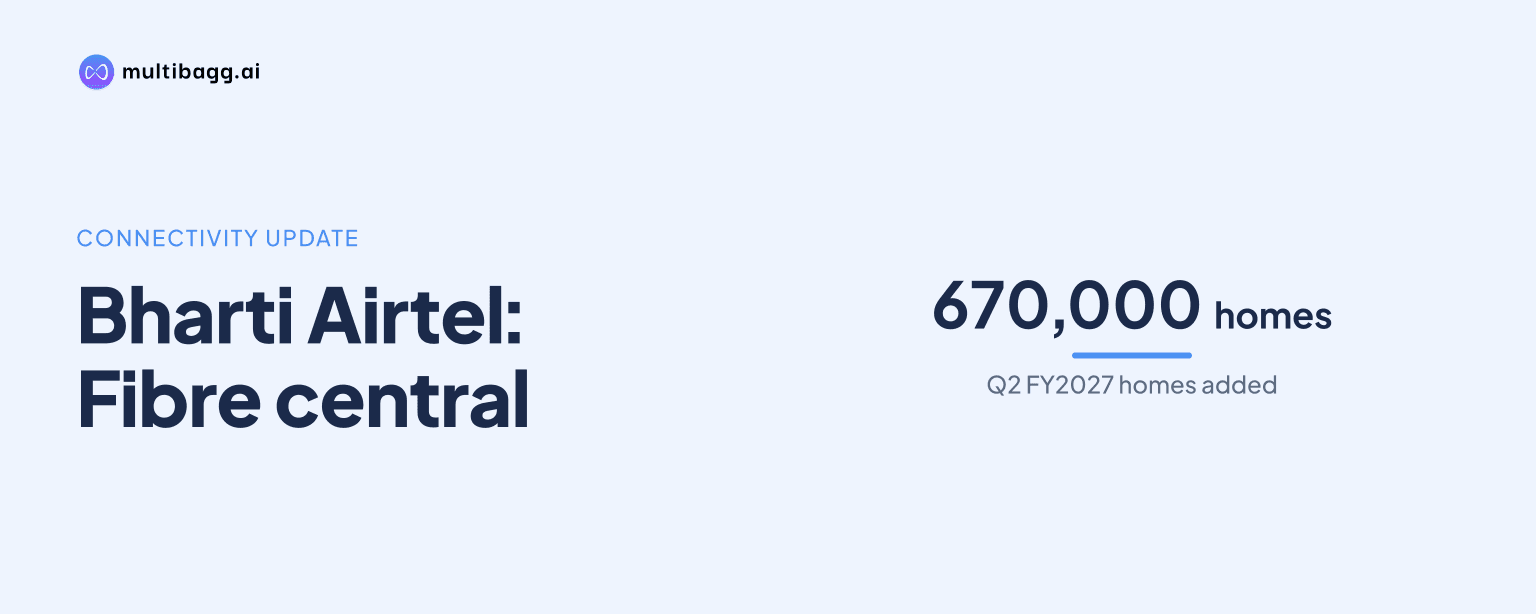
Bharti Airtel Limited made fibre the core of its home-broadband strategy in Q2 FY2027, ended September 30, 2026, after adding 670,000 homes, and said fixed-wireless access, or FWA, would be used only temporarily until a locality can be fibreized. Management said fibre provides the preferred in-home experience and supports stickier customers over the long term.
Know Bharti Hexacom inside out
Results, valuation, peers and who's buying, in one view.
What has Airtel changed in its home-broadband strategy?
Airtel has scaled back FWA-led expansion and is accelerating fibre home-pass expansion as the main route for growing its homes business. On the November 6, 2026 earnings call, management called fibre the “heart and center” of its home strategy. FWA will remain available to capture demand in places awaiting fibre deployment, rather than being the principal expansion technology.
Management said this is not a short-term stop-start decision. In response to an analyst question, Airtel said its assessment of market developments and its own customer experience led it to focus on fibreizing the country. It will use wireless on the fringes where needed, then fibreize markets once demand density emerges.
The strategy was disclosed alongside 670,000 home net additions in Q2 FY2027, which management said represented momentum building from the prior quarter. Airtel did not disclose the prior-quarter homes addition. In contrast, Digital TV lost more than 4 lakh customers during the quarter, led by its direct-to-home business, while management said internet protocol television, or IPTV, adoption remained strong.
Why does Airtel prefer fibre for home broadband?
Airtel prefers fibre because management considers it the best connectivity experience for use inside the home and says it produces the stickiest customers and better long-term value creation. The company did not provide a numerical comparison of fibre and FWA speeds, installation costs or churn. Its conclusion was based on global market experience and observations from its own customer base.
Demand remains concentrated in the top 1,000 cities, where Airtel has refined acquisition towards customer cohorts with stronger engagement and retention. Management cited rising smart television adoption, greater in-home data usage and growing digital-content consumption as factors increasing demand for high-speed broadband. Fibre rollout is therefore directed toward locations where the company expects sufficient density.
Airtel’s One Airtel plan is the commercial link between fibre broadband and other group services. Management said growing adoption of convergence is deepening customer relationships, raising engagement across the portfolio and supporting customer lifetime value. IPTV is part of this proposition, even as Digital TV recorded a loss of more than 4 lakh customers in Q2 FY2027.
How will Airtel use FWA after this reset?
Airtel will use FWA as an interim bridge before fibre reaches a particular area, not as its dominant long-term access network. An area with developing demand may receive wireless service first, but management said it intends to fibreize each market where demand density becomes visible. The call did not disclose the number of FWA customers, locations or home passes affected by this approach.
Management described FWA as an augmentative tool for wireless demand capture “on the fringes.” This means the company is not signalling a broad return to FWA-led expansion after a pause. Its stated plan is to retain FWA for a limited role while continuing fibre deployment across areas with sufficient customer demand.
The homes plan also depends on service execution after installation. Airtel said its artificial intelligence, or AI, led workmanship tools run on field engineers’ handsets and help standardize work on the ground. It also highlighted its Converge Data Engine, which combines data, AI and analytics to provide real-time context for customer interactions across channels.
Got a follow-up? Ask IRIS
What does Airtel disclose about funding fibre expansion?
Airtel has not disclosed a stand-alone capital-expenditure budget for fibre or FWA. India capital expenditure was Rs 7,430 crore in Q2 FY2027, while India earnings before interest, tax, depreciation, amortization and lease costs, or EBITDAaL, excluding passive infrastructure, exceeded Rs 20,400 crore. Neither figure was split between homes, mobile, enterprise and other India operations.
At the group level, consolidated revenue was about Rs 60,900 crore, up 4% sequentially, and capital expenditure was about Rs 12,500 crore. Consolidated EBITDAaL was about Rs 31,500 crore, up about 5.5% sequentially, producing operating free cash flow of over Rs 19,000 crore under Airtel’s definition of EBITDAaL less capital expenditure.
India revenue excluding passive infrastructure rose 3.2% sequentially, compared with Africa constant-currency revenue growth of 6.7%. Airtel also invested about Rs 2,900 crore in a strategic land parcel for its one-gigawatt data-centre capacity ambition. Management said data centres and cloud would require growth investment, but did not issue quantitative capital-expenditure guidance for homes or FWA.
How does fibre fit Airtel’s wider customer strategy?
Airtel is presenting fibre as part of a wider focus on higher-engagement customers across homes and mobile. In Q2 FY2027, it added 0.7 million revenue-earning mobile customers and 2.9 million smartphone data customers. Mobile average revenue per user, or ARPU, rose to Rs 271 from Rs 264, with management noting that the quarter included one extra day.
The homes and mobile segments use different growth mechanisms. Homes added 670,000 customers through broadband and convergence, while mobile growth included postpaid upgrades and plan premiumization. Postpaid net additions reached 1.2 million in Q2 FY2027, and postpaid customers accounted for 8.3% of Airtel’s total customer base.
Airtel Business is another part of the connectivity strategy, reporting revenue of about Rs 5,800 crore in Q2 FY2027. That was up 3.8% sequentially and 11.4% from the same quarter a year earlier, supported by deal wins in core connectivity and digital offerings including cloud, cybersecurity, internet of things and communications-platform-as-a-service. Fibre is thus one component of a portfolio spanning consumer convergence and enterprise infrastructure.
Conclusion
Airtel’s strategy reset places fibre, rather than FWA, at the centre of home-broadband expansion. The company is using its 670,000 Q2 FY2027 home additions and One Airtel convergence proposition to pursue a larger, more durable home-customer base, while retaining FWA for areas where it can meet demand before fibre is installed.
The next issue to watch is execution of accelerated fibre home-pass expansion in the top 1,000 cities and the pace at which Airtel fibreizes areas initially covered by FWA. Management has also flagged investment needs in data centres and cloud, including a one-gigawatt data-centre ambition, but has not provided a homes-specific capital-expenditure target or an FWA deployment schedule.