










Bharti Airtel Limited directs new capex to data centres
Key highlights
- Airtel said roughly 500-600 new sites were installed in the Q2 ended September 30, 2026 quarter, below 1,000.
- Airtel's acquired land provides optionality for at least a 400-500-megawatt data-centre plant over time.
- Airtel is consolidating 56 edge data centres from more than 100 metropolitan service centres.
- Airtel said the Vishakhapatnam data-centre build-out will involve lumpy capex over the next 12-18 months.
powered by IRIS
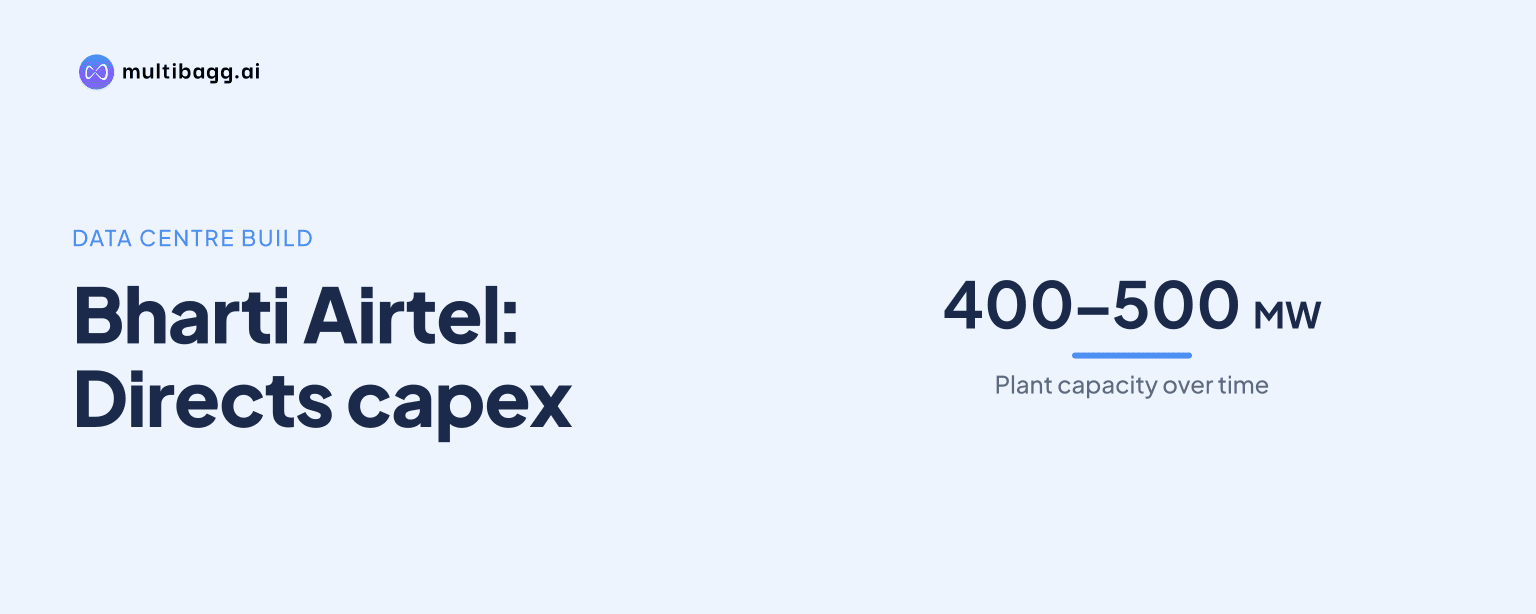
Bharti Airtel Limited said in the Q2 ended September 30, 2026 webinar that data centres and cloud will absorb much of its incremental capital expenditure, while core telecom spending should remain consistent, after radio build-out moderated to roughly 500-600 new sites in the quarter and acquired land created at least 400-500 megawatts of data-centre optionality.
Know Bharti Hexacom inside out
Results, valuation, peers and who's buying, in one view.
Why is Airtel moving incremental capex to data centres and cloud?
Airtel is moving incremental capex to data centres and cloud because management said radio-network investment has moderated after much of the build-out was completed. Executive Vice Chairman Gopal Vittal said new tower installations were below 1,000, at roughly 500-600 sites in the quarter, while some 5G expansion will continue.
The core telecom network remains an ongoing spending requirement, but management does not expect a sharp increase in that spending. Vittal said core-network capex depends on data volumes and consumption and is a small component, while transport investment remains substantial because Airtel continues fibreisation. He said the core business should be consistent rather than experience capex spikes.
The contrast is between a mature radio deployment cycle and new infrastructure growth projects. Airtel reported more than 200 million 5G users at the end of the Q2 ended September 30, 2026 period, but did not give a future radio-capex target. Management instead linked rising data use per subscriber to a stronger network and customer upgrades to higher plans.
How much data-centre capacity is Airtel planning?
Airtel has land that gives it the option to develop at least a 400-500-megawatt data-centre plant over time. Vittal said the land is concentrated in locations where demand appears high, and Airtel will continue to assess further land options as it develops its data-centre footprint.
The company is also trying to reduce construction time through modular development and supplier partnerships. Airtel is putting together a faster-build toolkit that includes construction partners and equipment such as chillers, allowing additional units to be created as demand develops rather than committing to a completion date for the full 400-500-megawatt potential.
Airtel is separately consolidating 56 edge data centres from more than 100 metropolitan service centres, or MSCs, into upgraded facilities. Management said it is seeking larger parcels at the edge as well, which would preserve the option to construct edge data centres alongside the larger campus opportunity.
How will Airtel fund data-centre investment?
Airtel said debt will certainly form part of funding for its data-centre projects, while a future equity raise remains undecided. Group Chief Financial Officer Soumen Ray said the company had completed an equity raise in June and July and had cash in the bank, but said large, long-term infrastructure projects would not be financed entirely through equity.
Management left the timing of any further equity decision open. Ray said a decision one or two years later would depend on the cash available to the three owners of Nxtra and the prevailing price of debt, making future financing a treasury decision rather than an announced capital-raising plan.
The data-centre programme may also make reported capex differ from cash spending during construction. Ray said land purchases and large data-centre projects can create a mismatch between cash-flow capex, capital work in progress, or CWIP, and eventual capitalisation. For the business-as-usual telecom operation, he said these measures converge over time.
Got a follow-up? Ask IRIS
What spending will Airtel continue in its telecom and homes businesses?
Airtel will continue spending on 5G, fibre transport and home broadband even as data centres and cloud take incremental growth capital. Vittal said the core business still requires transport capex because of fibreisation, while the quarter's roughly 500-600 new sites show that radio deployment has slowed materially from earlier network-build phases.
The homes business remains in an acquisition and growth phase, according to Managing Director and Chief Executive Officer for Airtel India Shashwat Sharma. He said fibre and customer-premises equipment, or CPE, are its two main capex components, and that recent earnings before interest and tax, or EBIT, reflected both this investment and the correction of lower-average-revenue-per-user acquisitions.
Airtel also identified shareholder distributions and investments in affiliates as uses of capital. Vittal said the company had announced a potential continued buyback in Airtel Africa and had also completed a buyback in Indus, while dividend payouts would keep increasing over time. He gave no numerical dividend target or allocation split among those priorities.
Will Airtel build GPU and AI cloud infrastructure?
Airtel is buying graphics processing unit, or GPU, chips for internal workloads but has not announced a separate capex programme for GPU leasing or artificial-intelligence cloud services. Ray said Airtel already has chips for internal use and is observing the market before making a disclosure on a commercial GPU infrastructure strategy.
Management described three potential business models: bare-metal GPU leasing, GPU-as-a-Service with software and orchestration, and a full artificial-intelligence stack for enterprise customers. Vittal called bare-metal leasing commoditised and cited counterparty risks among smaller participants, while saying Airtel is actively studying GPU-as-a-Service and enterprise cloud demand.
The near-term capex profile differs between physical data centres and cloud products. Vittal said land purchases and the Vishakhapatnam build-out would create lumpy spending over the next 12-18 months, whereas cloud investment would be more graded. That places data-centre construction ahead of any announced expansion into commercial GPU services.
Conclusion
Airtel’s allocation message is that its telecom core is entering a steadier investment phase rather than ending network spending. Radio capex has moderated to roughly 500-600 sites in the quarter, but fibre transport, 5G expansion and home broadband still require capital. The incremental shift is toward data centres and cloud, supported by land capable of accommodating at least 400-500 megawatts over time.
The next developments to watch are the Vishakhapatnam construction programme over the next 12-18 months, the effectiveness of Airtel’s modular build approach, and the funding mix between available cash, debt and any later equity decision. Management also has not committed a capex figure or timetable for GPU-as-a-Service or a full enterprise AI stack, describing those opportunities as under study.