










AIS Supplies M&M EV Roof While Expanding EV-Ready Glass
Key highlights
- AIS supplied the illuminated laminated panoramic Infinity Roof for M&M’s XEV 9E and BE 6 from Patan.
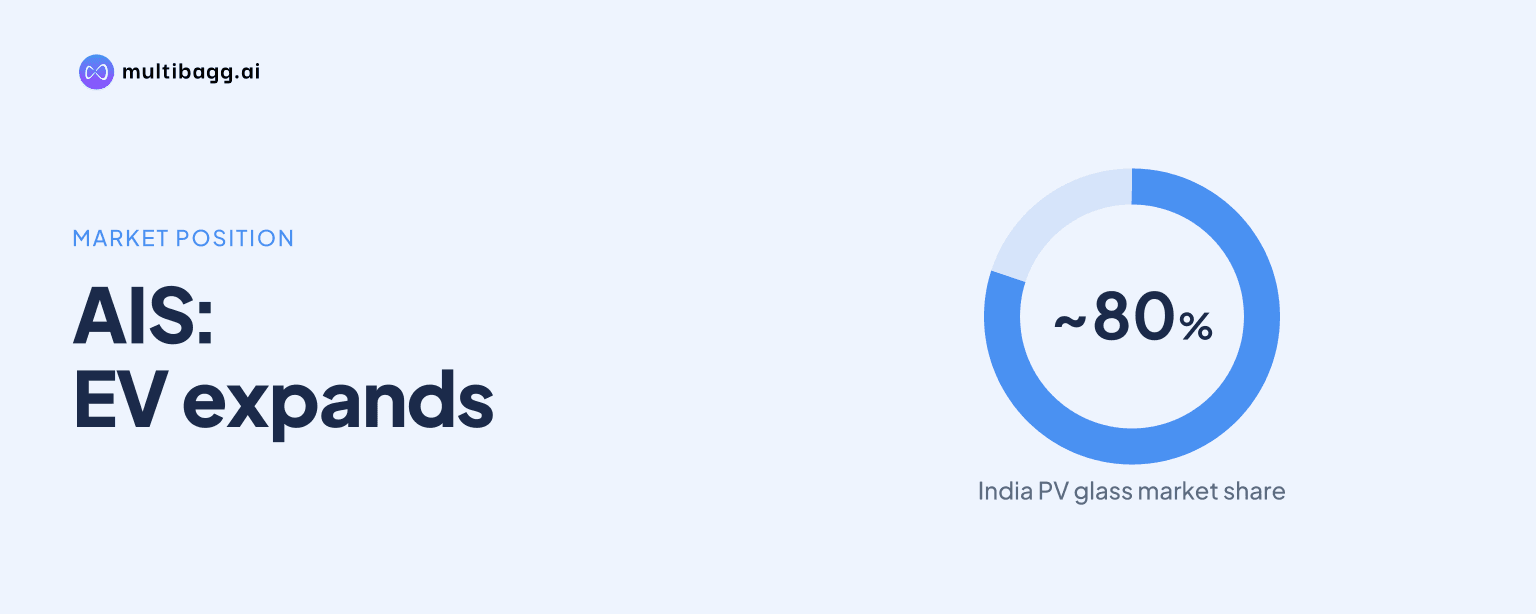
- AIS reported 13 OEM model launches in FY26 and about 80% share of India’s passenger-vehicle glass market.
- AIS has capacity of more than 10 million laminated pieces and more than 7.6 million tempered car sets.
- AIS operates five automotive-glass plants and has 2,150 tonnes per day of float-glass capacity across three plants.
powered by IRIS
Asahi India Glass Ltd. supplied an illuminated laminated panoramic roof for M&M’s XEV 9E and BE 6 while reporting 13 original equipment manufacturer (OEM) model launches in FY26. AIS is expanding its automotive offering into full illuminated roofs, augmented-reality head-up-display windshields, laminated EV sidelites and 2.8-millimetre lightweight glass, supported by capacity exceeding 10 million laminated pieces.
Know Asahi India Glass inside out
Results, valuation, peers and who's buying, in one view.
What EV-ready glass technologies does AIS offer?
AIS offers a stated EV-ready range comprising windshields extending to the B-pillar, full or illuminated glass roofs, augmented-reality head-up-display (AR-HUD) windshields, de-icer windshields, laminated sidelites and laminated infrared-cut sunroofs. The portfolio also includes lightweight glass with a stated thickness of 2.8 millimetres, positioning the company’s products around vehicle design, thermal management and weight requirements.
AIS’s wider windshield range includes acoustic, infrared-cut, heated, rain-sensor and advanced driver-assistance-system windshields, alongside head-up-display and AR-HUD variants. Its sidelite range includes ultraviolet-cut, water-repellent, solar-control, privacy and laminated acoustic glass, while its backlite range includes defogger and antenna-printed products. The product list therefore covers multiple glass panes rather than only roof systems.
AIS says laminated sidelites for EVs have been successfully developed. The source identifies both infrared-cut and acoustic laminated sidelites in its EV technology list, and separately offers normal and acoustic laminated sidelites in the portfolio. However, the presentation does not disclose volumes, revenue or named customer programmes for EV sidelites, so successful development should not be read as evidence of commercial scale.
How does the M&M roof programme demonstrate AIS capability?
AIS developed Marsroof, an illuminated laminated panoramic sunroof, and supplied it from Patan for the Infinity Roof on M&M’s XEV 9E and BE 6. This is the presentation’s named EV-related supply programme and links a finished illuminated roof product to two specific vehicle models.
The M&M programme combines laminated glass with an illuminated panoramic sunroof. AIS separately lists panoramic, fixed laminated and illuminated sunroofs within its automotive portfolio, indicating that the application draws on product categories already offered by the company. The presentation does not state the programme’s order value, production volume, vehicle-launch date or the share of roof glass supplied by AIS.
AIS identifies premiumisation and new products, including sunroofs, as one of 13 automotive growth drivers. It separately cites increasing glass area per vehicle and wider adoption of value-added glass. A panoramic roof can add glass area to a vehicle, while lamination and illumination are value-added features, but the presentation does not disclose pricing or per-vehicle content for the M&M models.
What manufacturing platform supports AIS automotive glass?
AIS says it is the only glass maker in India with in-house design and development of auto-glass machinery. It builds complete laminated lines except autoclaves and tempered lines except certain complex furnaces, while its equipment list includes computer numerical control pre-processing, printing, lamination bending, vacuum-ring de-airing, final inspection and auto loading.
The automotive operation has five manufacturing plants at Bawal, Roorkee, Chennai, Taloja and Patan, plus research and development centres at Bawal and Taloja. It reports capacity of more than 10 million laminated pieces and more than 7.6 million tempered car sets. These figures use different units, so they describe separate production capabilities and are not directly comparable as sales volumes.
AIS states that it first made laminated glass in India in 2002, whereas its FY26 presentation lists products including illuminated roofs, AR-HUD windshields and EV sidelites. The comparison shows a development from laminated-glass manufacturing in 2002 to a broader current technology range, although the presentation does not provide an annual history of product launches or automotive-glass revenue.
Got a follow-up? Ask IRIS
Why does AIS expect higher value per vehicle?
AIS identifies 13 automotive growth drivers, including Indian-market volume growth, more glass area per vehicle, value-added glass adoption, premiumisation, exports, automotive replacement glass, localisation, adjacent mobility categories, digitalisation and EV growth. These are management-identified drivers rather than quantified revenue, profit or EV-sales forecasts.
AIS reports about 80% share of India’s passenger-vehicle glass market, compared with about 12% domestic share in architectural glass and about 26% share of value-added architectural glass. The automotive share is 68 percentage points above the reported domestic architectural share, but the measures cover different segments and market definitions. AIS also reports 2,150 tonnes per day of float-glass capacity across three plants.
The company’s structure links upstream float production to vehicle-glass conversion. Its architectural business converts silica sand, soda ash and limestone into float glass, while its automotive business converts float glass into products for OEMs, original equipment service customers and the aftermarket. This vertical integration is a stated competitive edge, with captive float glass listed alongside scale, tooling, automation and OEM relationships.
How broad is AIS’s automotive customer and product base?
AIS covers windshields, sidelites, sunroofs, backlites and white-goods glass, serving passenger vehicles as well as buses, railways, tractors, off-highway equipment, three-wheelers and appliances. Its sidelite portfolio includes insulated-glass units for metro and railway applications, sliding windows for buses and trucks, and metro driver-cab assembly windows.
AIS reports about 80% share of Indian passenger-vehicle glass and says it supplies every passenger-vehicle OEM in India. Maruti Suzuki, a co-promoter, is identified as its largest automotive-glass customer. The company also names sunroof-system suppliers Webasto, Inalfa Roof Systems and CIE Group among customers, alongside multiple mobility and appliance manufacturers.
In FY26, AIS received three Maruti Suzuki awards for overall performance, supplier collaboration and spares performance. It also reports a Daimler global nomination as Best International Supplier for quality and 100% delivery. The presentation does not provide the assessment periods, scoring methodology or sales connected to these recognitions.
AIS’s broader network comprises 15 manufacturing units and 11 advanced warehouse-cum-sub-assembly units across nine states, compared with the five plants specifically assigned to automotive glass. The Consumer Glass business adds 151-plus Windshield Experts centres in 79-plus cities, providing a separate route to the automotive replacement market alongside OEM and original equipment service channels.
Conclusion
AIS’s disclosed EV-ready strategy centres on adding value through illuminated panoramic roofs, AR-HUD windshields, laminated sidelites, infrared-cut sunroofs and lightweight glass. The M&M XEV 9E and BE 6 Infinity Roof is the named commercial example, while five automotive plants, more than 10 million laminated-piece capacity and in-house machinery development form the stated operating base.
What to watch next is whether AIS identifies further vehicle programmes from its 13 FY26 OEM model launches and provides commercial detail on its successfully developed EV sidelites. Management lists premiumisation, increased glass area per vehicle, localisation, exports, automotive replacement glass and EV growth as drivers, but the presentation does not disclose an EV-glass revenue target, programme volumes or a timetable for additional technology commercialisation.