










Asahi India Glass Limited Q2 profit rises 187.5% on float gains
Key highlights
- AIS Q2FY27 PAT rose 187.5% year-on-year to Rs 167.3 crore.
- Float Glass Q2FY27 PBT increased 246.6% year-on-year to Rs 137.2 crore.
- AIS Q2FY27 EBITDA margin expanded to 22.1% from 17.1%.
- H1FY27 net cash from operating activities rose to Rs 298.3 crore from Rs 142.0 crore.
powered by IRIS
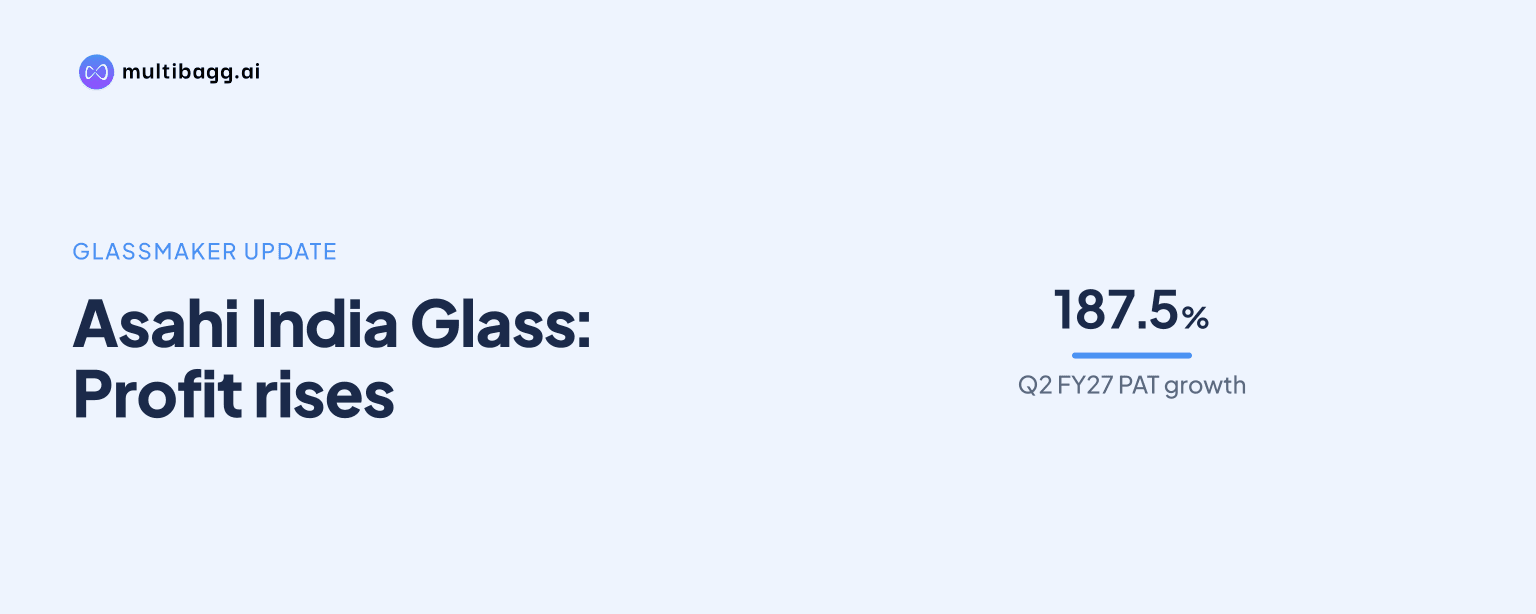
AIS reported Q2FY27 profit after tax of Rs 167.3 crore, up 187.5% year-on-year from Rs 58.2 crore, as Float Glass profit before tax increased 246.6% to Rs 137.2 crore and consolidated earnings before interest, tax, depreciation and amortisation margin rose to 22.1% from 17.1%.
Know Asahi India Glass inside out
Results, valuation, peers and who's buying, in one view.
How did AIS perform in Q2FY27?
AIS delivered higher income and profit in Q2FY27, with total income rising 36.9% year-on-year to Rs 1,591.0 crore and profit after tax, or PAT, reaching Rs 167.3 crore. Total income was also 12.1% above Rs 1,419.1 crore in Q1FY27. Management described the quarter as its best-ever financial performance, citing automotive volumes and improved Float Glass realisations.
Earnings before interest, tax, depreciation and amortisation, or EBITDA, rose 76.4% to Rs 351.4 crore from Rs 199.2 crore, faster than income growth. EBITDA margin increased by 5.0 percentage points to 22.1%, although it was below 23.3% in Q1FY27. Profit before tax rose 221.3% to Rs 226.7 crore from Rs 70.6 crore, while the tax charge increased to Rs 59.5 crore from Rs 12.4 crore.
PAT margin rose to 10.5% from 5.0% a year earlier and was unchanged from Q1FY27. Earnings per share were Rs 6.56 in Q2FY27, compared with Rs 2.22 in Q2FY26 and Rs 5.85 in Q1FY27. Gross profit increased 36.7% to Rs 895.3 crore, while gross margin was unchanged year-on-year at 56.3%.
What drove AIS Float Glass profit growth?
AIS Float Glass profit before tax, or PBT, rose 246.6% year-on-year to Rs 137.2 crore in Q2FY27 from Rs 39.6 crore. Segment revenue grew 58.4% to Rs 608.1 crore from Rs 383.9 crore, exceeding Automotive Glass revenue growth of 30.8% and the company’s 36.9% consolidated income growth.
Management attributed the segment’s revenue increase to better product mix, improved realisations and operational efficiencies. It also said the F2 line operated at full capacity in Q2FY27, whereas it had been in a cold-repair period in Q2FY26. Float Glass PBT consequently increased by Rs 97.6 crore over the year-earlier quarter.
Automotive Glass remained the larger revenue segment at Rs 1,065.9 crore, compared with Rs 608.1 crore for Float Glass. However, Float Glass generated slightly more Q2FY27 segment PBT, at Rs 137.2 crore against Rs 131.4 crore for Automotive Glass. Automotive Glass PBT still rose 69.2% from Rs 77.6 crore, supported by higher volumes amid passenger-vehicle demand.
Got a follow-up? Ask IRIS
Why did AIS EBITDA margin expand despite higher costs?
AIS expanded EBITDA margin to 22.1% from 17.1% because EBITDA grew 76.4%, compared with 36.9% growth in total income. Cost of goods sold rose to Rs 695.7 crore from Rs 507.4 crore, employee benefit expenses increased to Rs 145.0 crore from Rs 115.9 crore, and other expenses rose to Rs 398.8 crore from Rs 339.7 crore.
Management said cost of goods sold, including energy costs, remained elevated during the quarter. It said renewable-energy procurement and operational efficiencies partly mitigated the energy-cost effect. Gross margin remained at 56.3% in both Q2FY27 and Q2FY26, while EBITDA margin rose after gross profit.
Sequentially, EBITDA increased 6.3% to Rs 351.4 crore from Rs 330.5 crore, but the margin declined from 23.3% to 22.1%. Management attributed the sequential Automotive Glass margin impact to inflation in logistics, manpower and consumables, the ramp-up of Patan and Chennai capacity, and stabilisation of 12 new car-model launches.
What did H1FY27 show for AIS?
AIS reported H1FY27 total income of Rs 3,010.1 crore, up 25.3% from Rs 2,401.7 crore in H1FY26, while EBITDA increased 69.5% to Rs 682.0 crore. The H1FY27 EBITDA margin reached 22.7%, compared with 16.8% a year earlier, and gross margin rose to 57.7% from 52.9%.
H1FY27 PAT grew 180.0% to Rs 316.4 crore from Rs 113.0 crore, lifting PAT margin to 10.5% from 4.7%. Float Glass PBT rose 233.3% to Rs 254.2 crore, while Automotive Glass PBT increased 62.1% to Rs 259.0 crore. PBT in the Others segment declined 78.1% to Rs 3.2 crore from Rs 14.4 crore.
Net cash from operating activities was Rs 298.3 crore in H1FY27, compared with Rs 142.0 crore in H1FY26. This followed Rs 411.2 crore of cash generated from operations, Rs 268.8 crore of working-capital changes and Rs 112.9 crore of direct taxes paid. Cash and cash equivalents at the end of the period were Rs 279.1 crore, compared with Rs 937.9 crore at the end of H1FY26.
How did AIS balance sheet change by September 2026?
AIS total assets rose to Rs 8,314.5 crore at September 2026 from Rs 7,772.3 crore at March 2026. Property, plant and equipment increased to Rs 4,097.8 crore from Rs 3,970.3 crore, while capital work-in-progress declined to Rs 365.8 crore from Rs 444.6 crore.
Total borrowings, including current and non-current borrowings, were Rs 2,147.3 crore at September 2026, compared with Rs 2,058.7 crore at March 2026. Total equity rose to Rs 4,199.9 crore from Rs 3,934.2 crore over the same period. Finance cost fell 24.9% year-on-year to Rs 44.6 crore in Q2FY27 from Rs 59.4 crore.
Inventories increased to Rs 1,393.4 crore at September 2026 from Rs 1,226.6 crore at March 2026, and trade receivables rose to Rs 615.9 crore from Rs 508.7 crore. Current assets increased to Rs 2,670.8 crore from Rs 2,329.7 crore, while current liabilities rose to Rs 1,834.8 crore from Rs 1,631.6 crore.
Conclusion
AIS combined 36.9% Q2FY27 income growth with a 76.4% EBITDA increase and a 187.5% rise in PAT. Float Glass was the principal profit change, with PBT increasing to Rs 137.2 crore as the F2 line returned to full capacity, while Automotive Glass supplied Rs 131.4 crore of PBT and higher passenger-vehicle-linked volumes.
The next quarters will indicate whether AIS can sustain reported margins while managing elevated energy, logistics, manpower and consumables costs. Management said it commissioned Phase III tempered operations at Patan, expanded laminated capacity at Chennai and intends to continue investing in manufacturing capacity, technology, vertical integration and customer proximity.