










AIS revenue rises 58% as ROCE declines to 11.3% in FY26
Key highlights
- AIS revenue rose 58% to Rs 5,031 crore in FY26 from Rs 3,189.7 crore in FY22.
- AIS ROCE declined to 11.3% in FY26 from 21.0% in FY22.
- AIS EBITDA increased to Rs 959 crore in FY26, but PAT declined to Rs 345.1 crore.
- AIS invested Rs 3,160 crore in FY23-26, compared with Rs 3,000 crore over the 33 years since 1987.
powered by IRIS
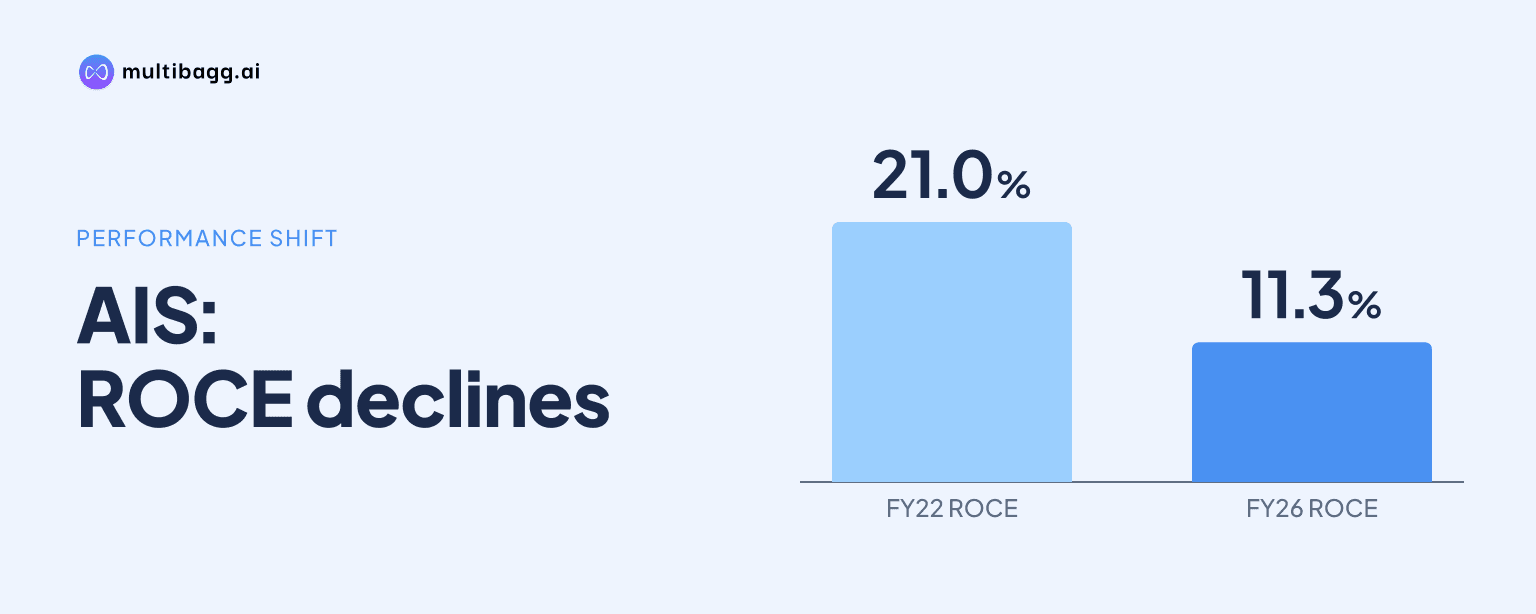
Asahi India Glass Ltd. increased revenue by 58% to Rs 5,031 crore in FY26 from Rs 3,189.7 crore in FY22, while return on capital employed (ROCE) declined to 11.3% from 21.0%. Over the same period, AIS reported Rs 3,160 crore of capital expenditure during FY23-26, alongside higher depreciation and finance costs in FY26.
Know Asahi India Glass inside out
Results, valuation, peers and who's buying, in one view.
What drove AIS revenue growth through FY26?
AIS grew revenue at a stated 12% per annum over FY22-FY26, with total income increasing by Rs 1,841.3 crore to Rs 5,031 crore. Growth varied by year: revenue increased by Rs 845.5 crore in FY23, Rs 330.7 crore in FY24, Rs 260.6 crore in FY25 and Rs 404.5 crore in FY26. The FY26 increase was therefore larger than the increases reported in FY24 and FY25.
The revenue expansion occurred during a substantial capital programme. AIS reports Rs 3,160 crore of capital expenditure across FY23-26, compared with Rs 3,000 crore invested during the 33 years since 1987. The programme included the Soniyana float plant, which AIS describes as its largest single investment, the completed cold repair of the Roorkee float line, phased expansion at Patan, an on-site assembly facility at Kharkhoda, and fire-rated glass and advanced automotive-glazing capabilities.
How did AIS margins and profit change?
AIS increased earnings before interest, tax, depreciation and amortisation (EBITDA) to Rs 959 crore in FY26 from Rs 798.1 crore in FY25, and EBITDA margin rose to 19.1% from 17.3%. This followed the FY24 margin of 17.1%, although the FY26 margin remained below 24.5% in FY22 and 20.1% in FY23. Gross margin increased to 55.2% in FY26 from 49.5% a year earlier, while cost of goods sold declined to Rs 2,251.8 crore from Rs 2,336.2 crore despite higher revenue.
Profit after tax (PAT) did not follow the FY26 EBITDA increase. PAT fell to Rs 345.1 crore from Rs 367.3 crore in FY25, and PAT margin declined to 6.9% from 7.9%, compared with 10.7% in FY22. Depreciation and amortisation increased to Rs 284.7 crore in FY26 from Rs 191.5 crore in FY25, while finance cost rose to Rs 203.9 crore from Rs 128.3 crore. Profit before tax consequently declined to Rs 458.8 crore from Rs 512.8 crore even as earnings before interest and tax increased to Rs 674.4 crore from Rs 606.6 crore.
Why did AIS ROCE and cash conversion decline?
AIS's ROCE declined to 11.3% in FY26 from 21.0% in FY22, falling in each year of the five-year series to 19.1% in FY23, 13.6% in FY24 and 11.7% in FY25. AIS defines ROCE as earnings before interest and tax divided by debt plus net worth. Return on equity also declined to 8.8% in FY26 from 19.7% in FY22, although FY26 earnings before interest and tax of Rs 674.4 crore exceeded the FY22 amount of Rs 620.3 crore.
Operating cash flow (OCF) relative to EBITDA also reduced in FY26. OCF-to-EBITDA was 0.52 in FY26, compared with 0.90 in FY25 and 0.87 in FY24. Cash generated from operations before working-capital changes increased to Rs 936.6 crore from Rs 787.1 crore, but working-capital changes used Rs 321.3 crore, compared with a Rs 77.1 crore addition in FY25. Net cash from operating activities consequently declined to Rs 501.7 crore from Rs 720 crore.
AIS recorded net investing cash outflow of Rs 665 crore in FY26, after outflows of Rs 1,191.3 crore in FY25 and Rs 923.7 crore in FY24. Net cash from financing activities was an inflow of Rs 245 crore in FY26, following an inflow of Rs 457.9 crore in FY25. Debt-to-equity fell to 0.52 times in FY26 from 0.96 times in FY25 and was also below the FY22 level of 0.69 times.
Got a follow-up? Ask IRIS
Which AIS segments produced FY26 growth?
Automotive Glass produced AIS's largest reported segment-revenue increase, rising to Rs 3,383 crore in FY26 from Rs 1,613.8 crore in FY22. Its segment profit before tax (PBT) increased to Rs 367.1 crore from Rs 168.9 crore over the same period. In FY26 alone, Automotive Glass revenue rose by Rs 372.1 crore from Rs 3,010.9 crore, while segment PBT increased by Rs 6.8 crore from Rs 360.3 crore.
Float Glass revenue was Rs 1,754 crore in FY26, up from Rs 1,503.4 crore in FY22 but only Rs 4.6 crore above FY23's Rs 1,749.4 crore. Its FY26 segment PBT was Rs 246.6 crore, below Rs 503.3 crore in FY23 and Rs 465.6 crore in FY22. The Others segment reported FY26 revenue of Rs 802.6 crore and PBT of Rs 25.5 crore, compared with revenue of Rs 172.6 crore and a PBT loss of Rs 24.1 crore in FY22.
Segment revenue includes inter-segment sales and other income, according to AIS's note. Inter-segment revenue rose to Rs 908.5 crore in FY26 from Rs 100.1 crore in FY22, affecting the relationship between the reported segment-revenue total and consolidated revenue. Total segment PBT was Rs 639.2 crore in FY26, before interest expense of Rs 203.9 crore and other reported items reduced consolidated profit before tax to Rs 458.8 crore.
What is AIS investing in after FY26?
AIS has approved a roadmap for investment over the next five years across greenfield and brownfield capacity in the glass value chain, although the presentation does not disclose an aggregate amount or timing. Management's stated priorities are new technology products and processes, stronger vertical integration, customer proximity and indigenous capabilities. FY26 installed automotive laminated-glass capacity was more than 10 million pieces, while tempered-glass capacity was more than 7.6 million sets.
The capacity plan lists FY26 float-glass capacity of 2,150 tonnes per day, up from 2,100 tonnes per day in FY25. AIS says projects pass four filters: manufacturing integration, customer proximity, return rationale and long-term competitiveness. At Soniyana F3, AIS secured 95 tonnes per annum of green hydrogen under a long-term arrangement, while 9.52% of FY26 capital expenditure was invested in environmental initiatives.
Conclusion
AIS's FY22-FY26 record combines a Rs 1,841.3 crore rise in revenue and a Rs 179 crore increase in EBITDA with lower returns and a lower net-profit margin. Automotive Glass generated the largest segment-revenue increase, while higher FY26 depreciation and finance costs accompanied a Rs 22.2 crore decline in PAT despite a Rs 160.9 crore increase in EBITDA.
The next point to watch is delivery of the approved five-year expansion roadmap, for which AIS has not disclosed a total investment amount or schedule. Management's stated tests of return rationale and long-term competitiveness, alongside movements in ROCE from 11.3%, OCF-to-EBITDA from 0.52 and Float Glass PBT of Rs 246.6 crore, are the disclosed measures relevant to that build-out.