










AIS spent Rs 3,160 crore, exceeding its 33-year prior capex
Key highlights
- AIS invested Rs 3,160 crore in FY23-26, compared with Rs 3,000 crore since 1987 over 33 years.
- AIS increased float-glass capacity to 2,150 tonnes per day in FY26 from 2,100 tonnes per day in FY25.
- AIS laminated automotive-glass capacity exceeded 10 million pieces in FY26, up from 8.8 million pieces in FY25.
- AIS reported FY26 revenue of Rs 5,031 crore and EBITDA of Rs 959 crore.
powered by IRIS
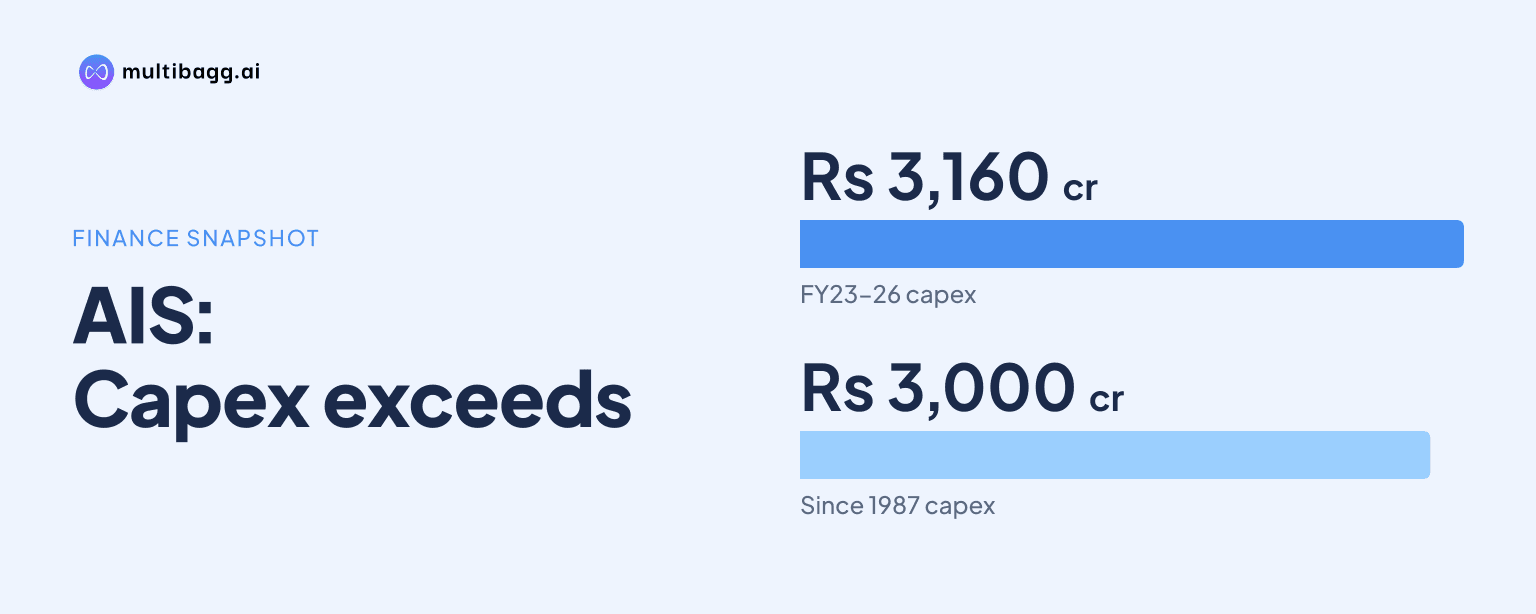
Asahi India Glass Ltd. invested Rs 3,160 crore in FY23-26, exceeding the Rs 3,000 crore it reported spending in the 33 years since 1987 by Rs 160 crore. The four-year programme included the Soniyana F3 float-glass plant, Roorkee float-line cold repair, phased Patan auto-glass expansion and an on-site assembly facility at Kharkhoda.
Know Asahi India Glass inside out
Results, valuation, peers and who's buying, in one view.
How much did AIS invest in FY23-26?
AIS invested Rs 3,160 crore across FY23-26, compared with Rs 3,000 crore of capital expenditure since 1987 over 33 years. In the company’s presentation, the four-year FY23-26 amount was Rs 160 crore higher than the expenditure shown for the preceding 33-year period.
AIS says its projects pass four filters: manufacturing integration, customer proximity, return rationale and long-term competitiveness. The presentation describes the build-out as intended to deliver profitable growth with disciplined capital allocation, rather than providing project-level returns or annual expenditure details.
What did AIS build with the Rs 3,160 crore programme?
AIS used the FY23-26 programme for production assets and processing capabilities, led by the Soniyana float plant, or F3, which it calls its largest single investment. The stated projects span float glass, automotive glass and advanced product capabilities rather than one customer segment.
The programme completed a cold repair of the Roorkee float line, expanded the Patan auto-glass facility in phases and established an on-site assembly facility at Kharkhoda. AIS also lists fire-rated glass and advanced automotive-glazing capabilities as part of the FY23-26 build-out.
Soniyana F3 also appears in AIS’s localisation and self-reliance pillar, which covers vertical integration across the sand-to-solutions chain. The company lists in-house design, tooling and raw materials, localised sourcing and micro, small and medium enterprise supplier development, while saying capacity expansion is paced with market demand.
How did AIS capacity change from FY25 to FY26?
AIS increased capacity in each of its three disclosed categories between FY25 and FY26: laminated automotive glass rose from 8.8 million pieces to more than 10 million pieces, tempered automotive glass rose from more than 7 million sets to more than 7.6 million sets, and float glass rose from 2,100 tonnes per day to 2,150 tonnes per day.
AIS lists laminated automotive-glass capacity at Bawal, Roorkee, Chennai, Taloja and Patan. Its tempered automotive-glass facilities are at Bawal, Roorkee, Chennai and Patan, while its float network comprises Taloja F1, Roorkee F2 and Soniyana F3.
The FY23-26 programme also included the Kharkhoda assembly facility alongside manufacturing expansion. Separately, AIS reported 151 Windshield Expert centres in more than 79 cities and more than 1,424 stockists, providing replacement and service reach for its consumer-facing automotive-glass business.
Got a follow-up? Ask IRIS
How did AIS financial metrics change during the investment period?
AIS reported revenue of Rs 5,031 crore in FY26, up from Rs 4,035 crore in FY23, while earnings before interest, tax, depreciation and amortisation (EBITDA) rose from Rs 811 crore to Rs 959 crore. Revenue therefore increased by Rs 996 crore across the FY23-FY26 period in which AIS reported Rs 3,160 crore of capital expenditure.
EBITDA margin declined to 19.1% in FY26 from 20.1% in FY23 despite the increase in EBITDA. Profit after tax (PAT) declined to Rs 345 crore from Rs 362 crore, and PAT margin fell to 6.9% from 9.0%; the presentation does not attribute these movements directly to the capital programme.
Return on capital employed (ROCE) was 11.3% in FY26, below 19.1% in FY23, while return on equity (ROE) declined to 8.8% from 17.6%. Debt-to-equity fell to 0.52 times in FY26 from 0.66 times in FY23, after reaching 0.96 times in FY25, showing lower reported leverage at the end of the investment period.
What is AIS planning after FY26?
AIS has approved a five-year roadmap covering greenfield and brownfield capacity expansion across the glass value chain. The presentation does not disclose a total rupee commitment, project-by-project schedule or capacity target for this programme, leaving the scale of spending after FY26 unspecified.
Management lists new technology products and processes, stronger vertical integration, customer proximity and indigenous capabilities as the programme’s priorities. Its innovation agenda includes sunroofs, augmented-reality head-up display glass, advanced driver-assistance-system-ready glass, climate-specific glass and fire-rated glass.
AIS says it has raised external capital only twice in about 40 years, most recently through a qualified institutional placement (QIP). It also cites total quality management and plan-do-check-act (PDCA) as execution frameworks, but does not provide revenue, margin or return forecasts for the approved roadmap.
Conclusion
AIS’s Rs 3,160 crore FY23-26 investment programme exceeded its stated Rs 3,000 crore expenditure over the preceding 33 years and covered float glass, automotive glass, assembly and advanced processing. Capacity rose from FY25 to FY26 in laminated automotive glass, tempered automotive glass and float glass, while FY26 revenue reached Rs 5,031 crore.
The next item to watch is disclosure on the approved five-year expansion roadmap, which includes greenfield and brownfield projects but has no stated investment amount or capacity target. Future reporting can also show how Soniyana F3, Patan and Kharkhoda affect AIS’s FY26 measures of 19.1% EBITDA margin, 11.3% ROCE and 0.52 times debt-to-equity.