










Ajax faces FY27 demand headwinds as manufacturing costs rise 6–7%
Key highlights
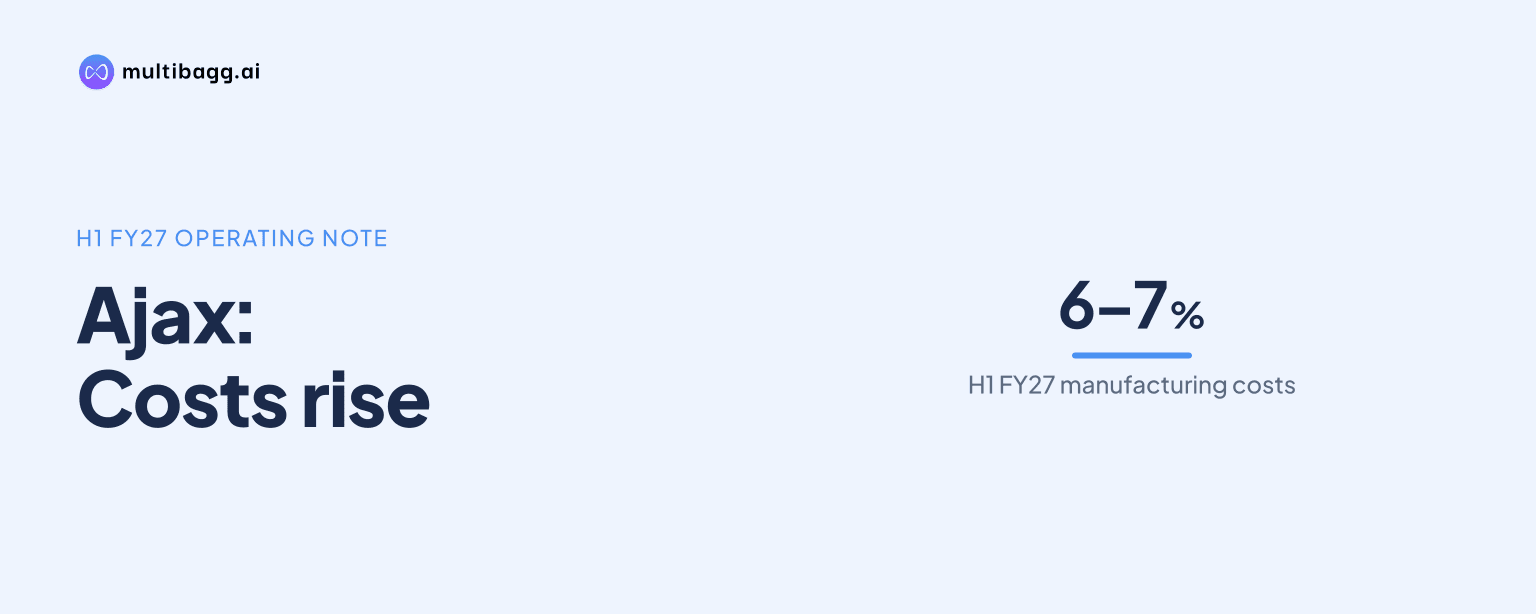
- Ajax said manufacturing costs rose roughly 6–7% year on year in H1 FY27.
- Highway construction declined 19% year on year in H1 FY27, while expected FY27 road construction is 21 km per day versus 25 km per day in FY26.
- Ajax took an approximately 1% price increase in September 2026 and may consider further calibrated increases in H2 FY27.
- Non-SLCM revenue rose 31.5% year on year to Rs 103.5 crore in H1 FY27.
powered by IRIS
Ajax Engineering Limited said a softer public-capex environment, a 19% year-on-year fall in highway construction in H1 FY27 and a roughly 6–7% rise in manufacturing costs are its principal FY27 headwinds. Ajax has responded with a roughly 1% September 2026 price increase, cost actions and expansion into additional product and customer pools.
Know Ajax Engineering inside out
Results, valuation, peers and who's buying, in one view.
How soft is state capital expenditure for Ajax?
State capital expenditure, or capex, utilisation weakened to 77.2% of budget in FY26 from 80.2% in FY25, according to Ajax. The presentation also showed that capex spending in April-August 2026 was 21% of the full-year budget, below the roughly 32% share recorded for revenue expenditure over the same period. This gap is relevant to Ajax because the company identifies state spending momentum as an industry demand factor.
The 21% April-August utilisation ratio for FY27 was also below the 24% recorded in FY24, although it matched FY25 and was near the 20%-22% range shown for FY22, FY23 and FY26. Ajax said several key states recorded sub-par utilisation in the April-August 2026 period: Uttar Pradesh was at about 10%, Maharashtra and Odisha were each about 16%, and Telangana was about 26%.
Ajax also pointed to an allocation mix that could constrain infrastructure-related outlays. Defence spending increased 37% year on year in April-August 2026, compared with 16% for non-defence spending, while subsidies rose 24% and had already reached 46% of the full-year budget. The presentation characterises this as a diversion of funds to other sectors, alongside the lower state-capex utilisation.
What do slower road projects mean for Ajax?
Highway construction declined 19% year on year in H1 FY27, while road capex increased only 2% in April-August 2026, Ajax said. Its presentation estimates an expected road-construction pace of 21 kilometres per day in FY27E, versus 25 kilometres per day in FY26. The change implies four fewer kilometres of expected daily construction activity than the preceding year’s pace.
Ajax links this slower pace of project execution with the broader soft demand environment, rather than disclosing a quantified revenue loss from highways. The company reported that customer sentiment remained tepid in H1 FY27 and stated that it expects a demand pick-up from H2. That expectation is management’s outlook, not a reported recovery in the first half.
The operating backdrop did not prevent some volume growth. Ajax’s self-loading concrete mixer, or SLCM, volumes reached 2,370 units in H1 FY27, up 2.5% year on year, while second-quarter volume growth was 6.3%. The difference between the quarter and the half-year growth rates indicates that the later quarter grew faster than the H1 average despite the cited highway and public-spending pressures.
How much have costs increased for Ajax?
Manufacturing costs increased by roughly 6–7% year on year in H1 FY27, driven largely by steel, Ajax said. The company also cited sharp increases in steel and other crude-linked commodities, as well as considerably higher freight costs. The presentation does not provide a separate rupee amount for the steel, commodity or freight effect.
Ajax said it took an approximately 1% price increase in September 2026 and will consider further price hikes in a calibrated manner during H2 FY27. The stated objective is to address rising commodity costs while balancing growth and profitability. Management also listed operational-efficiency measures, cost optimisation and supplier negotiations for better pricing terms as parts of its response.
The reported H1 margins show how these actions and costs were reflected in results. Gross margin was 25.2%, up 20 basis points year on year, with Ajax saying price hikes offset higher raw-material costs. Earnings before interest, tax, depreciation and amortisation, or EBITDA, margin was 11.5%, down 20 basis points year on year; Ajax attributed the broadly stable margin profile partly to price actions despite a one-time SAP implementation cost.
Got a follow-up? Ask IRIS
How is Ajax widening demand beyond its core market?
Ajax is widening its addressable market through the UDAAN Series of SLCMs, private-sector customer relationships, urban projects, batching plants and pumps. Management describes the UDAAN Series as an effort to democratise mechanisation in India. In non-SLCMs, it is relying on product differentiation, brand equity and its distribution network to deepen market penetration.
The non-SLCM business expanded faster than the core SLCM business in H1 FY27. Non-SLCM revenue increased 31.5% year on year to Rs 103.5 crore, compared with 3.3% growth in SLCM revenue to Rs 783.5 crore. Non-SLCM volumes were 303 units, up 12.6%, while SLCM volumes were 2,370 units, up 2.5%.
Ajax reported SLCM market share of 75.5% in H1 FY27, compared with 70.7% a year earlier, a gain of about 480 basis points. It also reported 48% year-on-year export-revenue growth in H1 FY27. These results coincided with faster growth in non-SLCMs and higher SLCM market share while total demand conditions remained soft.
How much financial capacity does Ajax have for its response?
Ajax reported cash and cash equivalents of more than Rs 1,150 crore as a war chest for growth and inorganic opportunities. Management said it is focused on cash generation, disciplined working capital and prudent capital allocation, rather than specifying an acquisition, investment amount or timetable. The presentation describes this balance-sheet flexibility as a means to pursue opportunities when they arise.
For H1 FY27, total revenue rose 5.5% year on year to Rs 961.6 crore and profit after tax increased 15.9% to Rs 106.5 crore. EBITDA rose 3.7% to Rs 110.6 crore. These reported results show positive growth during the period in which Ajax cited slower road construction, subdued state-capex utilisation and higher steel-linked manufacturing costs.
Conclusion
Ajax’s FY27 operating environment combines softer state-capex deployment, a lower expected road-building pace and roughly 6–7% manufacturing-cost inflation in H1. Its reported response combines a September 2026 price increase, supplier and operating-cost measures, and a broader product and customer strategy. H1 results show SLCM revenue growth of 3.3%, substantially faster 31.5% non-SLCM growth and a 75.5% SLCM market share.
The next item to watch is whether the demand pick-up Ajax expects in H2 FY27 materialises as state-capex utilisation and project execution develop. Management has also said it may consider further calibrated price increases in H2 FY27, while deploying more than Rs 1,150 crore of cash and cash equivalents for growth or inorganic opportunities if suitable opportunities arise.