










Alkem US approvals delayed as Daman affects eight launches
Key highlights
- Alkem says Daman remediation has delayed approvals for 3 important US products.
- Around 8 Daman-filed products are due for launch in the next 6 to 12 months.
- Alkem expects mid-single-digit US growth in constant currency for the year.
- Alkem reported 31% non-US growth excluding Occlutech in the first half.
powered by IRIS
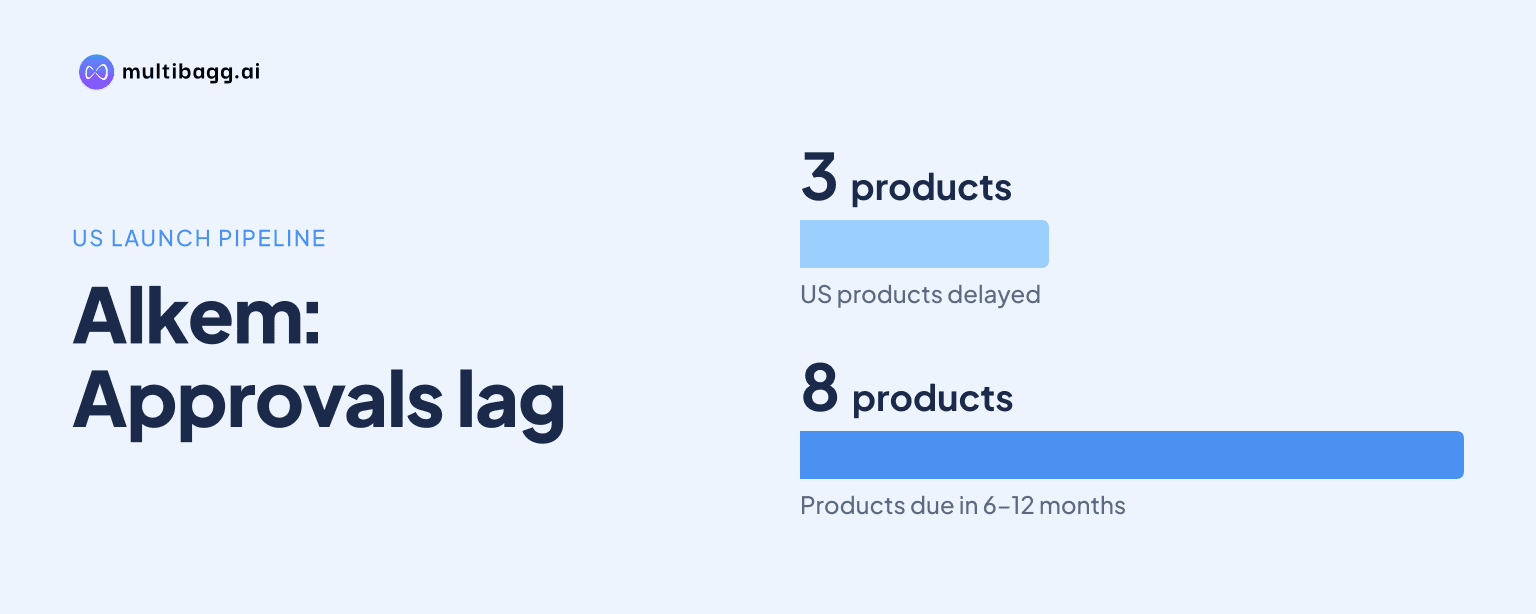
Alkem Laboratories Limited says remediation at its Daman site has delayed approval of three important US products and affects around eight products due for launch in the next 6 to 12 months. Management has submitted all corrective responses to the US Food and Drug Administration, but is awaiting the agency’s response and timing for a re-audit.
Know Alkem Laboratories inside out
Results, valuation, peers and who's buying, in one view.
Why are Alkem’s US product approvals delayed?
Alkem’s US approvals are delayed because new approvals from the Daman facility have been stalled while the site undergoes remedial measures. Management said three important products that had been lined up for launch have had their approvals delayed, making Daman remediation the organisation’s highest priority because of the resulting effect on the US business.
The issue also narrows the near-term launch opportunity within Alkem’s broader US filing portfolio. An analyst asked about 23 pending Abbreviated New Drug Applications, or ANDAs, and 18 tentative approvals; management said the more relevant measure was the roughly eight Daman-filed products due for launch in the next 6 to 12 months. Those launches are the immediate concern because their approvals remain held up.
How does the Daman issue change Alkem’s US outlook?
Alkem expects mid-single-digit US growth in constant currency for the year, rather than a material lift from planned launches. Management said the site remediation is an overhang, as stalled approvals mean prospective launches are not expected to raise US revenue guidance meaningfully. It nevertheless expects the second half, including the third and fourth quarters, to be slightly better than the first half.
The approval delay comes alongside product-specific pricing pressure. Management attributed the 16% US price erosion cited by an analyst to Sacuval, rather than the full portfolio. This distinction matters because the Daman hold-up reduces Alkem’s ability to use new products to offset the revenue effect of pricing on an existing product during the next two quarters.
Tolvaptan is another constrained contributor rather than an immediate offset. Management said the product has potential but may not scale meaningfully over the next two quarters because of its Risk Evaluation and Mitigation Strategy, or REMS, requirements. It said the product is sold through selected outlets and pharmacies, and that current contribution is not meaningful.
Alkem launched only two US products in the first quarter, Dapagliflozin and the Dapagliflozin-metformin combination. Management said both launches had not gained traction to the level anticipated. Against that backdrop, the delayed approvals of three additional products and the eight Daman-linked launches due within 6 to 12 months place greater weight on the timing of regulatory resolution.
What has Alkem completed at the Daman facility?
Alkem says it has completed and submitted its remediation responses to the US Food and Drug Administration. Management said it is now waiting for the regulator’s counter-response on how and when a re-audit could occur. The company did not disclose a date for an inspection, a potential clearance, or approval timelines for the three delayed products.
Management characterised the Daman observations as procedural gaps rather than infrastructure issues. It therefore said the remediation cost recorded in the first half was not significant and that there was no material cost associated with the work. The company linked the operational consequence to the three delayed approvals and the roughly eight products due for launch within 6 to 12 months, rather than to a disclosed capital expenditure programme.
The distinction between a completed company response and an agency re-audit is important. Alkem has done what it said was required from its remediation side, but the US Food and Drug Administration’s review and inspection timing remain unresolved. Until that process advances, the company cannot convert the approximately eight Daman-filed near-term products into launches.
Got a follow-up? Ask IRIS
Which parts of Alkem’s pipeline are most exposed?
Alkem’s near-term exposure is concentrated in products filed from Daman that are due for launch in the next 6 to 12 months, rather than all 23 pending ANDAs or all 18 tentative approvals. Management did not provide the names, revenue potential or exact approval stages of the eight affected products, so the transcript does not support estimating their individual sales impact.
The three specifically described as important delayed products appear to be a subset of the broader launch disruption, but management did not explicitly map them to the eight products. What it did state is that the three approvals had been delayed and were “really impacting” the US business. This makes regulatory timing, not simply the headline number of pending applications, the key operational variable.
Alkem’s broader international business offers a contrast to the US position. Excluding Occlutech, the company reported 31% growth in non-US operations in the first half, and management expected strong double-digit growth in the second half, led by Chile and Australia, with Germany and the United Kingdom also improving. Those markets do not remove the Daman constraint, but they underpin a different geographic growth profile.
In India, management expected overall growth of close to 11% for the year, compared with an analyst’s 9% to 10% proposition. It also said the full effect of government-set minimum import prices on penicillin-related materials, including Pen G and amoxicillin-clavulanic acid, was not fully reflected in the first half because older inventory remained. Management expects that effect to show in the second half and said it was built into margin guidance.
What should investors watch in Alkem’s next update?
The main item to watch is whether the US Food and Drug Administration responds on a Daman re-audit and whether that leads to renewed approval activity for the three delayed products. Alkem has not given a regulatory timetable, so the next evidence of progress would be a disclosed inspection plan, re-audit outcome or approval that permits launch of one or more of the eight products due in the next 6 to 12 months.
A second item is whether the modest US recovery management expects in the third and fourth quarters materialises despite the approval stall. The company expects the second half to be better than the first half, but it has also said Tolvaptan’s REMS restrictions will slow its ramp-up and that the two first-quarter launches were suboptimal. Results will therefore show how much existing products, pricing and limited launch activity can support the mid-single-digit constant-currency outlook.
Conclusion
Alkem’s Daman remediation is a concrete regulatory setback for its US business because it has delayed three important approvals and affects about eight products due for launch within 6 to 12 months. The immediate consequence is a lower ability to counter pricing pressure and weak early launch traction through fresh products, even as non-US markets and India have separate growth expectations.
Next, investors should watch for the US Food and Drug Administration’s response to Alkem’s submitted remediation package and the timing of any re-audit, neither of which management has disclosed. Management’s stated plan is to pursue an expeditious resolution with internal and external stakeholders, while maintaining an expectation of mid-single-digit US growth in constant currency for the year.