










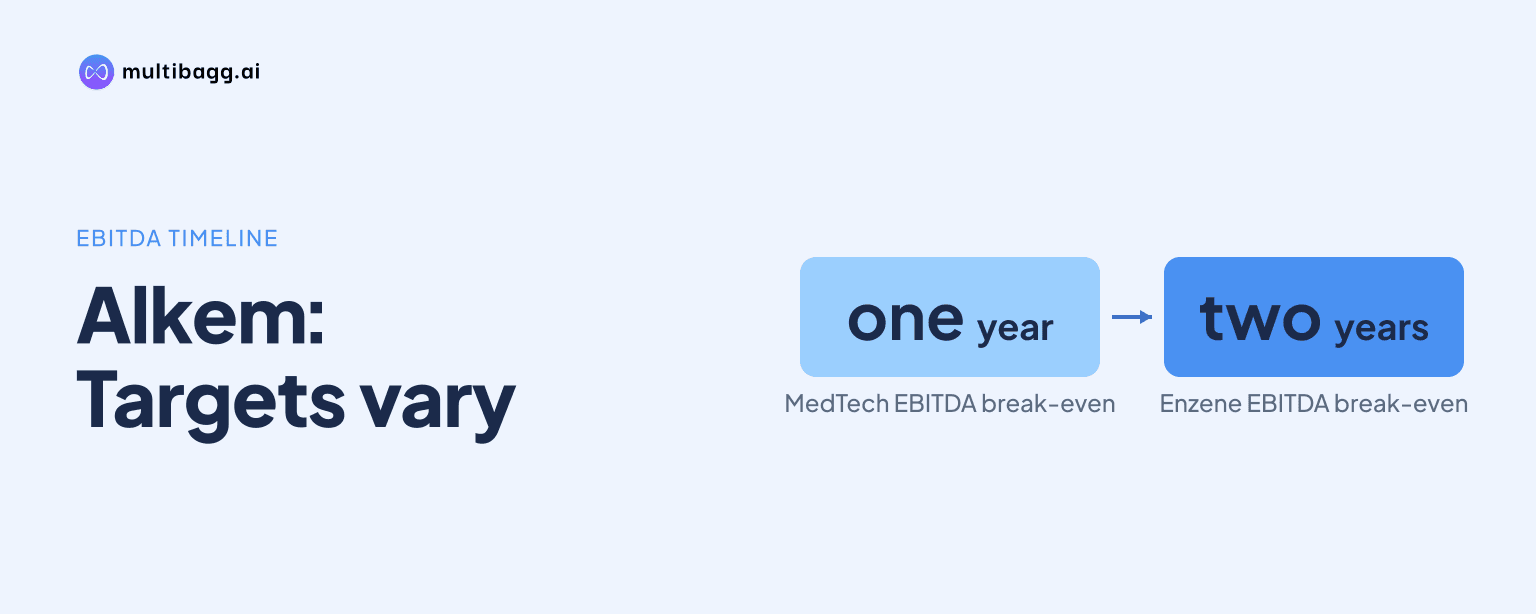
Alkem targets Enzene break-even in two years, MedTech one
Key highlights
- Alkem expects MedTech EBITDA break-even within about one year.
- Alkem expects Enzene EBITDA break-even in 18 months to two years.
- Occlutech reduced Alkem's Q2 FY27 EBITDA margin by 80 basis points.
- Alkem reported Q2 FY27 MedTech sales of Rs 133 crore and biotech sales of Rs 70 crore.
powered by IRIS
Alkem Laboratories Limited expects its MedTech business to reach earnings before interest, tax, depreciation and amortisation, or EBITDA, break-even within about one year and Enzene within 18 months to two years, while accepting near-term margin pressure to expand both platforms. Occlutech reduced Q2 FY27 EBITDA margin by 80 basis points after its consolidation into MedTech.
Know Alkem Laboratories inside out
Results, valuation, peers and who's buying, in one view.
When will Alkem's Enzene and MedTech businesses break even?
Alkem expects MedTech to move out of EBITDA losses within about one year, while Enzene is targeted to reach EBITDA break-even in 18 months to two years at most. Management provided the separate timelines in the Q2 FY27 call after an analyst asked when the drag from the two newer businesses would cease.
The detailed targets refine management's earlier comment that investors should factor in about a year and a half before the combined EBITDA drag is removed. MedTech has the earlier target, while Enzene has the longer runway. Management said both are growth engines and that it would rather trade growth for break-even, so the timelines are management targets rather than a plan to reduce investment immediately.
Alkem's growth objectives extend beyond the break-even dates. Management said Enzene could roughly double in revenue over four years, while the two newer platforms could be about three times their current size in five to six years. It said that growth would be somewhat back-ended, indicating that a larger part of the expansion is expected later in the period.
Why are Enzene and MedTech reducing Alkem's margin now?
Alkem said Occlutech diluted Q2 FY27 EBITDA margin by 80 basis points, or 0.80 percentage points, and uncertainty over Enzene's pace of improvement was another reason it retained FY27 EBITDA-margin guidance of 20% to 21%. Alkem reported a Q2 FY27 EBITDA margin of 22.5% on revenue from operations of Rs 4,520 crore, but management did not raise the full-year range.
The MedTech margin effect followed a changed consolidation base. Alkem consolidated Occlutech from 16 July, representing two and a half months of Q2 FY27, and reported MedTech sales of Rs 133 crore for the quarter, including Occlutech. Management also said purchase price allocation, or PPA, depreciation from the acquisition was about Rs 28 crore in the quarter and would continue in subsequent quarters.
Enzene's biotech sales were Rs 70 crore in Q2 FY27, down 35% year on year because management described contract development and manufacturing organisation, or CDMO, revenue as lumpy. This contrasted with Alkem's total revenue growth of 13.8% year on year and EBITDA growth of 11.3% in the quarter. The comparison shows why the newer businesses can affect group margins while their revenue bases are still being developed.
What is delaying Enzene's growth and break-even plan?
Alkem identified the delayed denosumab biologics licence application, or BLA, as Enzene's main setback because management had expected approval and now anticipates competition from 11 players. Management said the setback affects both the product opportunity and confidence in the United States platform, where regulatory approval can support CDMO customer activity.
The U.S. Enzene site has been inspected by the U.S. Food and Drug Administration, or FDA, but management said its regulatory position remained unclear until the BLA is approved. It also said the anticipated U.S. and CDMO ramp had not occurred at the expected pace. The site is not fully idle, according to management, as it has some CDMO business and is expected to be far busier in the second half of FY27 than in the first half.
A third pressure point is Enzene's India business-to-business biosimilars operation, where management said price erosion and competition were greater than expected. Management linked the BLA delay, slower U.S. CDMO ramp and domestic biosimilar conditions to Enzene's slower progress. It nevertheless said investors should not annualise the Q2 FY27 loss by multiplying it by four because it expects improvement as activity increases.
Got a follow-up? Ask IRIS
How much more will Alkem invest in Enzene and MedTech?
Alkem expects capital expenditure of Rs 300 crore to Rs 350 crore for Enzene over the next three years and said its main Enzene capital-expenditure cycle is otherwise largely complete. The disclosed spending plan therefore relates to the platform's remaining requirements rather than a new large-scale expansion programme.
For MedTech, Alkem expects capital expenditure of close to Rs 400 crore over the next three to four years. When an analyst described the combined requirement as about Rs 600 crore to Rs 700 crore over three to four years, management agreed. The call did not reconcile that broad combined estimate with the separately stated Enzene and MedTech amounts.
The capital plan accompanies acquisition-related balance-sheet and profit-and-loss effects. Alkem added identifiable Occlutech intangibles of close to Rs 1,100 crore, which management said would be amortised broadly over 10 years, and goodwill of close to Rs 700 crore. It also said borrowing associated with Occlutech had increased consolidated finance cost and that this effect would continue in subsequent quarters.
How does the break-even plan fit Alkem's wider FY27 outlook?
Alkem maintained FY27 EBITDA-margin guidance of 20% to 21% despite reporting 22.5% in Q2 FY27, citing the 80-basis-point Occlutech dilution and uncertainty over Enzene's recovery. Management's decision not to revise guidance indicates that the second-half outcome will depend on the pace of newer-business losses as well as the core pharmaceutical operations.
The core business provides a contrasting scale benchmark for the newer platforms. Q2 FY27 revenue from operations was Rs 4,520 crore, while MedTech sales were Rs 133 crore and biotech sales were Rs 70 crore. Management said Enzene and MedTech should grow faster than the core India business because their revenue bases are smaller and they operate in newer segments.
Management also said Alkem's India business could grow close to 11% for FY27. In the U.S., it expected mid-single-digit growth in constant currency for the year, while noting that new approvals remain constrained by the Daman site's ongoing remedial measures. These core-business expectations frame the funding environment for the Enzene and MedTech investment plans.
Conclusion
Alkem is prioritising the scale-up of Enzene and MedTech over immediate EBITDA outcomes, with MedTech targeted to break even first and Enzene expected to follow within up to two years. Q2 FY27 showed the near-term cost of that approach: Occlutech reduced EBITDA margin by 80 basis points, while Enzene's Rs 70 crore biotech sales fell 35% year on year in a lumpy CDMO quarter.
The next disclosed milestones are a busier second half of FY27 at Enzene's U.S. site, clarity on the denosumab BLA and U.S. FDA status, and the planned Enzene capital expenditure of Rs 300 crore to Rs 350 crore over three years. For MedTech, progress will depend on Occlutech integration and the deployment of close to Rs 400 crore over the next three to four years as management pursues its one-year EBITDA break-even target.