










Allcargo Global says initiatives drove 70% of recent gains
Key highlights
- Allcargo reported Q2 FY27 EBITDA of Rs 122 crore, compared with Rs 37 crore in Q2 FY26.
- Management said internal initiatives contributed about 70% of recent gains, while freight-rate tailwinds added 20% to 30%.
- Q2 FY27 gross profit rose 21% year on year to Rs 837 crore while staff and administrative costs were largely flat.
- Management expects freight rates to soften and normalize over the next four to five months.
powered by IRIS
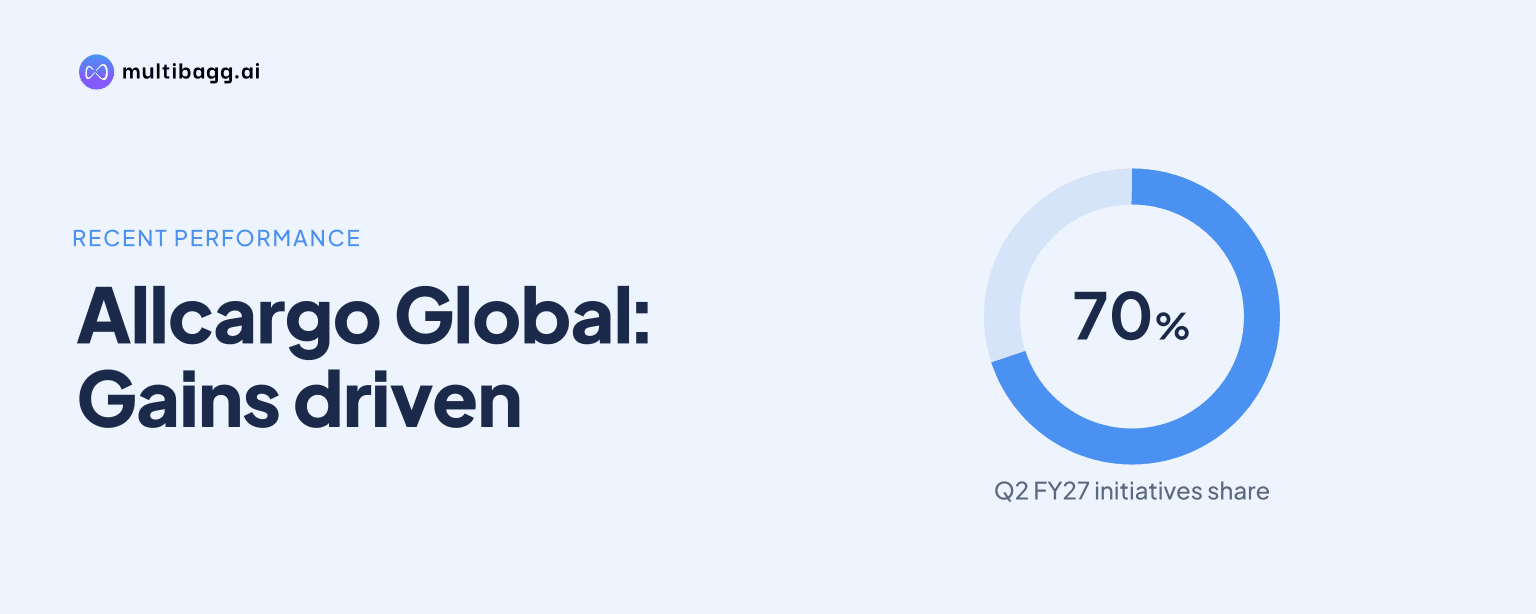
Allcargo Global said in Q2 FY27 that internal business initiatives generated about 70% of its recent performance gains, while elevated freight rates contributed 20% to 30%, as EBITDA rose to Rs 122 crore from Rs 37 crore a year earlier. Management expects freight rates to normalize over the next four to five months.
Know Allcargo Global inside out
Results, valuation, peers and who's buying, in one view.
How much of Allcargo’s improvement came from internal initiatives?
Allcargo said about 70% of recent gains came from business initiatives, with industry tailwinds accounting for the remaining 20% to 30%. Ravi Jakhar said the company was potentially two to three quarters ahead of its guidance curve because of the freight-rate environment, but management believed it would remain on track with its planned performance if those tailwinds disappeared.
The internal initiatives cited were profitability discipline, trade-lane monitoring, automation and cost control. In Q2 FY27, gross profit increased 21% year on year to Rs 837 crore, while staff and administrative costs were largely flat both sequentially and from Q2 FY26. Management’s assessment separates the operational improvement from a freight-rate benefit that it expects to fade.
What were Allcargo’s Q2 FY27 earnings results?
Allcargo returned to quarterly profitability in Q2 FY27, reporting profit after tax of Rs 32 crore against losses in the prior quarter and the year-earlier period. Consolidated revenue was Rs 4,320 crore, up 27% year on year and 23% from Q1 FY27, while earnings before interest, tax, depreciation and amortisation, or EBITDA, reached Rs 122 crore.
The improvement came despite lower year-on-year shipment volumes. Less-than-container-load, or LCL, volume declined 5.7%, full-container-load, or FCL, volume fell 12%, and air volume declined 10%, with management attributing part of the reduction to the Middle East. Sequentially, LCL volume rose 2.9%, FCL increased 1.3% and air volume grew 16%, indicating a better Q2 trend than the year-on-year comparison.
For H1 FY27, revenue rose 17% year on year to Rs 7,842 crore and gross profit increased 11% to Rs 1,570 crore. EBITDA was Rs 155 crore against Rs 6 crore in H1 FY26, while profit after tax was Rs 4 crore compared with a Rs 117 crore loss. The comparatively small first-half profit reflects the Rs 28 crore loss reported in Q1 FY27 before the Rs 32 crore Q2 profit.
When will Allcargo’s freight rates normalize?
Allcargo expects freight rates to continue softening and normalize over the next four to five months. Management said festive demand was slowing toward year-end, while supply-chain disruptions remained in place after the combination had previously caused freight rates to rise rapidly.
The change is uneven across trade lanes. Management said Middle East routes remained more affected, whereas rates on transpacific and transatlantic routes had softened somewhat. Since freight rates account for an estimated 20% to 30% of recent gains, management cautioned that a decline in rates could cause performance to move up and down during the next one or two quarters and could not be fully offset in a single quarter.
Management said the December quarter was more visible because the company was already in November, but described the January-to-March period as seasonally weaker and too early to forecast. Beyond the third quarter from the call, management said it expected performance to be at par with or ahead of current levels, based on the planned contribution from internal initiatives.
Got a follow-up? Ask IRIS
What volume and gross-profit targets has Allcargo disclosed?
Allcargo is targeting mid-single-digit volume growth of about 6% to 7% in both LCL and FCL under normal conditions. Management expects industry growth of about 5% to 6% for LCL and 3% to 4% for FCL, and said Allcargo could outgrow those markets, particularly because its FCL presence is relatively small.
The company said it would still reduce activity on less-profitable boxes and trade lanes, so blended volume growth could be more conservative while profitability improves. Management also said it believed it had maintained or gained market share despite the Q2 FY27 year-on-year volume declines, which it linked largely to market conditions in West Asia.
Management said quarterly gross profit of Rs 900 crore to Rs 1,000 crore could be achievable over the next couple of years, compared with Rs 837 crore in Q2 FY27. It said gross profit, rather than revenue, is the key operating measure in freight forwarding because revenue can move with freight rates. In Allcargo’s internal terminology, yield means gross profit per unit of volume.
Can Allcargo hold costs flat as it expands?
Allcargo’s strategy is to retain a broadly flat cost base in its blended dollar, euro and rupee currency basket while growing gross profit. Management said automation, technology, consolidation and centralisation are intended to offset inflation-linked pay increases, incentives and the operating costs associated with a larger business.
Staff and administrative costs were about 8% lower year on year in dollar terms, according to management. It said reported rupee costs can vary with currency movements, while gross profit can move in the same direction because freight rates and many operating costs are denominated in foreign currencies. Management did not project further absolute cost reductions; its stated objective is to maintain costs while expanding the business.
The operating model includes the ECU 360 platform, a central data lake and the in-house Topaz global operating system. Management said common financial, payroll and human-resources systems allow better automation and centralisation. It contrasted this with smaller competitors that may rely on agent partners across about 60 countries using different systems.
What do Allcargo’s balance-sheet and accounting comments show?
Allcargo reported net debt of Rs 587 crore on September 30, 2026, compared with Rs 571 crore at the end of June 2026, as elevated freight rates and higher activity raised working-capital requirements. Cash and cash equivalents rose to Rs 412 crore from Rs 374 crore at the beginning of the year, while days sales outstanding were about 46 to 47 days.
Management said receivables rose with shipment volumes and freight rates, with supplier payments also deferred. Contract assets and liabilities represent freight-on-the-water revenue under Indian Accounting Standards until shipments reach their destination and qualify for revenue recognition. Management expects historical bad-debt clean-up to be completed by the December quarter and said bad debts should return to historically negligible levels from January.
Conclusion
Allcargo’s Q2 FY27 performance combined Rs 122 crore of EBITDA and Rs 32 crore of profit after tax with management’s estimate that internal actions delivered about 70% of recent gains. Higher gross profit and broadly flat staff and administrative costs support management’s emphasis on operating initiatives, while the company explicitly attributes 20% to 30% of the improvement to elevated freight rates.
The next test is the planned normalization of freight rates over four to five months and the seasonally softer January-to-March quarter. Management’s disclosed markers are the December bad-debt clean-up, targeted 6% to 7% LCL and FCL volume growth, a flat cost-base strategy, and the longer-term aim of Rs 900 crore to Rs 1,000 crore of quarterly gross profit.