










Allcargo Global Limited Targets Rs 900-1,000 Crore Gross Profit
Key highlights
- Allcargo targets Rs 900 crore to Rs 1,000 crore of quarterly gross profit within the next couple of years, versus about Rs 837 crore cited for the current quarter.
- Management said about 70% of recent gains came from business initiatives and 20% to 30% from industry tailwinds.
- Staff and administrative costs were almost 8% lower year on year in dollar terms, according to management.
- Allcargo retained guidance of Rs 500 crore in consistent annualised EBITDA for calendar 2027.
powered by IRIS
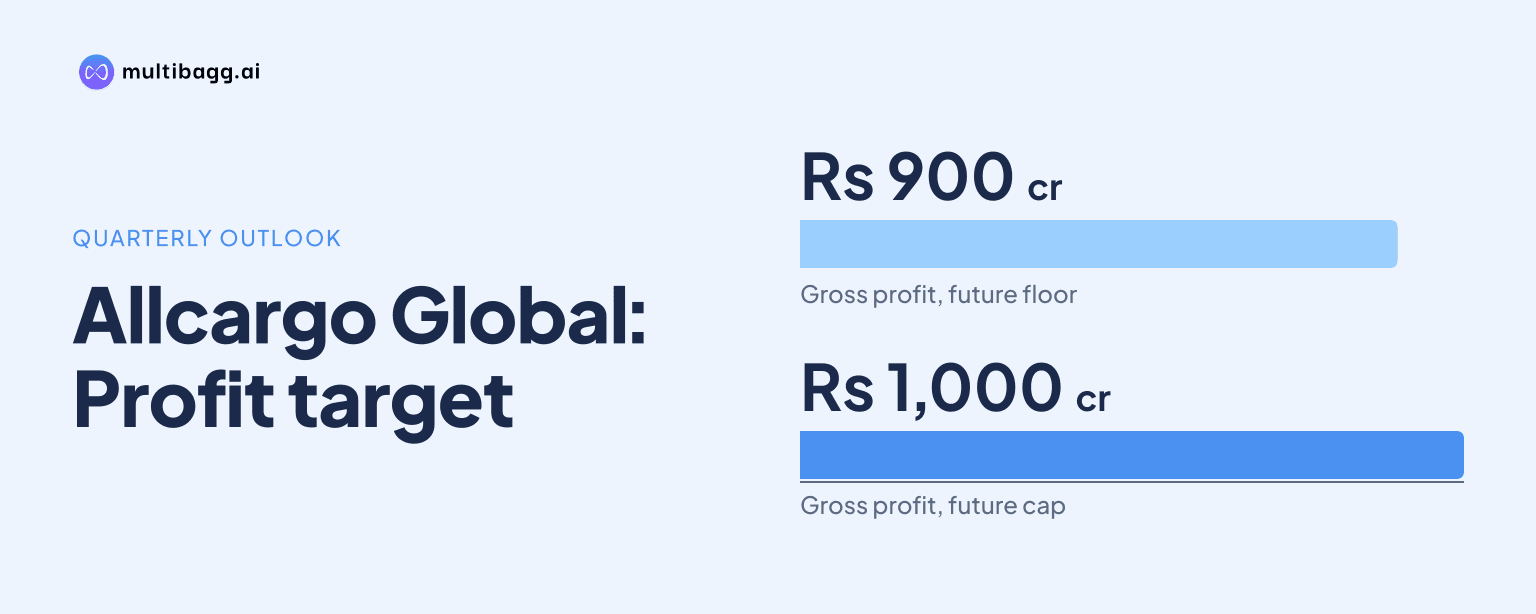
During the earnings call, Allcargo Global Limited said it aims to reach Rs 900 crore to Rs 1,000 crore in quarterly gross profit within the next couple of years, from about Rs 837 crore in the quarter cited by management. The plan relies on keeping staff and administrative costs broadly flat through technology, automation and consolidation.
Know Allcargo Global inside out
Results, valuation, peers and who's buying, in one view.
What quarterly gross-profit target has Allcargo set?
Allcargo is targeting Rs 900 crore to Rs 1,000 crore of gross profit per quarter over the next couple of years, compared with about Rs 837 crore in the quarter management cited. Management confirmed that Rs 900 crore a quarter would equal Rs 3,600 crore over a year, though it did not issue a formal annual gross-profit forecast.
Management said gross profit is the more relevant operating measure than reported revenue in its freight business. Freight rates can move revenue up or down even when volumes and operating execution are unchanged, whereas Allcargo manages its business around volume and yield. In this business, management defines yield as gross profit per unit of volume rather than revenue per unit.
The target does not amount to a forecast of freight revenue, because freight revenue is affected by prevailing ocean and air freight rates. Management instead described the objective as expanding the gross-profit pool while preserving the cost advantage created by its operational initiatives.
How does Allcargo intend to hold costs flat?
Allcargo’s strategy is to retain a flat staff and administrative cost base in a blended basket of US dollar, euro and rupee currencies while growing gross profit. Management said automation, technology and consolidation should offset upward pressures from inflationary salary increases, incentives and the costs of business expansion over the next two to three years.
Management said staff and administrative costs were almost 8% lower year on year in dollar terms. It said reported rupee costs can nevertheless change with currency ratios, especially because European payrolls are a significant component and are paid in euros. Management added that currency effects affecting costs should also be reflected in gross profit.
An analyst referred to annual employee costs of about Rs 2,000 crore and other operating expenses of about Rs 700 crore, a combined Rs 2,700 crore. Management did not validate these figures as its formal cost base, but said the broad strategy was to maintain relevant staff and administrative costs rather than pursue ongoing absolute reductions.
Allcargo distinguished these relatively predictable expenses from operating costs tied to freight rates. Management said freight-related operating costs move in line with operating revenue and the freight environment, while staff and administrative expenses are the cost lines it intends to keep flat in blended-currency terms.
Got a follow-up? Ask IRIS
What supports the gross-profit plan and what could disrupt it?
Management attributed about 70% of recent gains to business-transformation initiatives and an estimated 20% to 30% to industry tailwinds. It said Allcargo may be two to three quarters ahead of its guidance curve because of those tailwinds, meaning performance could vary if freight-market support fades before internal initiatives fully absorb the change.
Freight rates had risen across markets amid supply-chain disruption, according to management, with Middle East lanes more affected. Rates on major transpacific and transatlantic routes had softened somewhat, and management expected rates to keep softening and normalising over the next four to five months. It said a reduction in freight rates could create movement in results over the next one or two quarters because industry-related gains cannot be recouped in a single quarter.
Volume performance also informs the emphasis on profitability. Management said volumes declined about 5% to 5.5% year on year, largely because of market weakness in West Asia, where Allcargo has greater exposure to full-container-load, or FCL, and air freight. Sequentially, it reported growth of about 1.5% in FCL, 3% in less-than-container-load, or LCL, and more than 15% in air freight.
In a normal environment, management said it could target 6% to 7% volume growth in both LCL and FCL. It also said it would cut back on boxes and trade lanes that are less profitable, accepting a more conservative blended volume-growth rate if that produces a greater effect on profitability.
What would the target mean for EBITDA and cash generation?
Management said Rs 900 crore of quarterly gross profit with a flat cost base could lead to higher sustained earnings before interest, tax, depreciation and amortisation, or EBITDA. It did not provide a new EBITDA target during the call, and reiterated its earlier guidance of Rs 500 crore of consistent annualised EBITDA for calendar 2027.
Management said the business is asset-light, with warehouses and container freight stations leased or operated through third parties, and has hardly any capital expenditure. Depreciation mainly relates to goodwill amortisation from prior acquisitions; because no new acquisitions are foreseen in the near future, management expects depreciation to decline.
It also expects net interest-bearing debt to decline as the business generates cash. Management said effective tax rates should reduce as more offices turn profitable, limiting the mismatch in which taxes are paid in profitable geographies while deferred tax credits arise in loss-making locations. It expects cash-tax payments to be lower than reported tax expense as prior losses are used.
Management said an accounting cleanup linked to closed Middle East businesses should be completed by December. It also plans to review one or two investments that did not work as expected in the December quarter, and said bad debts should normalise from January, while declining to quantify a fiscal-year comparison.
Conclusion
Allcargo’s stated path to higher profitability is to lift quarterly gross profit from about Rs 837 crore to Rs 900 crore to Rs 1,000 crore while maintaining staff and administrative costs in blended-currency terms. Management’s case rests on technology, automation and consolidation offsetting inflation and growth costs, alongside a selective focus on more profitable volumes and trade lanes.
The next test is whether internal initiatives can sustain results as management expects freight rates to soften over the next four to five months and the January-to-March period brings usual seasonal weakness. Investors will also watch the December cleanup of bad debts and investment review, while management maintains its Rs 500 crore consistent annualised EBITDA guidance for calendar 2027.