










Allcargo Global returns to profit as Q2 EBITDA reaches Rs 122 crore
Key highlights
- Allcargo Global reported Q2 FY27 PAT of Rs 32 crore, compared with a Rs 28 crore loss in Q1 FY27.
- Q2 FY27 EBITDA was Rs 122 crore, versus Rs 37 crore in Q2 FY26 and Rs 33 crore in Q1 FY27.
- Q2 FY27 revenue rose 27% year on year to Rs 4,320 crore, while gross profit increased 21% to Rs 837 crore.
- Net debt was Rs 587 crore on September 30, 2026, compared with Rs 571 crore at June 2026-end.
powered by IRIS
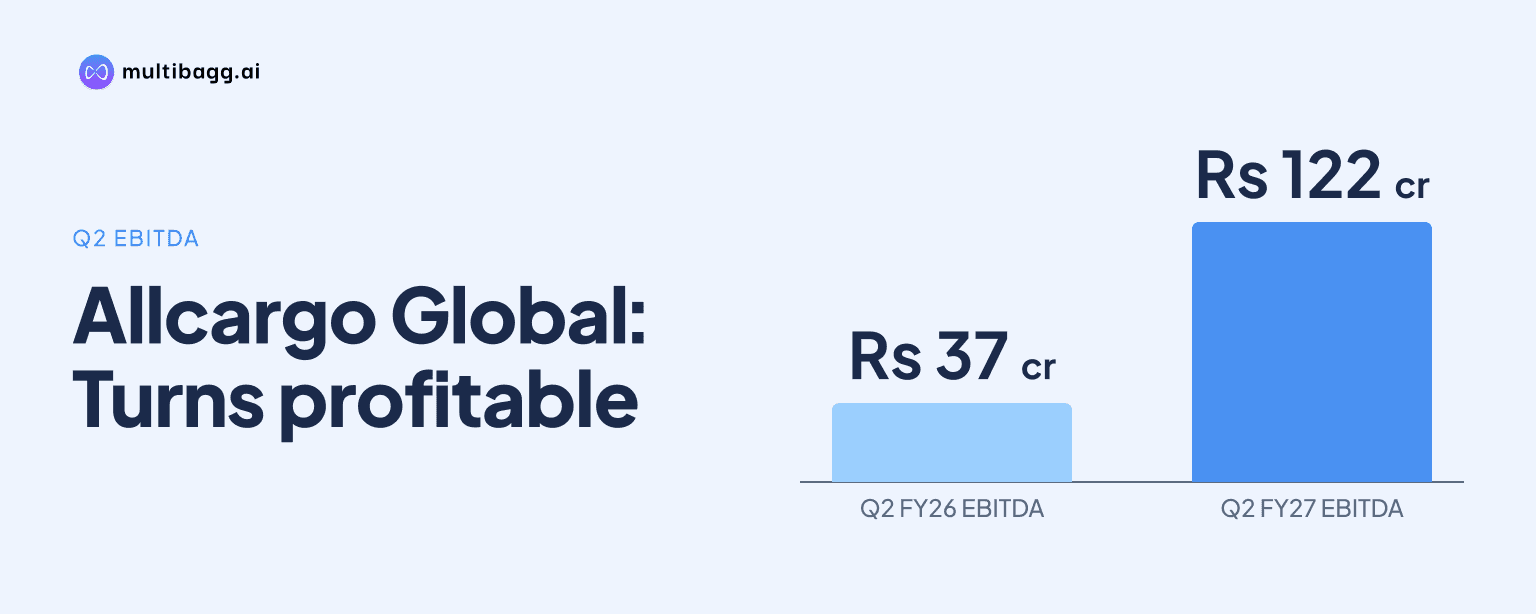
Allcargo Global Limited returned to profit in Q2 FY27, reporting profit after tax of Rs 32 crore as EBITDA reached Rs 122 crore. The result followed a Rs 28 crore loss in Q1 FY27, as gross profit rose to Rs 837 crore and staff and administrative costs remained largely flat, lifting EBITDA margin to 2.8%.
Know Allcargo Global inside out
Results, valuation, peers and who's buying, in one view.
How did Allcargo Global return to quarterly profit?
Allcargo Global returned to quarterly profit because gross profit increased while staff and administrative costs stayed largely flat in Q2 FY27. Consolidated revenue was Rs 4,320 crore, up 27% year on year and 23% sequentially, while gross profit reached Rs 837 crore, up 21% from Q2 FY26 and 14% from Q1 FY27. Management said elevated freight rates, capacity constraints and peak-season volumes supported the improvement.
EBITDA increased to Rs 122 crore in Q2 FY27 from Rs 37 crore in Q2 FY26 and Rs 33 crore in Q1 FY27. Earnings before interest and tax, or EBIT, turned to a Rs 71 crore profit from losses of Rs 49 crore a year earlier and Rs 23 crore in the preceding quarter. Profit after tax, or PAT, was Rs 32 crore, compared with losses of Rs 30 crore in Q2 FY26 and Rs 28 crore in Q1 FY27.
Allcargo Global's EBITDA margin rose to 2.8% in Q2 FY27 from 1.1% in Q2 FY26 and 0.9% in Q1 FY27. Management attributed the conversion of gross profit into earnings to disciplined trade-lane monitoring and cost control. The 1.9-percentage-point sequential margin increase accompanied the Rs 89 crore increase in EBITDA from Q1 FY27.
What drove Allcargo Global's gross-profit improvement?
Allcargo Global said higher freight rates and internal operating measures lifted Q2 FY27 gross profit to Rs 837 crore. Management cited better trade-lane management, higher-yield products, exits from loss-making boxes, operational efficiency and better contract negotiations. It said supply-chain disruption, port congestion and inventory constraints raised freight rates enough to more than offset lower volumes.
Staff and administrative costs were largely flat both year on year and sequentially in Q2 FY27, despite revenue reaching Rs 4,320 crore. Management said many operating payments are denominated in dollars, euros and other currencies, which appreciated against the rupee, but automation, outsourcing and other initiatives reduced the local-currency cost of doing business.
Management estimated that industry tailwinds accounted for 20% to 30% of recent gains and business initiatives for about 70%. This was management's assessment, not a financial allocation. It also said freight rates had started to decline gradually as festive demand slowed, and could normalize over the next four to five months, subject to supply-chain and geopolitical developments.
Did Allcargo Global's freight volumes grow in Q2 FY27?
Allcargo Global's main freight volumes rose sequentially but declined year on year in Q2 FY27. Less-than-container-load, or LCL, volume fell 5.7% year on year, full-container-load, or FCL, volume declined 12%, and air volume fell 10%. From Q1 FY27, LCL volume increased 2.9%, FCL volume rose 1.3%, and air volume grew 16%.
Management attributed much of the year-on-year decline to market conditions in West Asia, where FCL and air have a higher contribution. It told an analyst that Allcargo Global had maintained or gained market share on both year-on-year and quarter-on-quarter measures. The smaller LCL decline compared with FCL and air reflected the stated mix of products and affected markets.
For a normal market environment, management expects industry growth of about 3% to 4% in FCL and 5% to 6% in LCL. It said Allcargo Global is targeting volume growth of about 6% to 7% in both LCL and FCL, while retaining its focus on withdrawing from lower-profit boxes and trade lanes. These are management targets rather than reported FY27 outcomes.
Got a follow-up? Ask IRIS
How did Allcargo Global perform in H1 FY27 and manage debt?
Allcargo Global reported H1 FY27 EBITDA of Rs 155 crore, compared with Rs 6 crore in H1 FY26, while PAT turned to a Rs 4 crore profit from a Rs 117 crore loss. First-half revenue rose 17% year on year to Rs 7,842 crore and gross profit increased 11% to Rs 1,570 crore. The H1 PAT was lower than Q2 PAT because Q1 FY27 recorded a Rs 28 crore loss.
Net debt was Rs 587 crore on September 30, 2026, compared with Rs 571 crore at the end of June 2026. Management attributed the Rs 16 crore increase to higher working-capital needs caused by elevated freight rates and increased activity. Cash and cash equivalents increased to Rs 412 crore from Rs 374 crore at the beginning of the year.
Days sales outstanding, or DSO, stood at about 46 to 47 days, according to the chief financial officer. He said receivables had risen with volumes and the freight-rate environment, while supplier payments were also deferred within working capital. Management expects the current bad-debt provision, which it described as a cleanup of historical items, to be finalized by the December-quarter end and return to historical levels.
What is Allcargo Global planning to sustain profitability?
Allcargo Global plans to keep its cost base broadly flat while expanding gross profit through automation, centralisation and trade-lane management. Management said automation-related savings are intended to absorb inflationary cost increments over time. It cited the ECU 360 platform, a common data lake, the in-house Topaz operating system, and common finance, payroll and human-resources systems as tools for consolidation and outsourcing.
Management said the business has no significant capital expenditure requirement, while much of its depreciation relates to goodwill amortisation and other non-cash items. It also expects past losses in countries that have returned to profitability to be used against tax credits, potentially reducing cash tax payments relative to reported accounting tax expense. These are management expectations and no tax amount was disclosed.
Allcargo Global is considering a change to its financial-year calendar. Management said it may complete the required approvals for a shorter year ending December 2026, followed by January-to-December reporting that matches the global operating calendar. No approval or implementation date had been confirmed on the November 17, 2026 earnings call.
Conclusion
Allcargo Global's Q2 FY27 turnaround combined a Rs 32 crore PAT with Rs 122 crore of EBITDA, compared with a Rs 28 crore loss and Rs 33 crore of EBITDA in Q1 FY27. Revenue of Rs 4,320 crore, gross profit of Rs 837 crore and largely flat staff and administrative costs raised EBITDA margin to 2.8% from 0.9% sequentially.
The next key issue is whether business initiatives can offset freight-rate normalization over the next four to five months, as management expects rates to soften after the peak season. Investors can also watch the December-quarter resolution of bad-debt provisions, the 46-to-47-day DSO level, net debt after its Rs 587 crore September 30, 2026 balance, and the proposed December 2026 year-end transition.