










Allied Blenders and Distillers Limited targets 450-bps EBITDA gains
Key highlights
- ABD expects about 300 basis points of EBITDA-margin benefit by FY28 and another 150 basis points in FY29.
- ABD's backward-integration programme totals approximately Rs 1,600 crore, with 25% spent through FY26.
- The Moradabad bottling plant began operations in October 2026 with annual capacity of 6 million cases and expected savings of around Rs 27 per case.
- Net debt rose to Rs 1,273 crore at September 2026 from Rs 981 crore at March 2026 after Rs 351 crore of H1 FY27 capex.
powered by IRIS
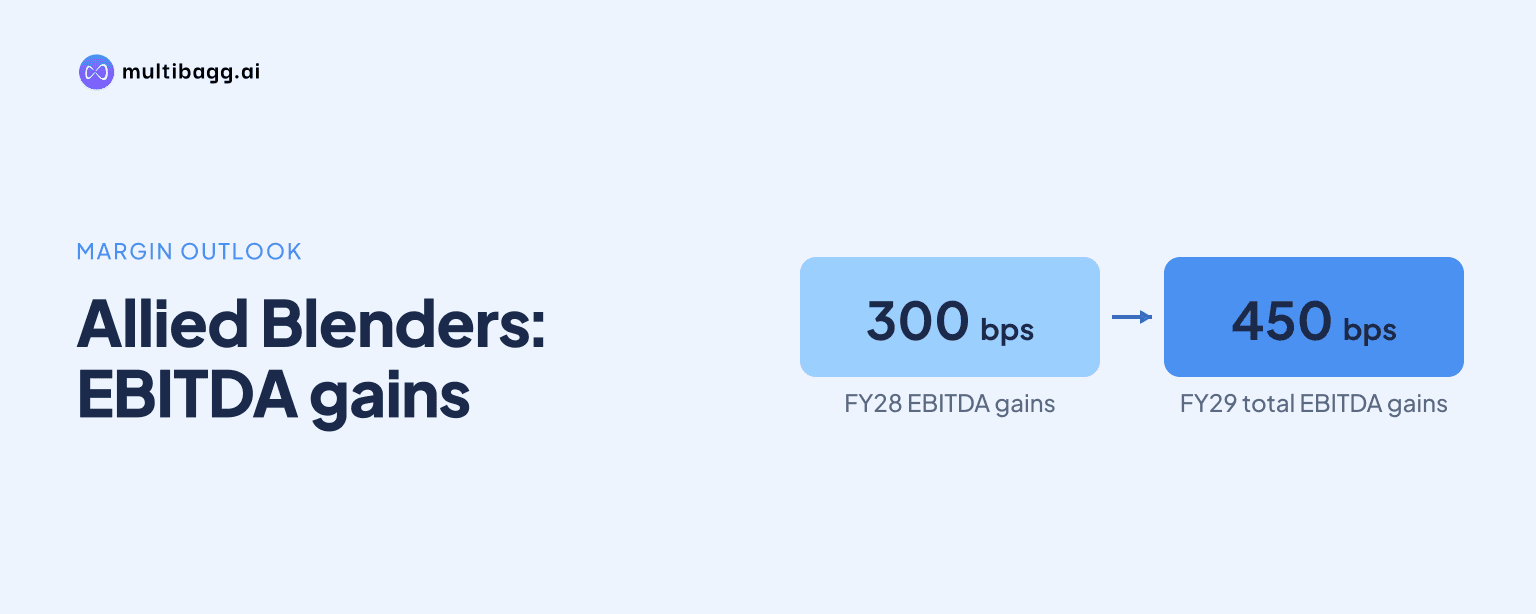
Allied Blenders and Distillers Limited expects its approximately Rs 1,600 crore backward-integration programme to add about 450 basis points to EBITDA margin by FY29, comprising roughly 300 basis points by FY28 and a further 150 basis points in FY29. The plan centres on captive distilling, malt, polyethylene terephthalate bottles and bottling capacity.
Know Allied Blenders & Distillers inside out
Results, valuation, peers and who's buying, in one view.
How much EBITDA-margin expansion is ABD targeting by FY29?
ABD is targeting approximately 450 basis points of EBITDA-margin benefit by FY29, with about 300 basis points expected by FY28 and a further 150 basis points in FY29. A basis point is one-hundredth of a percentage point, and management linked the projected benefit to projects in Telangana, Maharashtra, Uttar Pradesh and Andhra Pradesh.
The stated margin levers are higher in-house production of extra-neutral alcohol, or ENA, malt, polyethylene terephthalate, or PET, bottles and bottled products. ABD said these investments are intended to improve supply security and reduce structural costs, rather than change its expectation that FY27 EBITDA margin will remain broadly in line with FY26.
Reported Q2 FY27 EBITDA margin was 12.4%, down 66 basis points year on year, although gross margin rose 90 basis points to 45.3%. Management attributed the EBITDA-margin decline to continued investment in core brands and the new super-premium to luxury portfolio, while global supply-chain disruption had an estimated Rs 29 crore impact during the quarter.
On management's like-to-like calculation excluding that Rs 29 crore disruption impact, Q2 FY27 EBITDA would have been Rs 172 crore, up 32.3% year on year, and EBITDA margin would have been 14.9%, up 186 basis points. The comparison separates the projected integration gains from the supply-chain and brand-investment costs affecting reported quarterly profitability.
What does ABD's Rs 1,600 crore integration programme include?
ABD's approximately Rs 1,600 crore programme covers distilling, captive malt, PET-bottle manufacturing and bottling projects, with the balance scheduled over the next three years. Management said 25% had been spent through FY26 and about Rs 300 crore had been spent in the current year when it discussed the programme in the Q2 FY27 call.
In Telangana, ABD commissioned a captive malt distillery at Rangapur in October 2026 with investment of about Rs 75 crore and annual capacity of about 4 million bulk litres. The facility is part of an existing complex containing an ENA distillery, an Indian-made foreign liquor bottling unit and a PET-bottle plant, and is intended to reduce external malt sourcing for the Prestige & Above portfolio.
The Rangapur PET-bottle plant, commissioned in FY26, is already EBITDA accretive, according to management. In Maharashtra, the Aurangabad bottling project at subsidiary Minakshi Agro Industries was expected to begin operating within the next couple of months, while an ENA-distillery expansion was under construction for planned commissioning in H1 FY28 after receiving environmental clearance.
Management said it does not currently expect capex beyond the Rs 1,600 crore programme other than routine maintenance spending. With 40 manufacturing plants, ABD estimated annual maintenance capex of Rs 75 crore to Rs 100 crore, separate from the multi-year backward-integration outlay.
Got a follow-up? Ask IRIS
Why is Uttar Pradesh important to ABD's cost plan?
Uttar Pradesh is important because ABD has announced investment of more than Rs 600 crore there, covering operating bottling capacity and further distillery and bottling expansion. In January 2026, ABD acquired non-operating assets for about Rs 70 crore and began a Moradabad bottling-unit upgrade costing about Rs 40 crore.
ABD began commercial operations at its Moradabad bottling facility in October 2026 with initial capacity of 6 million cases a year. Management expects greater in-house bottling to improve service efficiency and save around Rs 27 per case in franchise fees, providing a direct cost mechanism within the broader margin plan.
In August 2026, ABD announced a 66 million-bulk-litre-a-year dual-mode distillery in Uttar Pradesh with investment of about Rs 293.5 crore. It also outlined about Rs 202 crore for a new automated bottling unit, expansion from 6 million to 13 million cases of annual bottling capacity, refurbishment of a 13 million-bulk-litre molasses distillery and additional land.
These projects follow total Q2 FY27 volume of 10 million cases, up 11.1% from 9 million cases in Q2 FY26. The announced capacity additions are intended to support that sales base, but the 450-basis-point margin outcome remains management's medium-term expectation rather than a reported result.
How is ABD funding capex and managing leverage?
ABD is funding the programme through internal accruals and debt, and management expects leverage to return within its framework by the end of the financial year. Operating cash flow rose to Rs 269 crore in H1 FY27 from Rs 147 crore in H1 FY26, while Rs 351 crore of capex spending during the half year was the predominant cause of higher net debt.
Net debt stood at Rs 1,273 crore at September 2026, compared with Rs 981 crore at March 2026, an increase of Rs 292 crore. Net debt to EBITDA was 2.2 times and net debt to equity was 0.8 times, above ABD's stated ceilings of below 2 times and 0.75 times respectively because of milestone-based capex payments.
India Ratings & Research upgraded ABD by two notches to IND AA- with a stable outlook during the period discussed. Management said it plans to maintain leverage within its defined framework throughout the investment cycle while completing the projects using internal accruals and debt.
Conclusion
ABD's 450-basis-point FY29 margin objective depends on converting approximately Rs 1,600 crore of investment into lower sourcing, packaging and franchise-bottling costs. The reported Q2 FY27 EBITDA margin of 12.4%, versus 13% a year earlier, shows that brand investment and the Rs 29 crore supply-chain disruption impact are still affecting near-term profitability.
The next disclosed milestones are the Maharashtra bottling project expected within the next couple of months, the Maharashtra ENA expansion targeted for H1 FY28 and progress on the Uttar Pradesh distillery and bottling expansion announced in August 2026. ABD also expects net debt to EBITDA and net debt to equity to return within its below-2-times and 0.75-times frameworks, respectively, on a full-year basis.