










Allied Digital keeps staffing as AI deflects 32% of L1 tickets
Key highlights
- Allied Digital has not announced a service-desk staffing reduction despite 32% L1-ticket deflection cited on the call.
- Management is operating AI and human teams in parallel before deciding whether to reduce direct people costs.
- Allied Digital did not disclose a rupee AI saving, a cost-to-serve confirmation or a timing target for personnel-cost reductions.
- Management is targeting 20% CAGR through partner-led, direct-enterprise and government business.
powered by IRIS
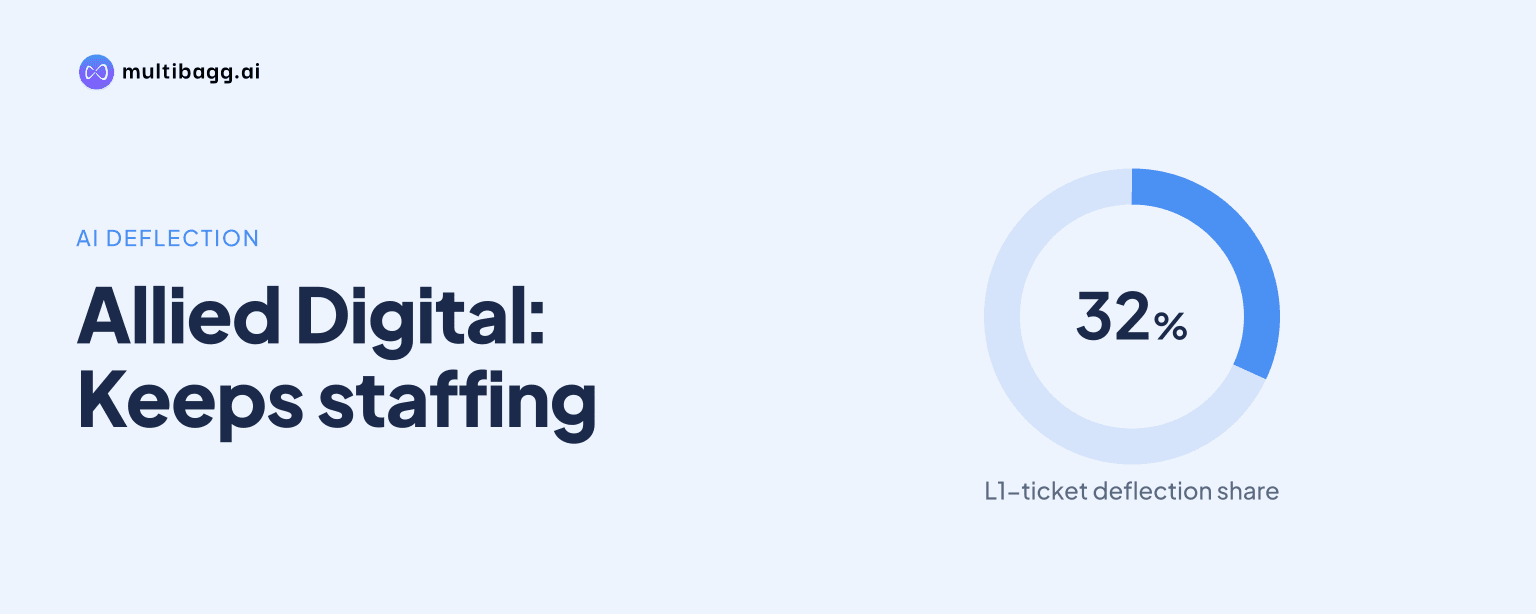
Allied Digital Services Limited has not reduced service-desk staffing after 32% Level 1, or L1, ticket deflection cited on its earnings call because it is operating AI alongside human teams before deciding whether to replace work with AI models and reduce direct people costs. Management gave no date or savings target for that decision.
Know Allied Digital Services inside out
Results, valuation, peers and who's buying, in one view.
Has Allied Digital reduced staffing after 32% L1 ticket deflection?
No, Allied Digital said it is maintaining a parallel run of AI and human service delivery before taking an eventual decision on reducing the direct cost of people. Management agreed that L1-ticket deflection is occurring, but did not announce layoffs, a headcount reduction, a workforce target or a timetable for changing the service-desk cost base.
The parallel-run approach separates an operational metric from a realised payroll outcome. The 32% L1-ticket deflection referred to by the analyst shows that first-line demand is being diverted, but Allied Digital said it must first establish the AI model alongside its existing people before replacing work with AI. Management described the company as being on the right path without quantifying the direct-cost saving already achieved.
How is Allied Digital using AI in managed services?
Allied Digital is using AI to move basic support activity towards Level 0 handling, where tickets can be addressed without deploying people. Nitin Shah said this trend reduces the number of tickets and can lower people costs, while the current 32% L1 deflection indicates that automated handling has already become part of the service-desk workflow.
Management set out three mechanisms for its managed-services strategy: raising automation where possible, using AI for preventive or anticipative problem solving rather than only correction, and developing an agentic ecosystem for better AI-agent orchestration. Allied Digital also cited its Digital Desk and UM automations as existing platforms from which it plans to provide more cost-effective and reliable managed services.
The approach is not uniform across all customers. Ramanan R said deployments depend on the nature of incoming tickets, the technologies already installed in an organisation and sensor technologies integrated into devices. Allied Digital is therefore applying a common automation framework to multiple scenarios after analysing each customer's ticket trends and technology environment.
When will Allied Digital's AI savings exceed client discounts?
Allied Digital did not say when AI savings would exceed any revenue impact from client discount demands. The analyst framed the question around 32% L1-ticket deflection and a 21% cost-to-serve reduction, but management did not confirm that cost-to-serve figure, disclose a margin bridge or give a period in which AI savings would outweigh client pricing effects.
That omission limits what can be inferred from the ticket-deflection metric. Management said Level 0 handling can reduce the need to deploy people, yet Allied Digital has not disclosed a rupee saving, a reported personnel-cost reduction or the proportion of managed-services work now performed by the AI model. The operational benefit may precede an accounting benefit while the parallel run continues.
Management instead described a direction of travel towards more cost-effective service delivery. That statement rests on the Digital Desk, UM automations, preventive problem solving and agentic AI development, rather than on a financial target. Allied Digital also did not disclose the discounts, if any, offered to customers in return for AI-enabled managed services.
Got a follow-up? Ask IRIS
What is Allied Digital doing to develop lower-cost services?
Allied Digital has assigned former chief executive Paresh Shah to lead innovation work that management said can reduce costs in an AI environment. Nitin Shah said Paresh Shah is handling a team focused only on innovation, although Allied Digital did not disclose an innovation budget, planned launch date, expected saving or named AI product from that team.
The innovation work sits alongside the three managed-services mechanisms described on the call. Automation can remove repetitive ticket activity, while preventive or anticipative AI seeks to address problems before corrective tickets arise. Allied Digital did not quantify how much of the 32% L1-ticket deflection is attributable to the Digital Desk, UM automations, preventive tools or any other process.
The company is also considering acquisitions in AI or cybersecurity, according to Nehal Shah. Management said it continually reviews companies but has not reached a stage where it could identify shortlisted targets. The stated rationale for either type of acquisition is support for delivery and sales, not a disclosed service-desk staffing plan.
How does AI fit Allied Digital's broader growth plan?
Allied Digital is positioning automation as a managed-services efficiency tool while targeting 20% compound annual growth rate, or CAGR, year over year. Management said it has not set a target ratio between direct enterprise sales and partner-led sales over the next 24 months, preferring to pursue contracts based on ticket size and customer stability.
The commercial plan has three routes: partner-led work for larger customers, direct sales to midsize and small customers that can expand over time, and government business in safe cities, smart cities, metros and airports. Management said one or two of these three buckets succeeding should help produce the 20% CAGR ambition, which it presented as strategy rather than a specified revenue-mix target.
Government business illustrates why management is balancing growth routes. An analyst said government revenue fell from 23% to 13% in Q2, while management said safe-city, smart-city and implementation projects typically involve six to eight months of implementation followed by three to five years of maintenance. Allied Digital said direct enterprise relationships can provide longer continuity and cross-selling without always requiring a request-for-proposal process.
What could delay the financial benefit from Allied Digital's AI?
Allied Digital's decision to continue AI and human operations in parallel is the clearest constraint on immediate personnel-cost savings. Management's stated priorities for the remainder of FY27 are cost discipline, growth investment and progressively strengthening profitability, but it did not identify a quarter in which the 32% L1-ticket deflection would lead to lower direct people costs.
Commercial conditions may also affect the timing of any margin effect. Management said product pricing became more stable after mid-October after earlier price increases made some government projects difficult to pursue. For selected projects, Allied Digital said original equipment manufacturer pricing had been blocked, but Nitin Shah described product markets as volatile and highly unpredictable, requiring cautious contract selection.
Conclusion
Allied Digital has demonstrated AI adoption through the 32% L1-ticket deflection cited during the call, but it has not yet converted that measure into a disclosed staffing reduction or quantified direct-cost saving. Its current model retains human operations while testing the Digital Desk, UM automations, preventive AI and agentic orchestration across customer-specific managed-services environments.
The next issue to watch is whether management ends the parallel run and reports a measurable reduction in direct people costs. Investors can also monitor progress against management's 20% CAGR ambition, its three sales routes and its stated FY27 priorities of cost discipline, growth investment and progressively stronger profitability.