










Allied Digital resumes government bids as OEM prices stabilise
Key highlights
- Allied Digital said OEM prices stabilised after mid-October, enabling renewed bids for large government projects.
- Management said a single large government order can reach Rs 700 crore.
- Allied Digital reported Q2 FY27 revenue of Rs 265 crore, up 14% year on year.
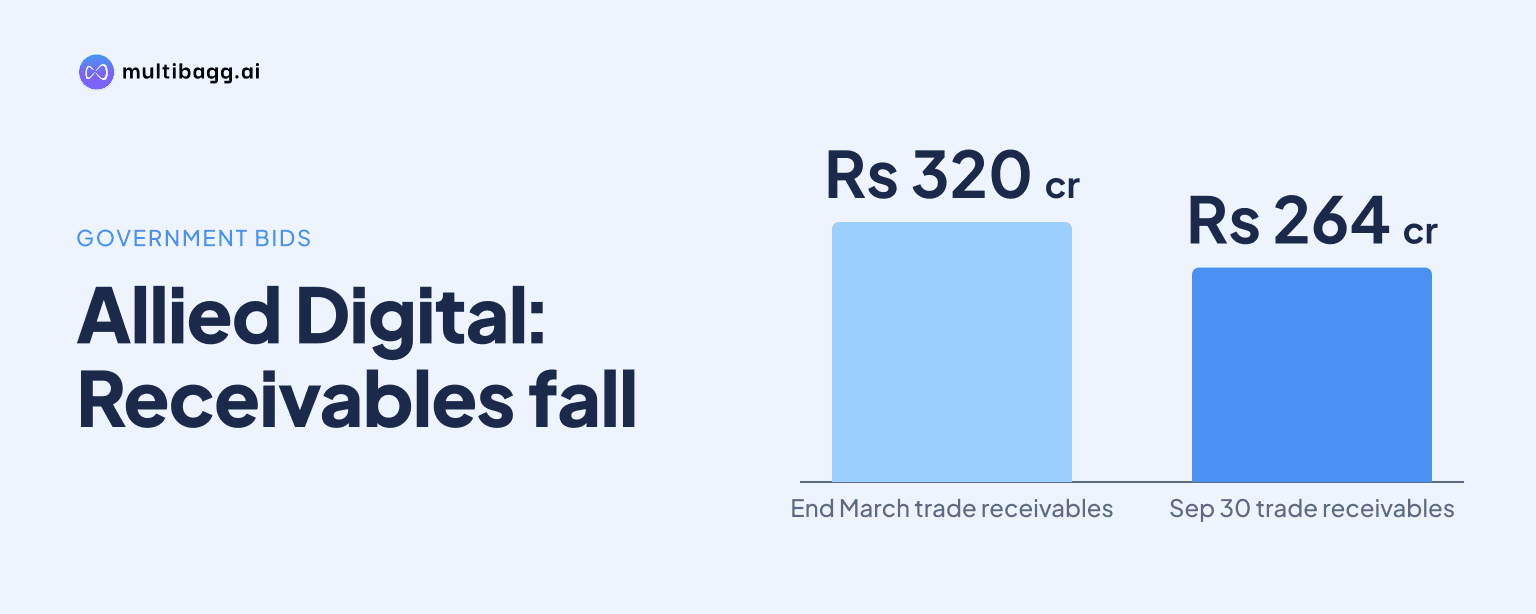
- Trade receivables fell to Rs 264 crore on 30 September 2026 from Rs 320 crore at the end of March 2026.
powered by IRIS
Allied Digital has resumed bidding for large government contracts after original equipment manufacturer prices stabilised from mid-October, management said, with potential single-ticket public-sector orders ranging up to Rs 700 crore. The company is submitting a bid for the Noida Safe City request for proposal on 6 November after previously limiting bids because higher hardware costs impaired project viability.
Know Allied Digital Services inside out
Results, valuation, peers and who's buying, in one view.
Why is Allied Digital bidding for government tenders again?
Allied Digital is bidding again because management said original equipment manufacturer, or OEM, pricing had become more stable after the middle of October. The company had earlier slowed its government-order pursuit because increases in equipment and hardware costs made certain projects commercially unviable. Management said costs remained elevated in its Q2 FY27 commentary, but OEMs were now supporting the company in pursuing larger projects.
The immediate opportunity is the Noida Safe City request for proposal, or RFP, with bid submission scheduled for 6 November. Management said Allied Digital was proceeding with that RFP but did not announce an award or disclose its value. It also said the company had submitted bids for other projects during the preceding days and weeks, with results potentially available within two to four weeks.
Management said more government case studies were advancing from initial requirements to the RFP stage, when Allied Digital becomes active in bidding. Its cited areas of experience include safe cities, smart cities, surveillance, command-and-control systems and integrated digital infrastructure. The company also secured a Maharashtra Industrial Development Corporation, or MIDC, engagement for internet leased-line connectivity implementation, maintenance and support across Maharashtra, its first government-agency order win after a three-quarter gap.
How did government-project softness affect Allied Digital's Q2 FY27 mix?
Government-project softness was offset by services and international growth in Q2 FY27, according to management. Allied Digital reported revenue of Rs 265 crore, up 14% year on year, while first-half FY27 revenue rose 16% to Rs 526 crore. Services revenue, which management described as predictable multi-year contracts, grew 31% year on year in Q2, and international revenue increased 36%.
An analyst said government revenue represented 13% of Q2 revenue, down from 23%, although management did not independently restate those percentages in its response. Management instead said it was seeking a balance between government and enterprise business. It described government projects as providing scale, while enterprise customers may have smaller ticket sizes but longer relationships, direct cross-selling opportunities and less exposure to elections or changes in government decision-makers.
Earnings before interest, tax, depreciation and amortisation, or EBITDA, rose sequentially in Q2 FY27 but remained below the prior-year quarter. Management said the 10% margin reflected investment in strengthening the sales organisation over the past year.
The comparison shows EBITDA increased by Rs 2 crore from Q1 FY27 to Rs 27 crore in Q2 FY27, but was Rs 1 crore below Q2 FY26. Profit after tax increased by Rs 1 crore sequentially to Rs 13 crore. For H1 FY27, management reported profit before tax of Rs 34 crore and profit after tax of Rs 25 crore.
How is Allied Digital protecting margins from hardware-price volatility?
Allied Digital is using OEM price blocks and commercial thresholds to manage product-cost risk. Management said pricing for the MIDC internet leased-line contract and other projects had been blocked with OEMs, giving the company visibility on product pricing and expected margins. It also said the company had declined contracts that did not meet its profitability and commercial-return criteria.
Management nevertheless described product pricing as volatile and highly unpredictable, even after the mid-October stabilisation. Allied Digital said it assesses accounts and customers cautiously rather than pursuing every available opportunity. OEMs were encouraging the company to bid for larger projects, but management gave no target for government tender wins or a value for its active tender pipeline.
Project design also combines product delivery with longer service work. Management said safe-city, smart-city and implementation contracts generally involve six to eight months of implementation, followed by about three to five years of maintenance. This structure gives Allied Digital an initial solution-delivery phase and subsequent maintenance activity rather than only a hardware sale.
Got a follow-up? Ask IRIS
What are the payment and working-capital risks in government work?
Allied Digital said government payments can be delayed at times, but management reported no large amounts stuck or unpaid. It said payments had been received overall, giving the company confidence to pursue such projects. The call did not disclose government receivables separately, so it does not establish a collection comparison between public-sector and enterprise contracts.
At the company level, trade receivables fell to Rs 264 crore on 30 September 2026 from Rs 320 crore at the end of March 2026. Debtor days improved to about 84 from 96 at the end of FY26, which management attributed to milestone billing and collection efficiency. The reduction occurred while management said the company was executing larger contracts and expanding operations.
Cash and cash equivalents stood at Rs 185 crore on 30 September 2026, compared with Rs 162 crore a year earlier. Gross borrowings increased to Rs 167 crore from Rs 98 crore over the same period, which management attributed to funding requirements from the larger scale of business. Management said Allied Digital remained in a positive net-cash position.
What does renewed bidding mean for Allied Digital's growth plan?
Allied Digital views government RFPs as one of three routes towards management's stated 20% compound annual growth rate, or CAGR, ambition. Management identified large RFPs in safe cities, smart cities, metros and airports as one route, partner-led work for scale as a second, and direct sales to midsize and small customers as a third. It said success in one or two of those buckets could support the intended revenue increase.
Management did not provide a target ratio between direct enterprise sales and partner-led sales for the next 24 months. It said partner-led and consortium projects provide scale and shared execution risk, while direct customer relationships can expand service opportunities and share of customer spending. Allied Digital reported more than Rs 74 crore of new orders and renewals in Q2 FY27, including the MIDC contract and a United States healthcare-provider engagement for a 24/7 artificial-intelligence-powered service desk.
Management said FY27 was a period of consolidation and institutional strengthening, including investment in sales execution, direct relationships, delivery capabilities and artificial-intelligence integration. After first-half FY27 revenue reached Rs 526 crore, management said the company was positioned to sustain its annual Rs 1,000 crore revenue milestone. That position remains subject to contract selection, hardware-price conditions and conversion of the government RFP pipeline.
Conclusion
Allied Digital's return to government bidding reflects improved OEM pricing conditions, not an indication that hardware-cost risk has ended. The company is combining price blocks, project screening and a six-to-eight-month implementation followed by three to five years of maintenance with services, international and enterprise growth. Q2 FY27 revenue of Rs 265 crore and receivables of Rs 264 crore provide the financial context for that approach.
The next disclosed events are the 6 November Noida Safe City bid submission and possible results from other recently submitted tenders within two to four weeks. Management's FY27 plan also calls for cost discipline, growth investment and progressively stronger profitability, while its Rs 1,000 crore annual revenue milestone depends on execution across government RFPs, direct customer engagements and partner-led contracts.