










Allied Digital Services Limited Q2 Revenue Rises 14% to ₹265 Crore
Key highlights
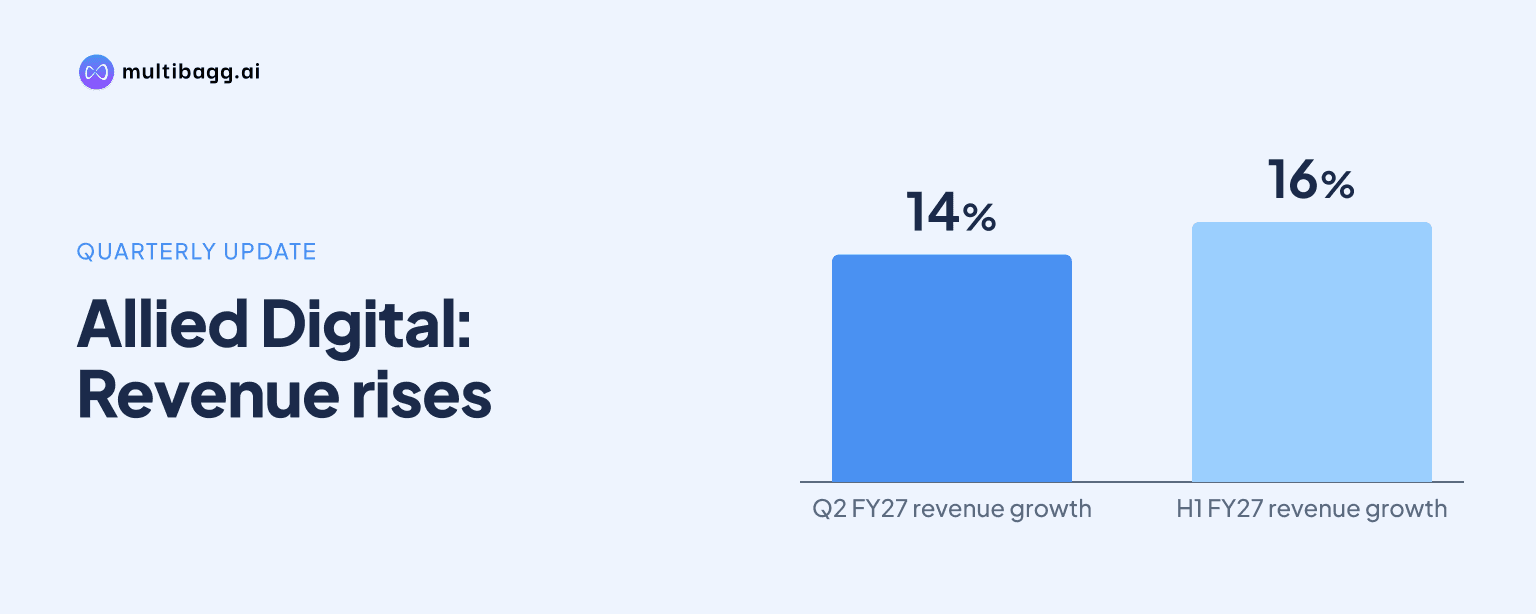
- Allied Digital Services reported Q2 FY27 revenue of ₹265.32 crore, up 13.53% year on year.
- Reported Q2 FY27 net profit declined 19.62% to ₹10.98 crore from ₹13.66 crore.
- Q2 FY27 EPS declined to ₹2.22 from ₹2.58 in Q2 FY26.
- H1 FY27 revenue reached ₹526 crore, up 16%, while profit after tax was ₹25 crore, down 16%.
powered by IRIS
Allied Digital Services Limited reported consolidated Q2 FY27 revenue of ₹265.32 crore, up 13.53% year on year, while reported net profit fell 19.62% to ₹10.98 crore and earnings per share declined to ₹2.22 from ₹2.58. The results show continued topline growth alongside weaker profitability during the July-September 2026 quarter.
Know Allied Digital Services inside out
Results, valuation, peers and who's buying, in one view.
What did Allied Digital Services report for Q2 FY27?
Allied Digital Services reported revenue of ₹265.32 crore for Q2 FY27, compared with ₹233.70 crore in the corresponding quarter of the previous year. The 13.53% year-on-year increase was also described as about 14% growth in the company-related earnings summaries.
Reported net profit was ₹10.98 crore, down from ₹13.66 crore a year earlier. Earnings per share were ₹2.22 in Q2 FY27, compared with ₹2.58 in Q2 FY26. The decline in profit and EPS occurred even as revenue increased, indicating that higher sales did not translate into a similar improvement in quarterly earnings.
The company declared its Q2 FY27 results on 3 November 2026. The quarterly reporting period ended on 30 September 2026, and the company held an earnings conference call on 4 November 2026 to discuss its Q2 and first-half performance.
How did the Q2 FY27 results unfold?
Allied Digital Services released consolidated results through its board-meeting outcome on 3 November 2026. The disclosures covered financial performance for the July-September quarter and the half year ended 30 September 2026.
The company subsequently submitted a revised investor presentation to BSE and NSE on 4 November 2026. The filing covered unaudited standalone and consolidated financial results and was made under Regulation 30 of the SEBI Listing Obligations and Disclosure Requirements Regulations, 2015.
Company-related earnings materials highlighted revenue growth in services and international business. The available information does not provide a full quarter-specific breakdown of revenue by geography, customer, contract type or business line. It also does not provide management guidance in the supplied material.
Some summaries rounded Q2 revenue to ₹265 crore and cited profit after tax of ₹13 crore. The exact quarterly result summary cited revenue of ₹265.32 crore and net profit of ₹10.98 crore. Investors should note that rounded presentation figures and separately reported profit measures may not be directly comparable without the full financial statements and accompanying notes.
What was Allied Digital Services' first-half performance?
Allied Digital Services reported H1 FY27 revenue of ₹526 crore, representing 16% year-on-year growth. The company’s earnings-call highlights described this as record first-half revenue, supported by services and international business activity.
H1 FY27 EBITDA was reported at ₹52 crore, up 4% year on year, while first-half profit after tax was ₹25 crore, down 16%. The first-half figures point to revenue growth outpacing the stated EBITDA growth rate, while profit after tax remained below the preceding-year level.
For context, the investor presentation cited FY26 revenue of ₹968 crore, EBITDA of ₹112 crore excluding a one-time provision of ₹36 crore, and profit after tax of ₹36 crore. These prior-year figures provide a base for assessing the scale of the current first-half revenue performance, although they do not constitute a full-year FY27 forecast.
Got a follow-up? Ask IRIS
Why does the gap between revenue and profit matter?
The difference between revenue growth and profit movement is the central feature of Allied Digital Services' Q2 FY27 update. Revenue rose by 13.53%, but reported net profit declined by 19.62% and EPS fell from ₹2.58 to ₹2.22. This means the quarter’s higher sales did not result in higher reported shareholder earnings.
The supplied disclosures do not state the detailed reasons for the profit decline, such as employee costs, project mix, finance costs, depreciation, taxes or provisions. Therefore, the available figures support an assessment of the outcome, but not a definitive explanation of the underlying margin movement.
For investors, the disclosures put focus on operating conversion rather than revenue alone. The H1 data similarly showed 16% revenue growth, 4% EBITDA growth and a 16% decline in profit after tax. Further clarity would depend on the detailed financial statements, notes to accounts and any subsequent management commentary.
How do the results affect investors and operations?
The Q2 release provides a current operating update for investors in Allied Digital Services, which provides end-to-end IT infrastructure services and digital solutions across India, other Asian markets, the United States, Australia, Europe and the Middle East. The reported revenue growth indicates continued business activity across its operating footprint.
At the same time, the profit decline is relevant because it affects EPS, a key per-share measure used by shareholders to assess reported earnings. The company’s revised presentation was filed with the exchanges, allowing market participants to review the disclosed quarterly and half-year information under the applicable listing framework.
The available material does not report a share-price reaction, a dividend decision, changes in workforce levels or new contract values. It also does not set a revenue or profit target for the remainder of FY27. As a result, the disclosed financial trend is clearer than the outlook for the next two quarters.
Conclusion
Allied Digital Services delivered double-digit Q2 FY27 revenue growth, with revenue reaching ₹265.32 crore, but reported net profit and EPS declined from the year-earlier quarter. The H1 results followed a similar pattern, as revenue rose faster than EBITDA and profit after tax fell year on year.
The next material update will be the company’s subsequent quarterly disclosure, alongside any detailed explanation of profitability, costs and business mix in financial statements or management communication. Investors will also track whether the services and international-business growth cited in the earnings materials continues through the remainder of FY27.