










Amagi turns ₹98 crore cash outflow into ₹94 crore inflow
Key highlights
- Amagi's first-half operating cash flow was a Rs 94 crore inflow, compared with a Rs 98 crore outflow a year earlier.
- Underlying working-capital absorption fell to Rs 14 crore from Rs 145 crore in the prior-year first half.
- First-half adjusted EBITDA rose to Rs 139 crore from Rs 58 crore, while cash conversion reached 67%.
- Amagi generated Rs 85 crore of free cash flow after Rs 9 crore of capital expenditure and ended the quarter with Rs 1,774 crore of cash and no debt.
powered by IRIS
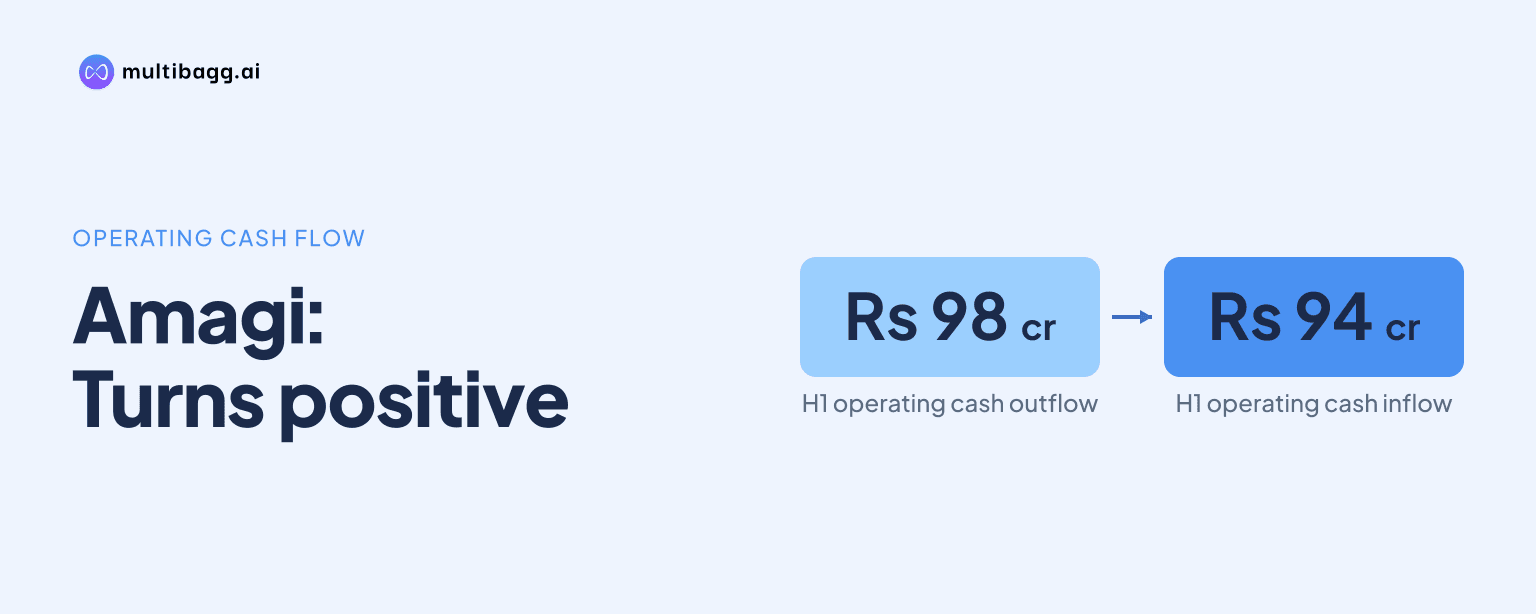
Amagi generated a Rs 94 crore operating cash inflow in the first half, reversing a Rs 98 crore outflow a year earlier, after underlying working-capital absorption fell from Rs 145 crore to Rs 14 crore. Management said stronger collections and a materially lower days sales outstanding, or DSO, drove adjusted operating cash conversion to 67% of adjusted EBITDA.
Know Amagi Media Labs inside out
Results, valuation, peers and who's buying, in one view.
How did Amagi reverse its operating cash flow in the first half?
Amagi reversed its first-half operating cash flow by reducing the cash absorbed by working capital by Rs 131 crore year on year. Underlying working-capital absorption was Rs 14 crore in the current first half, compared with Rs 145 crore in the prior-year period. Management attributed that reduction to strong collections and a materially lower DSO, a measure of the average time taken to collect receivables from customers.
The cash result also followed a larger profit base. Adjusted EBITDA, or earnings before interest, tax, depreciation and amortisation adjusted for specified items, rose from Rs 58 crore to Rs 139 crore in the first half. That increase of Rs 81 crore, together with the reduced working-capital requirement, resulted in operating cash flow switching from a Rs 98 crore outflow to a Rs 94 crore inflow.
What does Amagi's 67% cash conversion mean?
Amagi's 67% first-half adjusted operating cash conversion means it converted almost two-thirds of its Rs 139 crore adjusted EBITDA into adjusted operating cash flow. The rate exceeded management's stated aspiration of converting 50% to 60% of adjusted EBITDA into cash for the year. Management described 67% as the number to anchor on as a more steady-state first-half conversion rate.
The quarterly pattern was more volatile than the half-year measure. Management said second-quarter conversion was about 151%, principally because of strong collections, while the first quarter is structurally the weakest for cash. Annual increments, incentives and major software renewals land in the first quarter, according to management, so it cautioned that viewing either quarter alone could create misleading signals.
The comparison also includes non-operating items in each half. The prior-year first half had Rs 103 crore of pre-initial public offering employee stock option plan, or ESOP, and stock appreciation rights buyback payments, whereas the current year included roughly Rs 25 crore of IPO-related payments. Management said the current year's IPO-related payments were close to their last lap, while its underlying working-capital comparison was intended to separate operating progress from those items.
How capital-light was Amagi's first-half cash generation?
Amagi produced Rs 85 crore of free cash flow from its Rs 94 crore operating cash inflow after Rs 9 crore of capital expenditure in the first half. The Rs 9 crore difference between operating cash flow and free cash flow indicates that capital expenditure was limited relative to the cash generated from operations. Management therefore characterised the business as capital-light.
Cash on the balance sheet stood at Rs 1,774 crore at the end of the reported quarter, with no debt. That cash position followed quarterly revenue of Rs 476 crore and first-half revenue of Rs 913 crore. Management said the balance sheet gives it room to continue investing in the business as its first priority, rather than indicating a committed new use of the cash.
Management also said the cash provides flexibility for acquisitions where they add capability. Its areas of interest include the video supply chain, video distribution and live sports production, which it said could complement the platform. However, management disclosed no material transaction for the quarter and said its corporate-development work ranged from exploratory discussions to preliminary diligence.
Got a follow-up? Ask IRIS
Is Amagi's cash improvement supported by broader operating results?
Amagi's cash improvement was accompanied by a rise in first-half adjusted EBITDA to Rs 139 crore, up from Rs 58 crore, and a 7-percentage-point increase in first-half adjusted EBITDA margin to 15.3%. First-half revenue was Rs 913 crore, up 30%, or 34% excluding the effect of a large broadcaster migration that had boosted the prior-year comparison period. The higher earnings base was therefore a material contributor alongside lower working-capital absorption.
In the second quarter, revenue reached Rs 476 crore, up 27% on a reported basis and 33% excluding that prior-year base effect. Adjusted EBITDA was Rs 89.1 crore, producing an 18.7% margin, while indirect operating costs rose 7% against revenue growth of 27%. Management said the resulting gap supported operating leverage, though it also identified more than 200 basis points of temporary margin benefit from favourable foreign exchange rates, delayed hiring and reserve releases.
Management put the underlying second-quarter adjusted EBITDA margin closer to 16.5% after removing those timing benefits and said it expected the full-year margin to remain close to that range. It plans to reinvest some operating leverage in people, product and artificial intelligence, or AI. Accordingly, the first-half cash result reflects both improved collections and earnings growth, but management has not presented the elevated second-quarter margin as the full-year underlying run rate.
What could sustain or change Amagi's cash conversion?
Amagi's ability to sustain cash conversion will depend in part on collections and working capital, because management specifically linked the first-half improvement to stronger collections and a lower DSO. Revenue mix was broadly stable across Cloud Modernization, Streaming Unification, and Monetization & Marketplace, which accounted for roughly 20%, 55% and 25% of revenue respectively. That stability was cited alongside broad-based growth, but management did not give a numerical DSO figure or a future working-capital target.
The operating plan includes ongoing investment as well as potential acquisition activity. Management said research and development spending has been in the early-20% range as a share of sales and that 20% is a reasonable medium-term steady-state base case. It also said it does not capitalise expenses, meaning the research and development costs reported in the profit and loss account are fully loaded, a factor relevant to both reported earnings and future cash deployment.
For the next quarter, management expects elevated margins supported by the seasonal peak in US advertising associated with midterm elections and recurring cloud savings. It said it would remain disciplined on acquisition fit and price, and would disclose transactions when discussions reach a binding commitment. These plans may shape future cash use, but the first-half report does not provide a fresh operating-cash-flow target beyond the earlier 50% to 60% conversion aspiration that it has already exceeded at the midpoint.
Conclusion
Amagi's first-half cash result marks a clear change from the prior year: operating cash flow moved by Rs 192 crore, from a Rs 98 crore outflow to a Rs 94 crore inflow. The movement combined Rs 81 crore more adjusted EBITDA with Rs 131 crore less underlying working-capital absorption. Free cash flow of Rs 85 crore after Rs 9 crore of capital expenditure shows that most of the operating cash inflow remained after capital spending.
The next measure to watch is whether collections and lower DSO continue to limit working-capital absorption in the next quarter and through the remainder of the year. Management expects elevated third-quarter margins from the US advertising peak linked to midterm elections and recurring cloud savings, while maintaining a full-year underlying adjusted EBITDA margin expectation near 16.5% and planning reinvestment in people, product and AI.