










Amagi's Q2 FY27 margin masks 16.5% underlying level
Key highlights
- Amagi reported Q2 FY27 adjusted EBITDA of Rs 89.1 crore and an 18.7% margin on revenue of Rs 476 crore.
- Management said favourable foreign exchange, delayed hiring and reserve releases added more than 200 basis points to Q2 FY27 margin.
- Amagi expects FY27 adjusted EBITDA margin to remain close to 16.5% while reinvesting in people, products and AI.
- First-half FY27 adjusted operating cash flow was an inflow of Rs 94 crore, compared with an outflow of Rs 98 crore a year earlier.
powered by IRIS
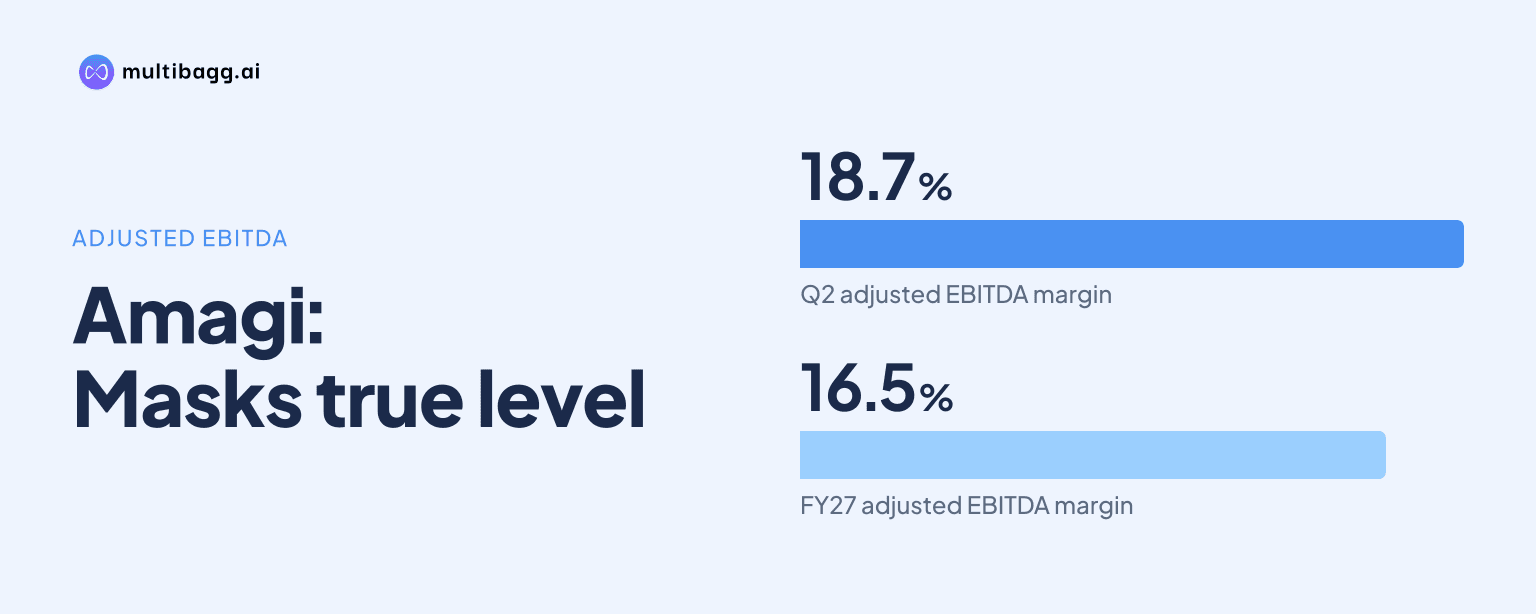
Amagi reported an 18.7% adjusted EBITDA margin in Q2 FY27, but management said more than 200 basis points of temporary benefits put its underlying margin closer to 16.5%. The reported result included favourable foreign exchange, delayed hiring and reserve releases, while management plans to reinvest part of operating leverage in people, products and artificial intelligence.
Know Amagi Media Labs inside out
Results, valuation, peers and who's buying, in one view.
Why was Amagi's reported EBITDA margin 18.7%?
Amagi's 18.7% reported adjusted EBITDA margin in Q2 FY27 reflected revenue growth exceeding indirect-cost growth, alongside more than 200 basis points of timing benefits. Adjusted EBITDA, or earnings before interest, tax, depreciation and amortisation, was Rs 89.1 crore on Rs 476 crore of revenue, with EBITDA up 114% year on year and revenue up 27% on a reported basis.
The cost trend below gross margin accounted for part of the increase. Indirect operating expenses fell to 49.3% of revenue in Q2 FY27 from 58.6% a year earlier, while gross margin was 68.1%. Management said Rs 47 of every Rs 100 of incremental revenue reached adjusted EBITDA, which it described as 47% flow-through on incremental sales.
Three timing factors increased the Q2 FY27 margin: favourable foreign exchange rates, delayed hiring and reserve releases. Management did not assign a value to each factor but said their combined effect exceeded 200 basis points, where 100 basis points equal one percentage point. It therefore distinguished the 18.7% reported outcome from the approximately 16.5% full-year margin reference.
What is Amagi's underlying FY27 margin outlook?
Amagi expects FY27 adjusted EBITDA margin to remain close to 16.5%, management's estimate after excluding Q2 FY27 timing benefits. Management said it intends to reinvest a portion of operating leverage in people, product development and artificial intelligence, or AI, rather than retain all of the Q2 margin uplift.
The 16.5% reference is below the Q2 FY27 reported margin but above the 15.3% adjusted EBITDA margin recorded in the first half. First-half adjusted EBITDA was Rs 139 crore on revenue of Rs 913 crore, and management said the margin increased by 7 percentage points from the prior-year first half.
Management expects Q3 FY27 to retain elevated margin levels, but it gave no numerical quarterly target. It cited the U.S. advertising peak associated with midterm elections and recurring cloud savings as contributors. Its stated full-year reference remains close to the 16.5% underlying margin rather than the Q2 FY27 peak.
How did revenue mix and gross margin change at Amagi?
Amagi's gross margin was 68.1% in Q2 FY27, down 1.6 percentage points year on year but up 0.8 percentage points sequentially. Management attributed the year-on-year decline entirely to a prior-year revenue-recognition base effect and said gross margin was flat year on year excluding that effect, within its stated 67% to 69% range.
The base effect arose from a large broadcaster migration in Q2 of the prior year. Management had expected that revenue-recognition timing benefit to reduce Q2 FY27 reported growth by about 600 basis points; the actual impact was 614 basis points. As a result, reported revenue growth was 27%, compared with 33% excluding the base effect, while constant-currency growth was 15% reported and 21% excluding it.
Revenue remained distributed across Amagi's three operating areas. Streaming Unification accounted for roughly 55% of revenue and grew 35%, while Monetization & Marketplace represented 25% and grew 28%, supported by a 65% increase in monetised impressions to 16 billion. Cloud Modernization represented about 20% of revenue and grew 9% reported, or about 36% excluding the base effect concentrated in that segment.
Got a follow-up? Ask IRIS
What costs supported Amagi's profit after tax increase?
Amagi's employee stock-option plan, or ESOP, expense fell to 5.3% of revenue in Q2 FY27 from 12% a year earlier, contributing to profit after tax of Rs 75 crore and a 14.9% margin. Management said profit after tax margin increased by 14.3 percentage points, of which 7.6 percentage points came from adjusted EBITDA and the balance primarily reflected ESOP costs.
The prior-year ESOP comparison included graded vesting of grants related to Amagi's initial public offering, according to management. Even after excluding that grant-timing effect, management said the ESOP line delivered about 200 basis points of leverage. This means the lower reported ESOP ratio was not solely caused by the prior-year grant schedule.
Management also told an analyst that a 10% move in the U.S. dollar would produce roughly a 1.5-point uplift in EBITDA margin because Amagi is long U.S. dollars. It said the 47% incremental flow-through was not significantly influenced by currency fluctuations, characterising a substantial portion as structural rather than foreign-exchange driven.
Where will Amagi reinvest its operating leverage?
Amagi plans to reinvest operating leverage in people, product and AI, and management said it is not making artificial cuts to product and engineering costs to increase margins. It said it may increase investment if new offerings scale faster than expected, while seeking to balance growth, investment and profitability.
The company launched four products in the quarter: Amagi STUDIO for cloud-based live production, FANPULSE for live sports-to-social vertical content, an integrated localisation system for captions, subtitles and dubbing, and Agentic NOC for network operations centre functions. Management called this its highest product-launch velocity to date, but said moving products through paying and scaling stages would take more than one quarter.
Amagi is also using agentic operations internally and has engaged a design partner among its top 10 customers for a next-generation Agentic NOC platform. Management said its operating experience across more than 10,700 channels supports that work. It did not disclose revenue, customers or pricing for the four newly launched products.
How much cash does Amagi have for investment and acquisitions?
Amagi ended the first half of FY27 with Rs 1,774 crore of cash and no debt, which management said provides room to invest in the business and consider acquisitions that add capabilities. Management identified video supply chain, video distribution and live sports production as areas of acquisition interest, subject to strategic fit, financial characteristics, management autonomy, synergies, integration feasibility and price.
Cash generation improved during the first half as adjusted operating cash flow turned to an inflow of Rs 94 crore from an outflow of Rs 98 crore a year earlier. Adjusted EBITDA increased to Rs 139 crore from Rs 58 crore, while underlying working-capital absorption declined to Rs 14 crore from Rs 145 crore, driven by collections and a lower days sales outstanding measure.
Free cash flow was Rs 85 crore in the first half after capital expenditure of Rs 9 crore. First-half adjusted operating cash-flow conversion was 67% of adjusted EBITDA, above management's 50% to 60% aspiration. Management said Q1 is structurally its weaker cash quarter because annual increments, incentives and major software renewals occur then, whereas Q2 is a stronger collections period.
Conclusion
Amagi's Q2 FY27 profitability increase combined operating leverage with temporary benefits. Revenue of Rs 476 crore and adjusted EBITDA of Rs 89.1 crore produced an 18.7% reported margin, but management's adjustment for more than 200 basis points of timing factors places its underlying FY27 reference near 16.5%. The first-half comparison also shows EBITDA rising to Rs 139 crore while operating cash flow moved to a Rs 94 crore inflow.
The next results to watch are Q3 FY27 margins and the progress of the four new products from launch toward paying and scaling stages. Management expects elevated Q3 margins from the U.S. advertising peak and cloud savings, while its disclosed plan is to reinvest part of operating leverage in people, product and AI rather than treat the Q2 FY27 margin as a new full-year baseline.