










Ambani Orgochem Targets 2.25-Fold Tarapur Capacity by FY28
Key highlights
- Ambani Orgochem targets Tarapur acrylic capacity of about 4,500 tonnes a month, up from 2,000 tonnes.
- Ambani Orgochem estimates Tarapur investment at Rs 15 crore to Rs 20 crore and says it has taken debt for the project.
- Ambani Orgochem reported H1 FY27 operating income of Rs 171.21 crore, up 54.87% year on year.
- Ambani Orgochem said Dahej peroxide capacity is operating at about 40% utilisation.
powered by IRIS
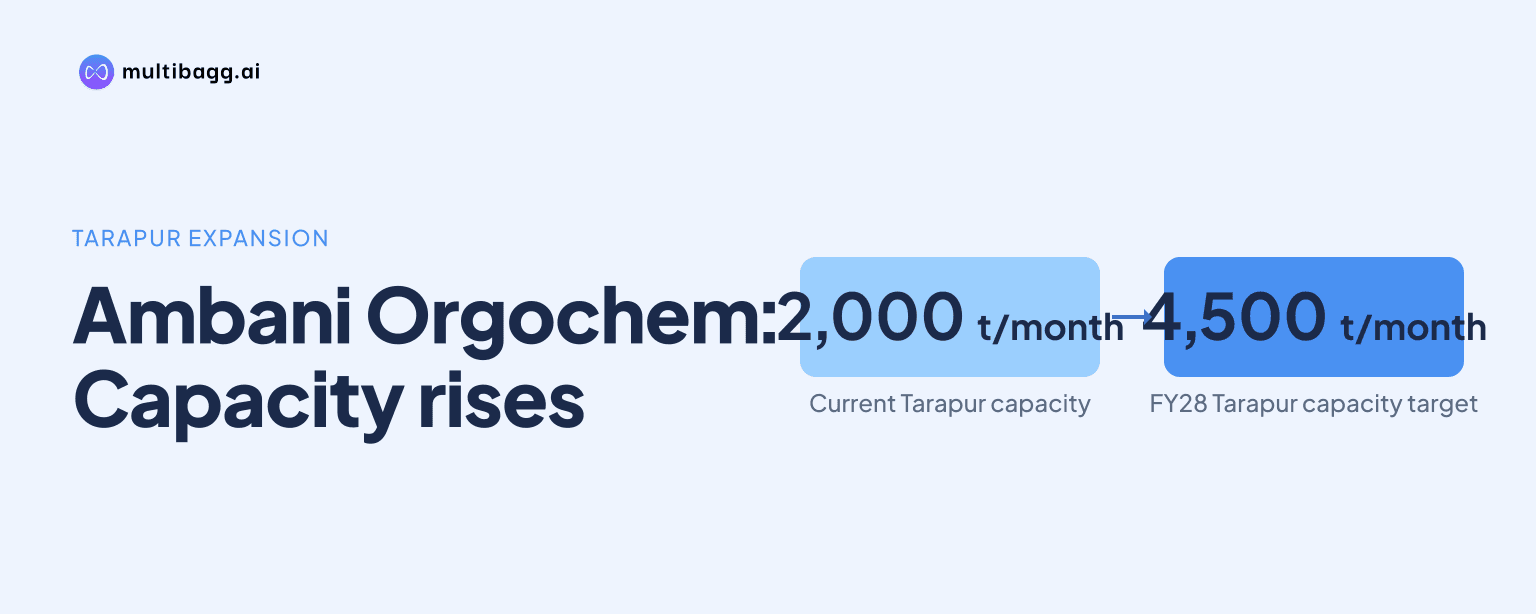
Ambani Orgochem Limited expects its Tarapur acrylic coatings and adhesives capacity to increase from 2,000 to about 4,500 tonnes a month, or 2.25 times, with management saying FY28 should show the expansion’s full turnover and profitability effect. The Rs 15 crore to Rs 20 crore project addresses a facility operating at 100% utilisation or more.
Know Ambani Orgochem inside out
Results, valuation, peers and who's buying, in one view.
Why is Ambani Orgochem expanding Tarapur?
Ambani Orgochem is expanding Tarapur because the existing 2,000-tonnes-per-month acrylic facility is fully utilised, and management said it cannot supply current customers at the required level. The company supplies acrylic products across India and more than 40 countries for paints and coatings, adhesives, carpets, textiles, paper and construction applications.
The planned capacity of about 4,500 tonnes a month would add about 2,500 tonnes monthly, equal to a 125% increase from the present level. Management described the emulsion operation as a traditional business of 30 to 40 years and said the capacity increase responds to a shortage of available supply rather than a new product category.
The project covers Ambani Orgochem’s eco-friendly acrylic coatings and adhesives vertical, one of its four stated businesses. Management cited a shift by customers towards water-based emulsions as they seek environmentally conscious solutions, but did not disclose separate revenue, volume or margin data for water-based acrylic products.
Management also said Ambani Orgochem intends to produce opaque binders, described as hybrid cross-linked core-shell polymer technology. It said customers currently use opaque polymers and that opaque binders could improve final-product performance while offering cost opportunities, although no production date, sales target or revenue contribution was disclosed.
When will Ambani Orgochem’s Tarapur expansion affect results?
Ambani Orgochem expects to close the Tarapur expansion by the end of the fourth quarter, with the capacity effect expected from the following year. Management said FY28 should show the full outcome from the expansion in both turnover and profitability.
The project timing follows the six months ended September 30, 2026, which the company reported as H1 FY27. Management did not provide a specific commissioning date or state whether all of the additional capacity would become available immediately after the fourth-quarter completion.
Management said H2 FY27 would be better than H1 FY27 but did not issue numerical revenue, profit or margin guidance. In H1 FY27, total income from operations increased 54.87% year on year to Rs 171.21 crore from Rs 110.56 crore, while earnings before interest, tax, depreciation and amortisation, or EBITDA, rose 43% to Rs 11.32 crore from Rs 7.92 crore.
Net profit increased to Rs 3.5 crore in H1 FY27 from Rs 19.07 lakh in H1 FY26, while earnings per share rose to Rs 4.02 from Rs 0.249. Operating cash flow was positive at Rs 1.84 crore, compared with an outflow of Rs 8.99 crore in H1 FY26, although management said working-capital control would remain a financial priority.
How will Ambani Orgochem fund the Tarapur project?
Ambani Orgochem estimates the Tarapur investment at Rs 15 crore to Rs 20 crore and said it has taken debt for the ongoing project. Management therefore identified debt as the funding source for the immediate capacity increase at its established Tarapur operation.
For Dahej, management said it is planning a qualified institutional placement, or QIP, and warrant issues, with most of that investment expected to come from those sources. It did not disclose the planned QIP proceeds, warrant terms, potential dilution, Dahej capital expenditure or borrowing terms for Tarapur.
Management said Tarapur is an extension of existing manufacturing capacity, allowing production to rise without a substantial increase in fixed costs. The finance team said the project is expected to be EBITDA accretive and EBITDA positive from day one, contrasting it with a greenfield project that might require six to eight months before revenue begins.
That margin outcome is management’s expectation rather than a reported result. Management said both Tarapur and Dahej expansions are for products already made by the company, and it expects margins to increase because fixed costs would not rise substantially as capacity and revenue grow.
Got a follow-up? Ask IRIS
How does Tarapur compare with Ambani Orgochem’s other businesses?
Ambani Orgochem said acrylic emulsions generate higher revenue volumes, while organic peroxides and salicylic acid derivatives contribute a greater portion of margin. The Tarapur project is therefore intended to increase the volume base, alongside specialised businesses that management said have a different margin contribution.
The company’s four verticals are peroxide derivatives, salicylic acid and salicylate derivatives, metal octoates, and eco-friendly acrylic coatings and adhesives. In salicylic acid, it currently makes about 50 tonnes a month and plans to raise capacity to about 200 tonnes monthly, a fourfold target separate from Tarapur.
In peroxide derivatives, Ambani Orgochem offers more than 20 products and has developed di-tert-amyl peroxide and 2,5-dimethyl-2,5-di-tertiary-butyl peroxyhexane. It is also progressing five additional peroxide molecules and developing two raw materials in-house, with pilot trials nearing completion, to support about six further organic peroxide molecules.
Dahej is operating at about 40% utilisation in the peroxide business, according to management, compared with Tarapur’s 100% or higher utilisation. Management linked Dahej’s lower use to difficulties moving Class 5.2 peroxide products amid geopolitical conditions, particularly through the Strait of Hormuz.
What will Ambani Orgochem do after Tarapur?
Ambani Orgochem plans to move to the Dahej expansion after Tarapur is completed, with management indicating an FY28 completion timeline. Management later said FY29 and FY30 should show more visible bottom-line benefits from the Dahej factory.
The disclosed Dahej milestone is an expansion in the salicylic division, while the company’s medium-term plan of three to five years also includes capacity at Dahej and other strategic locations. Management did not disclose Dahej’s eventual capacity, revenue potential, profitability contribution or detailed construction schedule.
The company’s assets had increased before the planned expansions were completed. Total assets were Rs 264.81 crore as of September 30, 2026, compared with Rs 204.94 crore a year earlier, while fixed assets rose to Rs 95.31 crore from Rs 84.23 crore.
Management identified customer adoption, market conditions, capital allocation and geopolitical disruption as factors affecting execution. It said product approvals typically take about one to five or six months depending on the customer and application, while new products move through laboratory work and pilot batches before commercial production.
Conclusion
Tarapur is Ambani Orgochem’s immediate manufacturing expansion, targeting an increase of about 2,500 tonnes a month from 2,000 tonnes to about 4,500 tonnes. The debt-funded project follows H1 FY27 operating-income growth of 54.87% and is intended to address supply constraints at a facility management says is already fully utilised.
The next milestones are fourth-quarter closure of the Tarapur project and the FY28 results that management says should reflect it fully. Investors can also monitor progress on the Dahej salicylic expansion, planned QIP and warrant funding, and whether Strait of Hormuz logistics improve for Dahej’s peroxide business, which management says is operating at about 40% utilisation.