










Anawil shows EBITDA per tower rises with integrated supply contracts
Key highlights
- Anawil indicates integrated-supply EBITDA of Rs 40 to 50 lakh per tower, versus Rs 25 to 30 lakh for pure conversion.
- Anawil’s integrated-supply margin is approximately 14% to 16%, compared with 44% to 50% for pure conversion.
- Anawil’s order book was Rs 395.6 crore across 320 towers as of October 31, 2026.
- Anawil produced 210 towers in FY26, up from 135 towers in FY25.
powered by IRIS
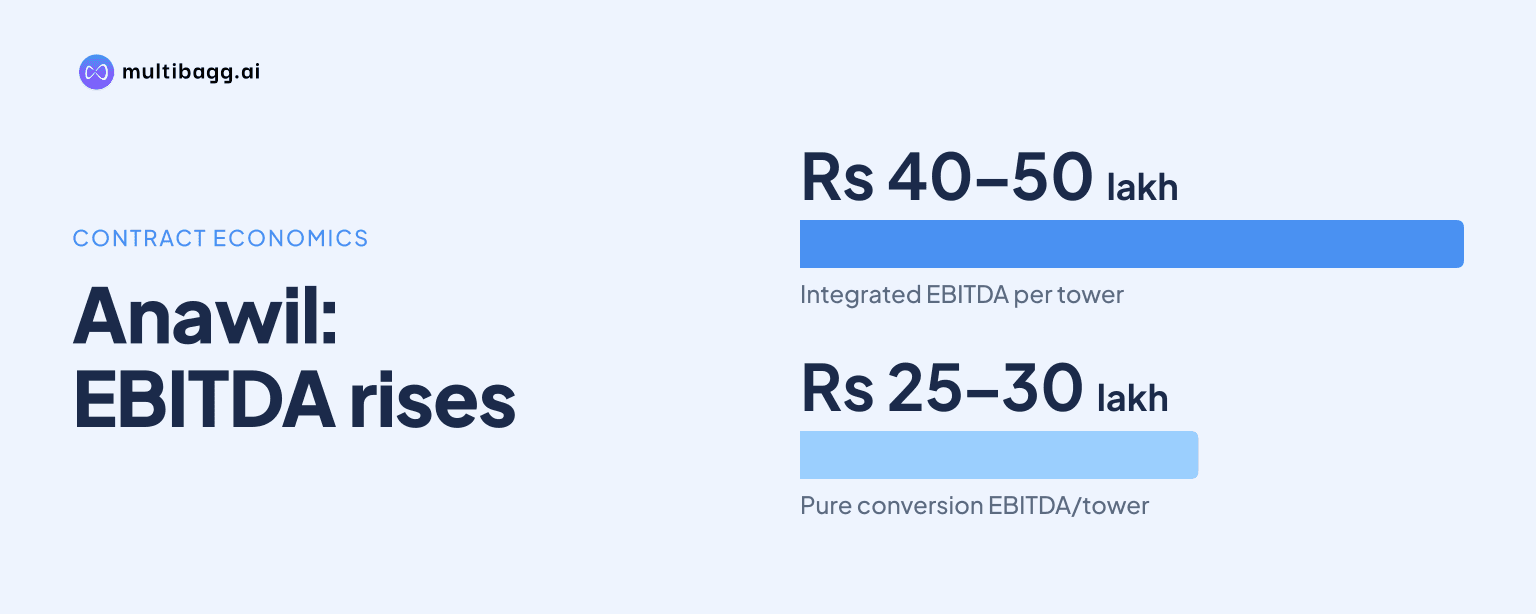
Anawil Wire and Engineering Limited shows that integrated supply carries EBITDA, or earnings before interest, tax, depreciation and amortisation, of Rs 40 to 50 lakh per tower, compared with Rs 25 to 30 lakh for pure conversion, although its indicated margin is 14% to 16% against 44% to 50%.
Know Anawil Wire and Engineering inside out
Results, valuation, peers and who's buying, in one view.
Why does Anawil compare EBITDA per tower across its models?
Anawil compares EBITDA per tower because its three models have different supply scopes, revenue bases and material responsibilities. Pure conversion covers tower manufacturing using customer-supplied material and has indicated EBITDA of Rs 25 to 30 lakh per tower. Integrated supply adds raw-material procurement to tower manufacturing, producing the highest stated EBITDA range of Rs 40 to 50 lakh per tower.
Conversion + Internals sits between the two models, with stated EBITDA of Rs 35 to 40 lakh per tower. Its scope combines tower manufacturing with in-house tower internals, while material procurement follows the agreed supply arrangement. The presentation links the progression from Rs 25 to 30 lakh to Rs 40 to 50 lakh of EBITDA per tower to expanding supply scope, rather than to a disclosed change in tower size or plant capacity.
How do Anawil’s three tower models differ economically?
Anawil’s pure-conversion model has the highest indicated EBITDA margin, at approximately 44% to 50%, but the lowest EBITDA per tower, at Rs 25 to 30 lakh. The customer supplies the material, and Anawil manufactures the tower. The company describes the model as having a narrower supply scope and lower EBITDA per tower.
Anawil indicates that Conversion + Internals generates Rs 35 to 40 lakh of EBITDA per tower at a margin of approximately 33% to 37%. The model adds internally manufactured components to tower fabrication, including access ladders, platforms, decks and cable racks. Integrated supply has the highest revenue range at Rs 3.0 to 3.5 crore per tower, compared with Rs 1.0 to 1.1 crore for Conversion + Internals and Rs 50 to 60 lakh for pure conversion.
Why is Anawil’s integrated-supply margin lower?
Anawil attributes its lower integrated-supply margin to raw-material costs being included in the revenue base. The integrated model has an indicated EBITDA margin of approximately 14% to 16%, while the company procures material and records revenue of Rs 3.0 to 3.5 crore per tower. In pure conversion, customer-supplied material leaves a revenue base of Rs 50 to 60 lakh per tower.
The comparison shows that percentage margin and rupee EBITDA measure different aspects of the disclosed models. Pure conversion indicates a 44% to 50% margin and Rs 25 to 30 lakh of EBITDA per tower, whereas integrated supply indicates a 14% to 16% margin and Rs 40 to 50 lakh. Anawil labels integrated supply as its highest-value-per-tower model because it includes raw-material procurement as well as fabrication.
Got a follow-up? Ask IRIS
What products support Anawil’s higher-value supply scope?
Anawil supports added supply scope through customised wind turbine towers of up to 140 metres and in-house tower internals. Its components include access ladders, platforms, decks, cable racks and supporting assemblies, configured to original equipment manufacturer, or OEM, specifications. These internals are the stated value-addition mechanism in the Conversion + Internals model, which has indicated EBITDA of Rs 35 to 40 lakh per tower.
Anawil’s manufacturing process includes internal-kit fitting after flange fitting and circumferential welding. Specified ladders, platforms and cable supports are integrated at that stage, followed by blasting, coating, inspection and dispatch preparation. The company identifies a tower-internals manufacturing initiative at Koppal as supporting backward integration, alongside its capability to manufacture towers up to 140 metres.
Can Anawil execute more higher-value tower contracts?
Anawil has installed capacity of 612 towers a year across two facilities, comprising 420 towers a year at Koppal, Karnataka, and 192 towers a year at Kutch, Gujarat. Koppal commenced operations in December 2022 and has capacity for 35 towers a month. Kutch commenced operations in March 2026 and has capacity for 16 towers a month.
Anawil’s output increased from 114 towers in FY24 to 135 in FY25 and 210 in FY26, while utilisation rose from 38% to 45% and then 48%. Production was 107 towers in H1FY27, compared with 62 towers in H1FY26. The presentation says Kutch was undergoing approvals and production ramp-up, so its 192-tower annual capacity does not establish achieved output.
What remains unknown about Anawil’s contract mix?
Anawil does not disclose the allocation of its Rs 395.6 crore order book across pure conversion, Conversion + Internals and integrated supply. The order book covered 320 towers as of October 31, 2026, but the supplied presentation does not identify the number of towers under each commercial structure. It therefore does not show how much of the backlog could carry the Rs 40 to 50 lakh integrated-supply EBITDA range.
Anawil also does not provide raw-material purchase prices, working-capital terms or realised historical EBITDA per tower by model on these pages. Its H1FY27 financial snapshot reports revenue of Rs 154.0 crore, EBITDA of Rs 36.08 crore and a 23.4% EBITDA margin, but it does not reconcile those consolidated figures to the three model ranges. The model economics should therefore be read as indicated unit ranges rather than reported average results for completed contracts.
Conclusion
Anawil’s disclosed unit economics show that broader supply scope is associated with higher revenue and EBITDA per tower. The progression runs from Rs 25 to 30 lakh of EBITDA for pure conversion, to Rs 35 to 40 lakh for Conversion + Internals, and Rs 40 to 50 lakh for integrated supply. Margin percentages move in the other direction because integrated contracts include raw-material costs in revenue.
The next disclosed execution markers are Kutch’s approvals and production ramp-up after its March 2026 start, Koppal’s utilisation and tower-internals integration, and conversion of the Rs 395.6 crore order book recorded on October 31, 2026. Disclosure of the 320-tower order-book split by model would show the extent to which integrated-supply unit economics are represented in future execution.