










Anawil H1FY27 revenue of Rs 154 crore exceeds FY26 total
Key highlights
- Anawil reported H1FY27 revenue of Rs 154 crore, 272.2% above H1FY26 and above FY26 revenue of Rs 143.3 crore.
- Integrated supply represented 64% of H1FY27 revenue and 51% of the Rs 395.6 crore confirmed order book.
- H1FY27 EBITDA increased 255.8% year on year to Rs 36.1 crore, while EBITDA margin declined 108 basis points to 23.4%.
- Anawil had 320 towers in its confirmed order book on October 31, 2026, plus Rs 44.1 crore of LOIs for 44 towers.
powered by IRIS
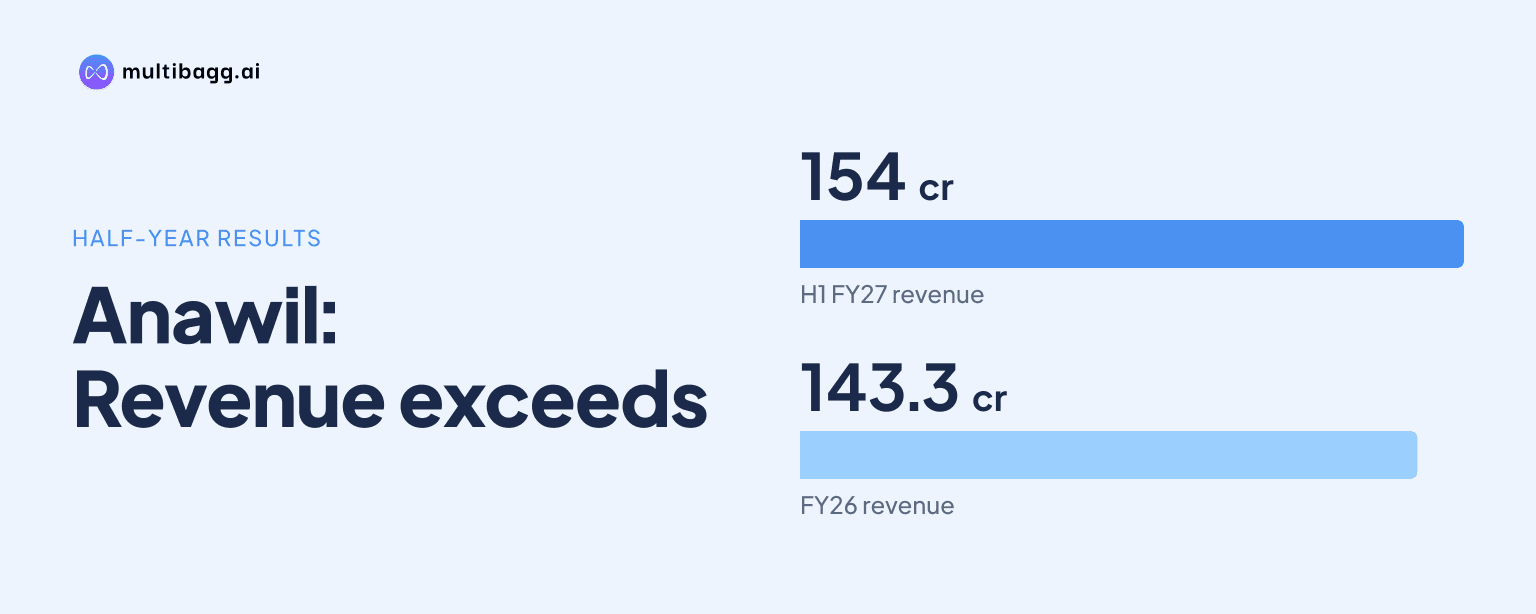
Anawil Wire and Engineering Ltd reported revenue from operations of Rs 154 crore in H1FY27, exceeding its Rs 143.3 crore revenue for all of FY26, as integrated supply contributed 64% of first-half sales. Earnings before interest, tax, depreciation and amortisation, or EBITDA, rose 255.8% year on year to Rs 36.1 crore, although EBITDA margin declined to 23.4%.
Know Anawil Wire and Engineering inside out
Results, valuation, peers and who's buying, in one view.
How did Anawil’s H1FY27 revenue exceed its FY26 total?
Anawil’s H1FY27 revenue was Rs 154 crore, Rs 10.7 crore above the Rs 143.3 crore it reported for FY26. Revenue also increased 272.2% from Rs 41.4 crore in H1FY26. Management attributed the increase to higher tower production, stronger execution and the growing contribution of integrated supply contracts.
The company produced 107 towers in H1FY27, up 72.6% year on year, while revenue increased faster than tower volume. Management said integrated supply involves a larger scope of work and therefore produces higher revenue realisation per tower. It also said H1 is normally seasonally softer than H2 for tower production, making the first-half revenue comparison with FY26 significant.
FY26 revenue had risen 82.3% from Rs 78.6 crore in FY25, while FY26 EBITDA more than doubled from Rs 30.1 crore to Rs 61.2 crore. H1FY27 revenue therefore surpassed a full year that had already grown substantially. First-half profit did not exceed FY26 levels: H1FY27 EBITDA of Rs 36.1 crore and profit after tax of Rs 14.4 crore remained below FY26 EBITDA of Rs 61.2 crore and profit after tax of Rs 36 crore.
What business mix drove Anawil’s H1FY27 revenue?
Integrated supply was Anawil’s largest H1FY27 revenue category, contributing 64% of the Rs 154 crore total. Pure conversion accounted for 21%, conversion plus internals for 11%, and other revenue for 4%. The company defines other revenue as tower accessories and scrap.
Management calls integrated supply Model 3 and says its greater value addition supported higher realisations and higher absolute EBITDA per tower. EBITDA per tower was Rs 32.8 lakh in H1FY27, up 104.7% year on year. Management considers this measure more relevant than percentage margin comparisons because the company’s business models have different material requirements.
The confirmed order book was less concentrated in integrated supply than first-half revenue. As of October 31, 2026, integrated supply represented 51% of the Rs 395.6 crore order book, compared with its 64% revenue share. Pure conversion represented 25% of the order book versus 21% of H1FY27 revenue, while conversion plus internals accounted for 24% versus 11%.
The shift towards Model 3 also increased the material component of reported costs. Cost of goods sold rose to Rs 89.7 crore in H1FY27 from Rs 14.9 crore in H1FY26, while other expenses increased to Rs 25.4 crore from Rs 14.7 crore. Management said material-intensive integrated supply contracts carry lower percentage margins despite generating higher absolute EBITDA per tower.
Got a follow-up? Ask IRIS
What happened to Anawil’s profit and margins?
Anawil’s EBITDA rose to Rs 36.1 crore from Rs 10.1 crore in H1FY26, but EBITDA margin declined 108 basis points to 23.4% from 24.5%. A basis point is one-hundredth of a percentage point. Management attributed the margin movement to the increasing share of material-intensive integrated supply work and initial operating expenses at the Kutch, Gujarat facility ahead of its full ramp-up.
Profit after tax increased 539.3% to Rs 14.4 crore from Rs 2.3 crore, and its margin rose to 9.3% from 5.4%. Earnings before interest and tax rose to Rs 23.4 crore from Rs 5.5 crore, with its margin increasing to 15.2% from 13.3%. Finance cost increased to Rs 5.3 crore from Rs 2.5 crore, while depreciation and amortisation rose to Rs 12.9 crore from Rs 5 crore.
H1FY27 margins were below FY26 levels, when EBITDA margin was 42.7% and profit-after-tax margin was 25.1%. The presentation does not provide a full like-for-like bridge against FY26, but identifies Model 3’s lower percentage margin and Kutch start-up expenses as H1FY27 factors. Management expects better cost absorption as Kutch utilisation rises, which is a forward-looking expectation rather than a reported result.
The chairman and managing director extended Anawil a Rs 21.68 crore loan at 6% per annum to support funding requirements. That disclosure accompanied cash profit after tax of Rs 27.3 crore in H1FY27, up 276.3% from Rs 7.2 crore in H1FY26. The presentation does not specify the loan’s use of proceeds or repayment terms.
What order visibility and FY27 targets does Anawil report?
Anawil had a confirmed order book of Rs 395.6 crore for 320 towers as of October 31, 2026, excluding letters of intent, or LOIs, of Rs 44.05 crore. The presentation also displays these additional LOIs as Rs 44.1 crore for 44 towers, reflecting rounded figures. The confirmed order book was about 2.6 times H1FY27 revenue of Rs 154 crore.
Management said the order book supports a significant pickup in H2FY27 execution because H1 is generally the softer production half. Its FY27 guidance is revenue of Rs 450 crore to Rs 500 crore and profit after tax of Rs 55 crore to Rs 60 crore. Against H1FY27 revenue of Rs 154 crore and profit after tax of Rs 14.4 crore, reaching that guidance depends on a materially larger contribution in H2FY27.
The Kutch expansion is nearing completion and is planned to add annual manufacturing capacity of 192 towers. Anawil says its combined installed capacity across two facilities will be 612 towers annually. Management also plans in-house manufacturing of kits at Koppal, Karnataka, to increase backward integration and support larger orders.
Management’s stated strategy is to raise utilisation at Kutch, increase the share of conversion plus internals and integrated supply work, and execute the 320-tower order book on time. The presentation does not provide a Kutch commissioning date or quantify the immediate earnings effect of Koppal kits manufacturing. It says these actions are intended to help Anawil work towards FY27 guidance.
Conclusion
Anawil’s H1FY27 performance shows a substantial rise in revenue scale, with Rs 154 crore exceeding FY26 revenue of Rs 143.3 crore. The result was driven by 107 towers and a 64% integrated-supply revenue share, while the more material-intensive mix lifted EBITDA to Rs 36.1 crore and EBITDA per tower to Rs 32.8 lakh but reduced EBITDA margin to 23.4%.
The next reported milestones are H2FY27 execution against management’s revenue target of Rs 450 crore to Rs 500 crore and profit-after-tax target of Rs 55 crore to Rs 60 crore. Management has linked progress to the Rs 395.6 crore confirmed order book, rising Kutch utilisation, the planned 192-tower capacity addition and in-house kits manufacturing at Koppal, while Rs 44.1 crore of LOIs remain outside the confirmed order book.