










Anawil H1FY27 revenue rises 272% to Rs 153.97 crore on Model 3
Key highlights
- Anawil reported H1FY27 revenue from operations of Rs 153.97 crore, up 272.2% year-on-year.
- Anawil produced 107 towers in H1FY27, a 72.6% year-on-year increase.
- Model 3 contributed 64.3% of Anawil’s H1FY27 revenue.
- Anawil’s confirmed order book was Rs 395.58 crore, excluding Rs 44.05 crore of LOIs.
powered by IRIS
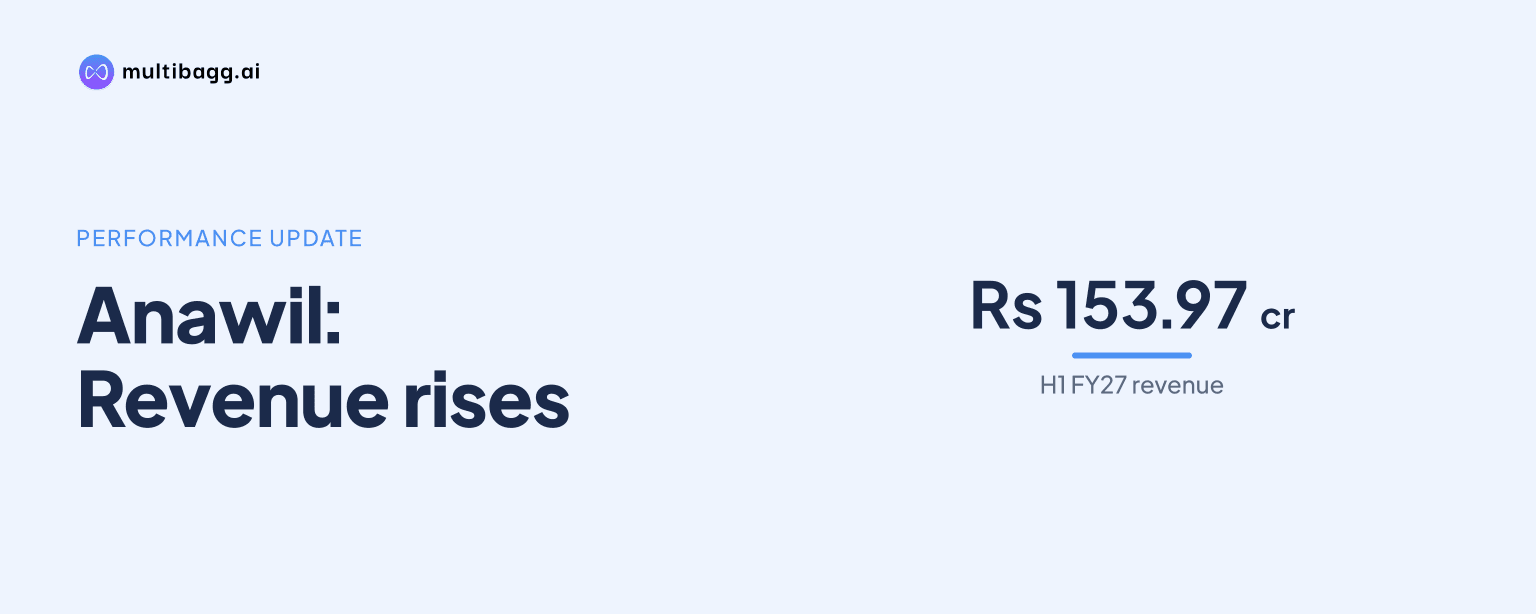
Anawil Wire & Engineering Limited reported H1FY27 revenue from operations of Rs 153.97 crore, up 272.2% year-on-year for the half year ended September 30, 2026, as 107 towers were produced and material-inclusive Model 3 contracts supplied 64.3% of sales. The first-half revenue exceeded Anawil’s Rs 143.27 crore revenue for all of FY26.
Know Anawil Wire and Engineering inside out
Results, valuation, peers and who's buying, in one view.
How did Anawil’s H1FY27 revenue change?
Anawil’s revenue from operations rose 272.2% year-on-year to Rs 153.97 crore in H1FY27, exceeding the Rs 143.27 crore it reported for the full FY26. Tower production increased 72.6% year-on-year to 107 towers, while higher realisations from integrated-supply contracts also contributed to the increase in reported sales.
Model 3 became Anawil’s largest revenue stream in H1FY27, contributing 64.3% of revenue. Model 1 accounted for 21.2%, Model 2 contributed 10.8%, and other sources represented 3.7%, showing that the half-year sales mix was led by the contract format with a larger material component.
The contrast between output growth and revenue growth is material. Tower production rose 72.6%, compared with a 272.2% rise in revenue, which Anawil linked to higher realisations from integrated-supply contracts. Management said the changing business mix allowed Anawil to undertake a larger scope of work under Model 3 arrangements.
The H1FY27 result therefore reflects both higher tower volumes and a shift in what Anawil supplies with each contract. Anawil manufactures tubular wind turbine towers for the onshore wind-energy sector, and management said different business models have varying material requirements.
Why did Anawil’s margin profile change in H1FY27?
Anawil reported EBITDA, or earnings before interest, tax, depreciation and amortisation, of Rs 36.08 crore in H1FY27, up 255.8% year-on-year, while the EBITDA margin was 23.4%. Profit after tax, or PAT, rose 539.3% year-on-year to Rs 14.39 crore, with a PAT margin of 9.3%.
The 23.4% EBITDA margin reflected the greater contribution of Model 3 contracts, which management said carry relatively lower percentage margins because they include materials. Management also said Model 3 generated higher absolute EBITDA per tower despite its lower percentage margin profile.
Anawil’s absolute EBITDA per tower was Rs 32.82 lakh in H1FY27, increasing 104.7% year-on-year and 14.8% from FY26. Management described this measure as its key operating-profitability indicator because material requirements vary across Model 1, Model 2 and Model 3 contracts, making percentage margins less directly comparable between them.
Initial operating expenses at Anawil’s Kutch, Gujarat plant also affected H1FY27 profitability while the facility was in its early ramp-up phase. Management expects increased utilisation to improve cost absorption, but this is a forward-looking expectation rather than a reported H1FY27 outcome.
The earnings figures show that profit rose alongside revenue despite the altered margin mix. EBITDA increased 255.8%, slightly below the 272.2% revenue increase, while EBITDA per tower increased 104.7%; these measures capture different effects from the higher-value, material-inclusive Model 3 sales and the 107-tower production level.
Got a follow-up? Ask IRIS
What supports Anawil’s FY27 execution plan?
Anawil had a confirmed order book of Rs 395.58 crore at the November 6, 2026 announcement, excluding letters of intent, or LOIs, worth Rs 44.05 crore. The company said the confirmed order book was targeted for execution by the end of Q1FY28, providing its stated basis for near-term execution visibility.
Model 3 represented 51.3% of the confirmed order book, compared with 24.5% for Model 1 and 24.2% for Model 2. This order-book mix is less concentrated in Model 3 than H1FY27 revenue, where Model 3 represented 64.3%, while Model 1 and Model 2 together represented 32.0% of sales.
Anawil said H1 is typically seasonally softer than H2 in tower production and management anticipates a significant pickup in H2FY27 execution. Its Kutch capacity expansion was nearing completion and trial runs were underway as of November 6, 2026; Anawil also cited in-house kits manufacturing at Koppal, Karnataka, as a step toward backward integration.
Anawil has combined annual manufacturing capacity of 612 towers across Koppal and Kutch, with capability to manufacture customised towers of up to 140 metres. These plant details provide context for management’s stated aim to scale production and undertake larger orders, although the release does not disclose the capacity available at either facility separately.
Management has guided for FY27 revenue of Rs 450 crore to Rs 500 crore and PAT of Rs 55 crore to Rs 60 crore. Management linked the guidance to expected stronger H2FY27 execution, the Rs 395.58 crore confirmed order book and improving utilisation at Kutch, while noting that forward-looking statements are subject to disclosed risks and uncertainties.
Conclusion
Anawil’s H1FY27 performance was defined by Rs 153.97 crore of revenue, 107 towers produced and a 64.3% Model 3 revenue contribution. Sales increased faster than tower output because integrated contracts carried higher realisations, while the 23.4% EBITDA margin reflected the larger material component of that business model and initial Kutch operating costs.
The next disclosed milestones are H2FY27 execution, completion and ramp-up of the Kutch expansion, and delivery of the Rs 395.58 crore confirmed order book targeted by Q1FY28. Investors can also track Anawil’s progress against management’s FY27 guidance of Rs 450 crore to Rs 500 crore in revenue and Rs 55 crore to Rs 60 crore in PAT.