










Anupam Rasayan completes Bliss deal, takes 50.07% stake
Key highlights
- Anupam Rasayan completed its Bliss GVS acquisition on September 28, 2026, and holds approximately 50.07% of equity capital.
- The deal used Rs 300 crore of term debt and Rs 1,450 crore of non-controlling, non-voting capital.
- Bliss GVS contributed only 3 operating days to Q2 FY27 consolidated results after the September 28, 2026 closing.
- Management indicated a 22% to 24% sustained EBITDA margin for Bliss GVS and expects synergy momentum in 3 to 4 quarters.
powered by IRIS
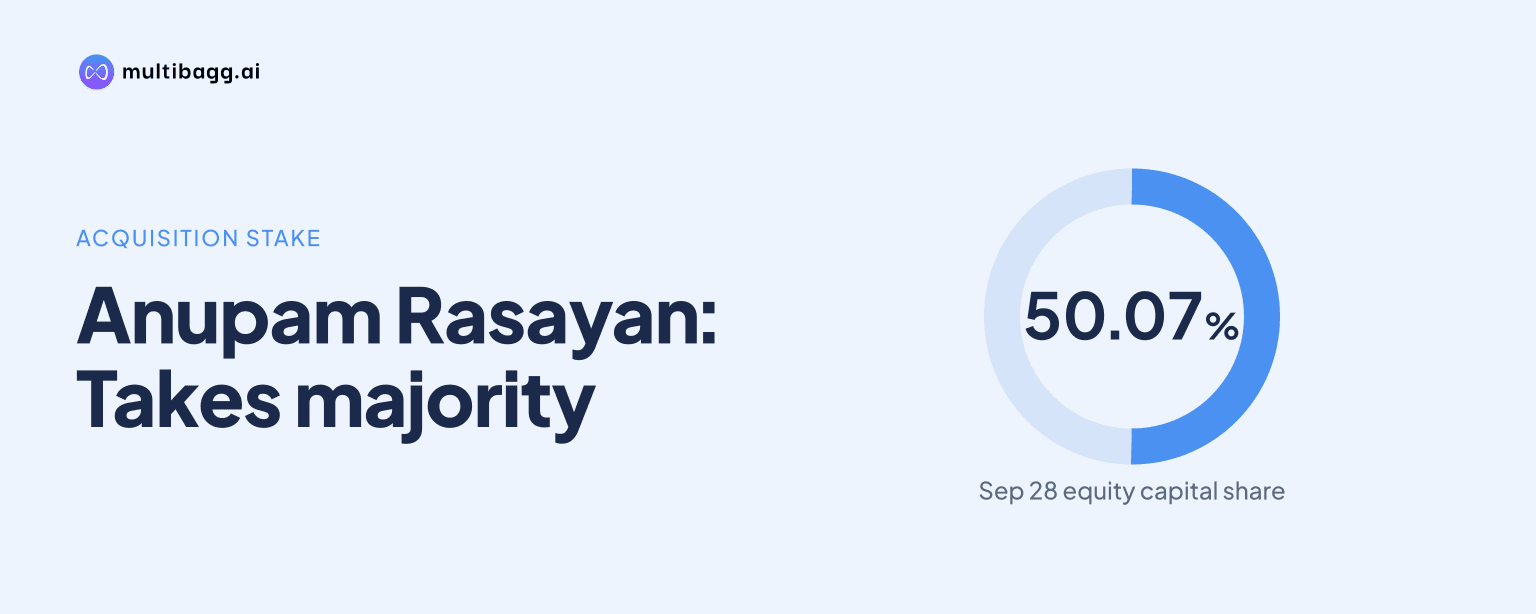
On September 28, 2026, Anupam Rasayan India Limited completed the acquisition of approximately 50.07% of Bliss GVS Pharma, using Rs 1,750 crore of disclosed financing to add finished-dosage formulations. The acquisition expands Anupam Rasayan from pharmaceutical intermediates and custom synthesis into a wider pharmaceutical value chain, although Bliss GVS contributed only three operating days to Q2 FY27 results.
Know Anupam Rasayan India inside out
Results, valuation, peers and who's buying, in one view.
What did Anupam Rasayan acquire through the Bliss GVS deal?
Anupam Rasayan acquired approximately 50.07% of Bliss GVS Pharma’s equity capital and completed the transaction on September 28, 2026. Management described Bliss GVS as a formulations business with manufacturing infrastructure, an international distribution network and more than 150 brands, adding finished-dosage capabilities to Anupam Rasayan’s pharmaceutical intermediates and custom synthesis operations.
The transaction is intended to widen Anupam Rasayan’s presence across the pharmaceutical value chain rather than simply add formulation revenue. Management said the combined platform could support product development, manufacturing efficiencies, customer relationships and gradual expansion in regulated markets, while Bliss GVS can draw on Anupam Rasayan’s specialty-chemical and key starting material capabilities.
Bliss GVS joins Tanfac Industries and Jayhawk Fine Chemicals in Anupam Rasayan’s acquisition-led expansion. Management said Tanfac supports fluorination-related supply, while Jayhawk adds United States manufacturing, advanced custom synthesis, life sciences and Performance Materials capabilities; Bliss GVS is the formulations element in the proposed pharmaceutical platform.
How was the Bliss GVS acquisition financed?
Anupam Rasayan financed the acquisition with a Rs 300 crore term loan and Rs 1,450 crore raised through a non-controlling, non-voting instrument. The Rs 1,750 crore funding came from financial investors led by Bain Capital, with Trust Group and Investec also participating, according to the chief financial officer.
Management said this structure was designed to fund the purchase while preserving the balance sheet for future growth and expansion. The call did not disclose the transaction purchase price, interest rate, repayment schedule or financing cost, so the transcript does not establish the eventual valuation or leverage impact of the deal.
The different timing of consolidation is material for Q2 FY27. Bliss GVS’s balance sheet was consolidated in September 2026, but its revenue and operating performance were included only from September 28, leaving three days of operating contribution in the quarter ended September 30, 2026.
What financial trends did Anupam Rasayan report in Q2 and H1 FY27?
Anupam Rasayan reported Q2 FY27 consolidated total income of Rs 821 crore, up 11% from Rs 739 crore in Q2 FY26, while EBITDA rose 41% to Rs 202 crore from Rs 144 crore. Management attributed the EBITDA margin increase to about 25% from 19.4% mainly to a higher Performance Materials contribution and favourable product mix.
For H1 FY27, total income rose 21% to Rs 1,489 crore, EBITDA increased 38% to Rs 377 crore and profit after tax rose 10% to Rs 116 crore. H1 EBITDA margin was 25.5%, compared with 22.2% in H1 FY26, but the quarter did not provide a full-period indication of Bliss GVS’s earnings because of the September 28 acquisition date.
Anupam Rasayan generated Rs 328 crore of operating cash flow in H1 FY27, compared with Rs 334 crore in the entire previous financial year. Excluding the Bliss GVS balance sheet, management said the working-capital cycle fell to 271 days from 276 days, with inventory management and receivables collection remaining integration priorities.
Got a follow-up? Ask IRIS
When will Anupam Rasayan see synergies from Bliss GVS?
Management expects some Bliss GVS synergy benefits or commercial momentum to emerge in three to four quarters. The immediate task is to identify actions that can start quickly and those requiring a phased plan with Bliss GVS management, rather than setting a quantified savings or sales target.
Management identified supply-side sourcing, contract development and manufacturing organisation opportunities, and regulated-market access as potential levers. Anupam Rasayan said its expertise in key starting materials and specialty chemicals could support Bliss GVS sourcing, while its activity in the United States, Europe and other regulated markets could support the formulations business.
Customer conversations around the combined platform have become more active following completion of the transaction, management said. It did not quantify the contract development and manufacturing organisation pipeline, expected revenue or cost savings because discussions were advanced but not ready for public disclosure.
Bliss GVS plant utilisation was in the 40s during the period discussed on the November 6, 2026 call. Management said utilisation had risen alongside growth from the prior year, but it did not disclose an exact percentage, individual plant capacity or a target utilisation level.
What margin and growth outlook has management given for Bliss GVS?
Management indicated a 22% to 24% sustained EBITDA margin range for Bliss GVS. It said recent performance benefited from higher-margin product sales and price increases, so it preferred to use the 22% to 24% range rather than extrapolate the recent reported operating margin.
That indicated range is below Anupam Rasayan’s reported consolidated EBITDA margins of about 25% in Q2 FY27 and 25.5% in H1 FY27. The comparison is not a direct measure of Bliss GVS performance because the acquired business was consolidated for only three operating days in Q2 FY27.
In Q2 FY27, life science-related specialty chemicals contributed 42% of revenue, Performance Materials 28% and other fluorinated products 29%. In H1 FY27, the corresponding mix was 41%, 29% and 28%; management said a rising contribution from pharmaceuticals and Performance Materials could reduce revenue cyclicality over the next four to eight quarters.
Management also said Anupam Rasayan derives roughly 20% to 25% of revenue from pharmaceutical key starting materials, while Bliss GVS adds formulations. Active pharmaceutical ingredients remain the stated missing link in the pharmaceutical chain, and management said it continues to evaluate alternatives without identifying a target or announcing another deal.
Conclusion
The Bliss GVS acquisition gives Anupam Rasayan a 50.07% holding in a pharmaceutical formulations business and extends its model beyond intermediates and custom synthesis. Its Rs 1,750 crore financing combines a Rs 300 crore term loan with Rs 1,450 crore of non-controlling, non-voting capital, while the three-day Q2 FY27 operating contribution limits early conclusions on financial integration.
The next markers are management’s stated three-to-four-quarter window for synergy momentum, Bliss GVS utilisation in the 40s, and the 22% to 24% sustained EBITDA-margin range. Investors can also watch for any disclosure on the active pharmaceutical ingredient gap that management says it is evaluating as part of its longer pharmaceutical platform plan.