










Anupam Rasayan links acquisitions into supply-chain platforms
Key highlights
- Anupam said polymers contributed about 20% to 25% of revenue before Jayhawk's wider platform benefits.
- Bliss was consolidated from September 28, 2026, contributing three days to Q2 FY27 results.
- Management expects Bliss synergy momentum in three to four quarters through supply, CDMO and market-access initiatives.
- Management is targeting H2 FY27 consolidated revenue of Rs 2,400 crore to Rs 2,500 crore.
powered by IRIS
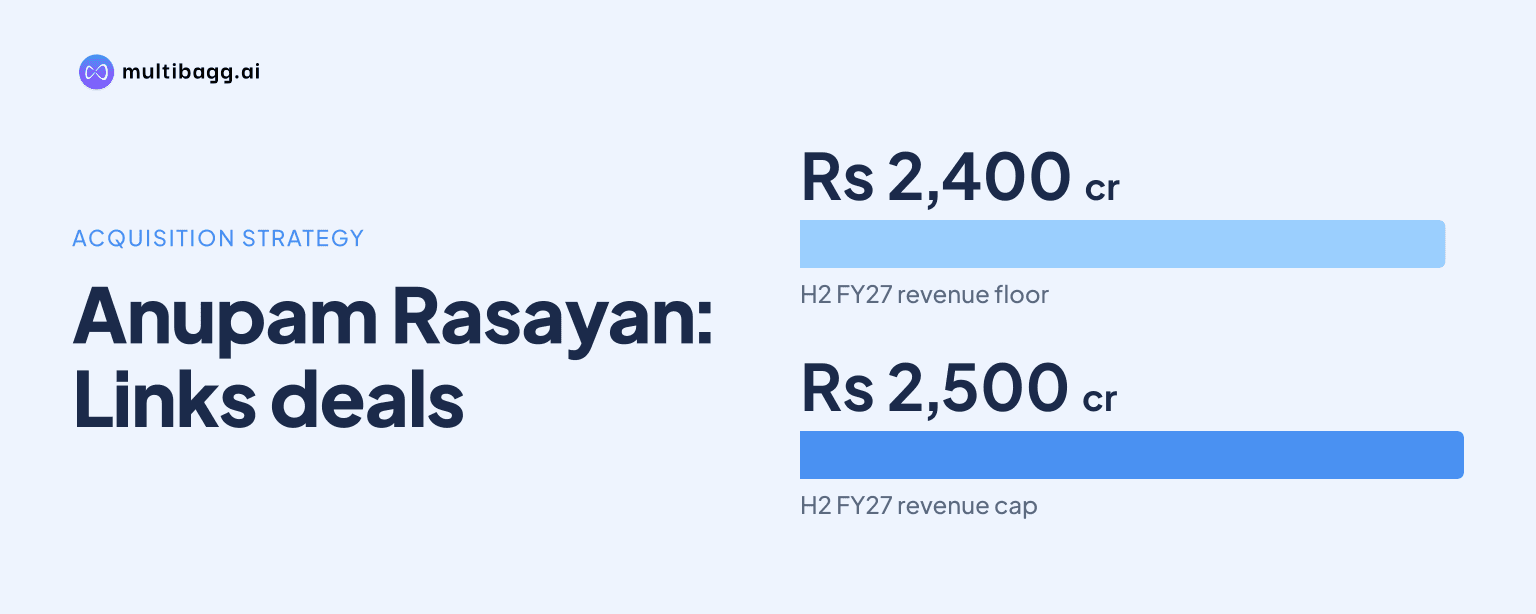
Anupam Rasayan said its acquisitions are designed to build end-to-end supply-chain platforms across fluorination, polymers and pharmaceuticals, rather than add separate revenue streams. Management’s near-term measure of the plan is H2 FY27 consolidated revenue of Rs 2,400 crore to Rs 2,500 crore, as Tanfac, Jayhawk and Bliss are included for fuller periods.
Know Anupam Rasayan India inside out
Results, valuation, peers and who's buying, in one view.
Why is Anupam pursuing acquisitions across the value chain?
Anupam is pursuing acquisitions to offer an integrated supply chain rather than individual products or chemistries. Management said it had already developed that model in agrochemicals and is extending it into pharmaceuticals, polymers and Performance Materials, while reducing its historical concentration in the agrochemical market.
The proposed chain spans basic materials including hydrogen fluoride (HF), potassium fluoride (KF) and nitrobenzene through to monomers, polymers, active pharmaceutical ingredients (APIs) and formulations. Management named India, the U.S., Europe, Japan and Africa as relevant geographies, and said the strategy covers pharma, polymers, agrochemicals, electric vehicles and semiconductor-related Performance Materials over the next two to three years.
How do Tanfac and Jayhawk change Anupam's polymer offering?
Tanfac is intended to secure the HF and KF supply sources that support Anupam’s fluorination chemistry. Jayhawk then extends the offering towards polymer production and adds a U.S. manufacturing base. Management said polymers represented about 20% to 25% of revenue before considering the broader value-chain role of the acquired operations.
Jayhawk also adds high-temperature oxidation and Grignard reaction capabilities, which management described as complementary to Anupam’s existing chemistry portfolio. The combined India and U.S. manufacturing footprint is intended to give customers sourcing choices between locations, particularly for U.S., European and other regulated markets.
Management also cited Jayhawk’s validations in semiconductor and defence applications as a route to shorten time to market. As an example rather than a disclosed order, it said a Japanese customer considering 1,000 tonnes indicated that volumes could potentially triple if Jayhawk supplied the material, while also expressing interest in a further-processed polymer output from the U.S.
How does Bliss fit Anupam's pharmaceutical platform?
Bliss adds formulations to Anupam’s pharmaceutical key starting material business, which management said accounts for about 20% to 25% of Anupam revenue. The acquisition was completed on September 28, 2026, and Bliss was included in Q2 FY27 consolidated results only from that date, or for three days.
An API business remains the missing part of the planned pharmaceutical chain between key starting materials and formulations. Management said it is actively evaluating alternatives and holding discussions, but did not identify a target, set a transaction timetable or disclose financial terms for any possible API acquisition.
Management also sees operational links from its specialty-chemicals sourcing and contract development and manufacturing organisation, or CDMO, activity. It said Bliss plant utilisation was in the 40% range and that Anupam can support sourcing, while its customer presence in U.S. and European regulated markets could support Bliss’s commercial reach.
Got a follow-up? Ask IRIS
When could Anupam begin seeing Bliss acquisition synergies?
Management expects some benefit or momentum from Bliss-related synergies in three to four quarters, rather than immediately after the September 28, 2026 acquisition. It said the teams are deciding which initiatives should begin immediately and which need a planned implementation, focusing on supply, CDMO activity and end-market access.
CDMO discussions involving both companies became more active after the transaction closed, according to management. However, it did not quantify prospective revenue or name customers, describing the discussions as advanced but not at a stage for public disclosure. That distinction means the potential synergies remain an execution plan rather than contracted business.
For ongoing profitability, management said it would use a 22% to 24% earnings before interest, tax, depreciation and amortisation, or EBITDA, margin range for Bliss on a consolidated basis. Bliss had reported about 26.2% operating EBITDA margin in the first half, but management attributed that level partly to higher-margin product sales and price-rise pass-through and retained the lower guidance range.
What revenue plan and further acquisition pipeline did management disclose?
Management said it was looking for H2 FY27 consolidated revenue of around Rs 2,400 crore to Rs 2,500 crore, as Anupam, Jayhawk, Tanfac and Bliss are consolidated for fuller periods. It said this implies an annualised revenue run rate of about Rs 4,800 crore, later describing a range of Rs 4,800 crore to Rs 5,000 crore. Jayhawk had been consolidated for four months, compared with Bliss’s three days in Q2 FY27.
The target follows consolidated H1 FY27 total income of Rs 1,489 crore, up 21% from Rs 1,230 crore in H1 FY26. H1 EBITDA rose 38% to Rs 377 crore from Rs 273 crore, and the EBITDA margin increased to 25.5% from 22.2%, while profit after tax increased 10% to Rs 116 crore from Rs 106 crore. Management said it continues to evaluate multiple opportunities, but disclosed no additional acquisition.
Conclusion
Anupam’s strategy combines control of fluorination inputs through Tanfac, U.S. polymer manufacturing and chemistry capabilities through Jayhawk, and formulations through Bliss. The 20% to 25% revenue contributions management cited for both polymers and pharmaceutical key starting materials show why the company is seeking connected supply chains across multiple end markets rather than a single-product expansion.
The next measures are H2 FY27 consolidated revenue of Rs 2,400 crore to Rs 2,500 crore and the expected three-to-four-quarter period for initial Bliss synergy momentum. Management’s stated plan to fill the API gap remains unresolved, while its disclosure that it continues to evaluate further opportunities leaves the pace and scope of additional acquisitions open.