










AnZen solar generation rises to 484 million units in Q2 FY27
Key highlights
- AnZen generated 484.0 million units of solar power in Q2 FY27, versus 429.9 million units in Q2 FY26.
- AnZen's solar collection days declined to 15 in Q2 FY27 from 20 in Q2 FY26.
- AnZen reported a weighted-average solar tariff of Rs 3.73 per kilowatt-hour.
- AnZen recorded 5,426 solar training man-hours and nil fatal incidents in Q2 FY27.
powered by IRIS
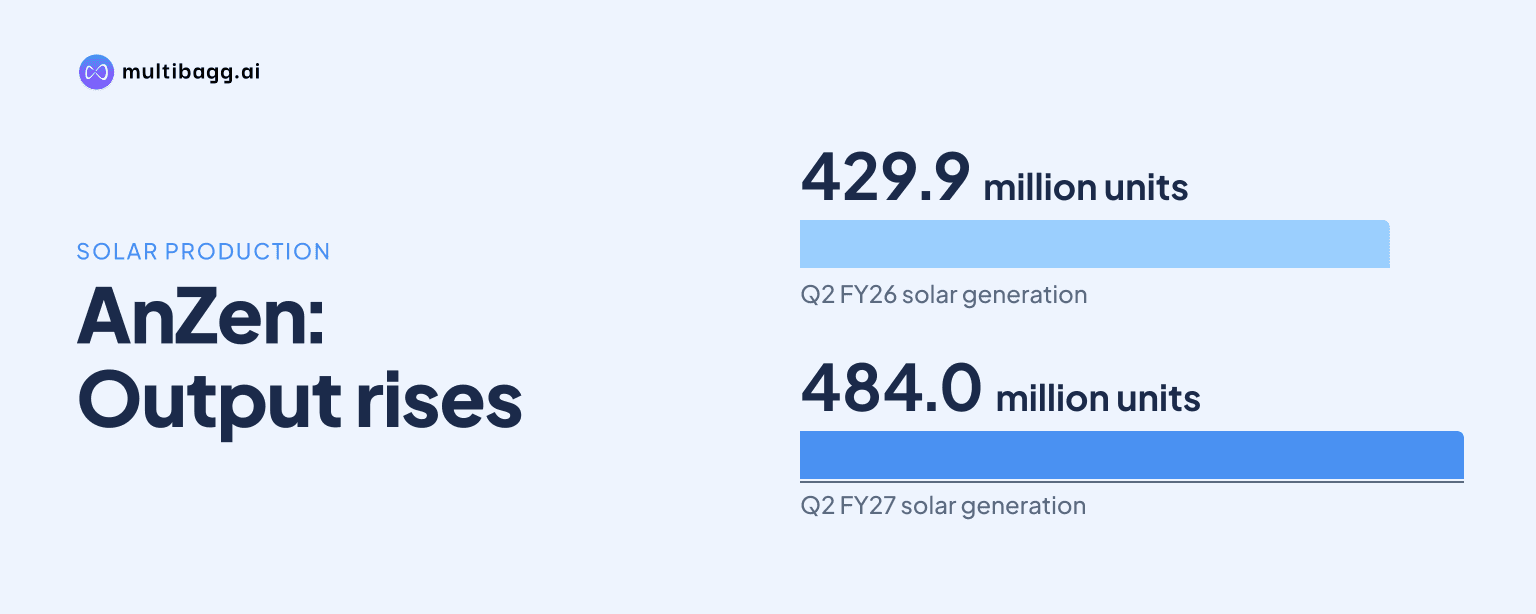
AnZen India Energy Trust generated 484.0 million units of solar power in Q2 FY27, 12.6% above 429.9 million units in Q2 FY26, while collection days declined to 15 from 20. AnZen attributed the higher output to higher irradiation and improved plant availability at Solzen after an inverter issue in H1 FY26.
Know Anzen India Energy Yield Plus Trust inside out
Results, valuation, peers and who's buying, in one view.
How much solar power did AnZen generate in Q2 FY27?
AnZen generated 484.0 million units in Q2 FY27, compared with 429.9 million units in Q2 FY26. The increase of 54.1 million units represents a 12.6% rise over the corresponding quarter, based on the operational data reported for the solar portfolio.
The quarter-on-quarter comparison moved in the other direction: Q2 FY27 generation was 61.5 million units below Q1 FY27's 545.5 million units, a decline of 11.3%. Q2 FY27 was also 22.3 million units below Q4 FY26's 506.3 million units, but remained above Q3 FY26's 441.0 million units and Q2 FY26's 429.9 million units.
Why was AnZen's Q2 FY27 generation higher year on year?
AnZen said Q2 FY27 generation exceeded the corresponding FY26 period because irradiation was higher following a delayed and weaker monsoon in FY27, whereas the monsoon had arrived earlier than usual in FY26. The explanation applies to both Q1 FY27 and Q2 FY27, for which output was reported at 545.5 million units and 484.0 million units, respectively.
AnZen also attributed the increase to improved plant availability at Solzen after an inverter issue in H1 FY26. This availability factor is specific to the comparison with corresponding prior-year periods, while the sequential reduction from 545.5 million units in Q1 FY27 to 484.0 million units in Q2 FY27 is shown in the reported generation series without a separately stated cause.
What tariff does AnZen's solar portfolio receive?
AnZen reported a weighted-average tariff of Rs 3.73 per kilowatt-hour for its solar portfolio. A kilowatt-hour is one unit of electricity, so the disclosed tariff provides portfolio-level price context for the 484.0 million units generated in Q2 FY27 rather than a separately reported revenue figure.
The tariff disclosure should not be treated as a calculation of quarterly revenue because the presentation does not state solar revenue for Q2 FY27 alongside the generation data. It shows that Q2 FY27 generation of 484.0 million units followed 545.5 million units in Q1 FY27, while the weighted-average tariff was presented as a portfolio measure.
Got a follow-up? Ask IRIS
Did AnZen improve solar collection days in Q2 FY27?
AnZen reduced solar collection days to 15 in Q2 FY27, from 16 in Q1 FY27 and 20 in Q2 FY26. The Q2 FY27 result was the lowest collection-days figure in the five reported quarters, which also included 16 days in Q3 FY26 and 17 days in Q4 FY26.
AnZen calculates collection days as quarter-end collection divided by total revenue, multiplied by 365, and excludes unbilled revenue. The measure is weighted using direct-current, or DC, capacities, meaning the 15-day result is a capacity-weighted portfolio figure rather than an unweighted average of individual solar assets.
What operational indicators did AnZen report for its solar assets?
AnZen reported 5,426 training man-hours and nil fatal incidents for the solar portfolio in Q2 FY27. These health, safety and environment figures sit alongside the quarter's 484.0 million units of generation and 15 collection days, linking operating output, cash-cycle measurement and safety reporting for the period.
AnZen describes its asset-management approach as using drone inspections, infrared and spectral imagery, remote monitoring through a central command centre, and predictive-maintenance tools. The platform reported solar assets of about 1,725 megawatt-peak, or MWp, and said these operating practices are intended to minimise downtime, improve asset life and support predictable long-term performance.
Conclusion
AnZen's Q2 FY27 solar data show a year-on-year increase in generation alongside a shorter collection cycle: output reached 484.0 million units versus 429.9 million units in Q2 FY26, and collection days fell to 15 from 20. Management attributed the higher corresponding-period generation to weather-related irradiation and improved Solzen availability after the H1 FY26 inverter issue.
The next operational updates will show how AnZen's technology-led asset-management plan performs across its approximately 1,725 MWp solar portfolio. The disclosed plan includes remote monitoring, predictive maintenance, drone-based inspections and infrared and spectral imagery, with the stated aim of minimising downtime and improving asset life.