










AnZen India Energy Trust reaches 100% availability in Q2 FY27
Key highlights
- DMTCL, NRSS and KTL each reported 100.0% availability in Q2 FY27.
- Q2 FY27 availability was 2.0 percentage points above the 98% normative level.
- Higher availability generated approximately Rs 3.79 crore of incentive income for the period ended September 30, 2026.
- Transmission operations reported 1,471 training man-hours and nil fatal incidents.
powered by IRIS
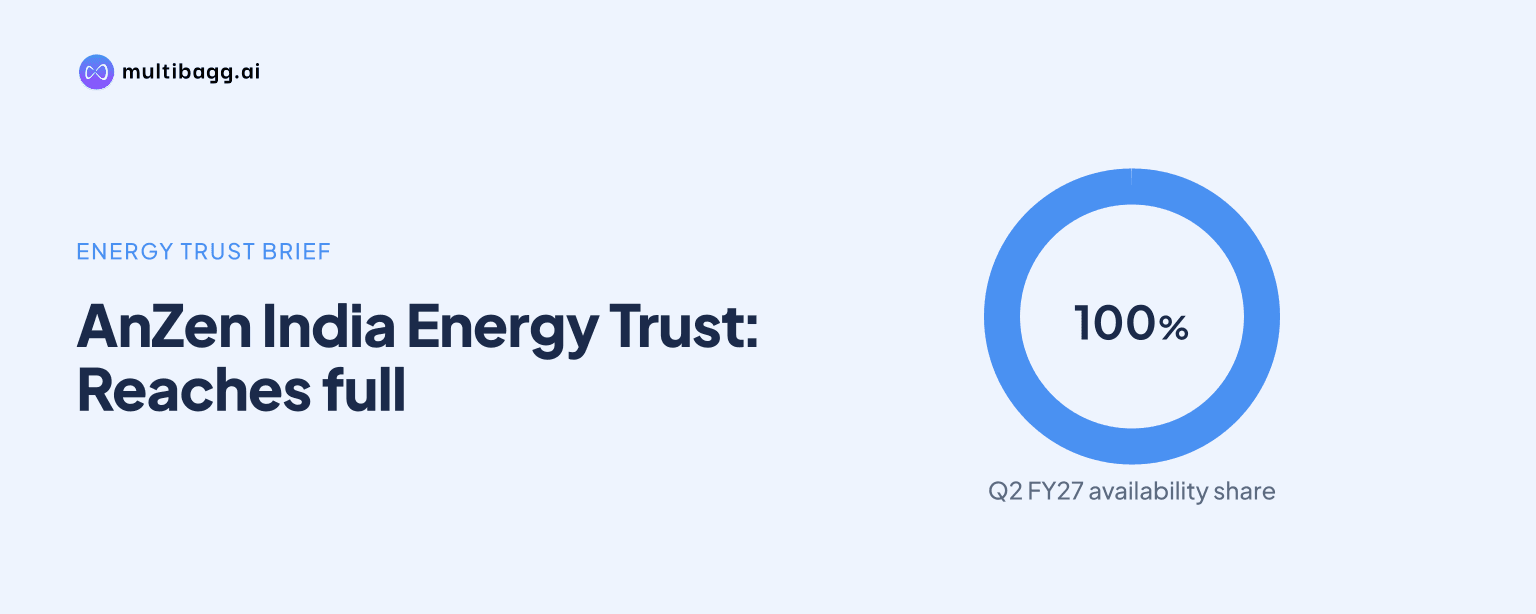
AnZen India Energy Trust reported 100% availability at DMTCL, NRSS and KTL for the second quarter of fiscal year 2027 (Q2 FY27), exceeding the 98% normative availability level and recording approximately Rs 3.79 crore of incentive income for the period ended September 30, 2026. The result followed availability of 99.7% to 99.9% across the three projects in Q1 FY27.
Know Anzen India Energy Yield Plus Trust inside out
Results, valuation, peers and who's buying, in one view.
What availability did AnZen report in Q2 FY27?
AnZen reported 100.0% availability at each of its three transmission projects, DMTCL, NRSS and KTL, in Q2 FY27. This put every project 2.0 percentage points above the 98% normative availability stated in the presentation. The company presents availability as a project-level operating measure for its transmission portfolio.
DMTCL recorded the largest improvement against its FY26 average, rising from 99.4% to 100.0% in Q2 FY27, a 0.6-percentage-point change. NRSS and KTL each had a 99.8% FY26 average and reached 100.0% in Q2 FY27, while their Q2 FY26 readings were already 100.0%. The simple average for the three projects increased from 99.8% in Q1 FY27 to 100.0% in Q2 FY27.
How did Q2 FY27 compare with the preceding quarter?
AnZen improved availability at all three projects from Q1 FY27 to Q2 FY27. DMTCL increased by 0.1 percentage points from 99.9%, NRSS by 0.3 percentage points from 99.7%, and KTL by 0.2 percentage points from 99.8%. Each moved from above the 98% normative level to 100.0%.
The Q2 FY27 outcome also contrasts with Q4 FY26, when DMTCL was at 100.0% but NRSS was at 99.4% and KTL at 99.2%. In Q3 FY26, NRSS and KTL were both at 100.0%, whereas DMTCL was at 99.0%. The quarter ended September 30, 2026 was the first displayed period in which all three projects simultaneously recorded 100.0%.
What revenue did higher transmission availability generate?
AnZen reported approximately Rs 3.79 crore of incentive income from higher availability in the period ended September 30, 2026. The presentation says this amount forms part of revenue from contracts with customers in the consolidated financial statements, connecting the availability outcome to reported contract revenue rather than identifying it as a separate revenue line.
The company also disclosed approximately Rs 45 lakh of additional revenue from other long-term contracts for the same period. Together, the two identified operating items total approximately Rs 4.24 crore, although the presentation separately describes the larger amount as availability-linked incentive income and the smaller amount as revenue from other long-term contracts. The 98% normative threshold is the benchmark against which the 100.0% project readings were shown.
Got a follow-up? Ask IRIS
What do the disclosed collection measures show?
AnZen's displayed transmission collection series shows 32 collection days and 111% collection efficiency for Q2 FY26. That compares with 29 days and 94% efficiency in Q1 FY26, meaning collection days increased by three days while collection efficiency increased by 17 percentage points in the two displayed periods.
The same series lists collection days of 37, 30 and 36 for Q2 FY25, Q3 FY25 and Q4 FY25, respectively, alongside collection efficiency of 114%, 99% and 110%. AnZen defines collection days as quarter-end collection divided by total revenue, multiplied by 365, and collection efficiency as total quarterly collection divided by total quarterly billing. The presentation says the weights for these measures are based on H1 FY27 revenue.
How does AnZen describe its transmission operating approach?
AnZen lists drone-based inspections, infrared and spectral imagery, remote monitoring, a central command centre and predictive-maintenance tools among its technology-led operating initiatives. The presentation links these practices to minimising downtime, improving asset life, enhancing safety and supporting sustainability targets, but it does not quantify the separate contribution of any individual tool to Q2 FY27 availability.
The platform describes its transmission project-management capability as approximately 1,835 circuit kilometres and its solar asset capability as approximately 1,725 megawatt-peak. It also states that transmission assets have average availability above 99%. For the Q2 FY27 transmission portfolio, health, safety and environment data included 1,471 training man-hours, nil fatal incidents and 354 kilolitres of rainwater harvested.
Conclusion
AnZen's Q2 FY27 transmission update shows simultaneous 100.0% availability at DMTCL, NRSS and KTL, compared with a 98% normative level. The result was above the Q1 FY27 range of 99.7% to 99.9% and was accompanied by approximately Rs 3.79 crore of availability-linked incentive income, with a further Rs 45 lakh disclosed from other long-term contracts.
What to watch next is whether each project continues to stay above the disclosed 98% normative availability target and whether availability-linked incentive income continues in subsequent reported periods. The presentation also identifies remote monitoring, drone inspections and predictive maintenance as operating initiatives, while reporting a transmission asset average availability above 99%.