










Apex expects zero EU shrimp tariffs starting early 2027
Key highlights
- Apex expects EU shrimp tariffs to fall from 4.3% on RTC and about 7.2% on RTE products to 0% from early 2027, subject to the arrangement taking effect.
- The EU and UK accounted for 32% of Apex shrimp sales volume in Q2 FY27, while regional volume recovered 46% quarter on quarter.
- Apex reported Q2 FY27 shrimp sales volume of 2,973 metric tons, up 14% year on year, with average realization of Rs 874 per kilogram.
- Apex retained its FY27 target of 12,000 metric tons but cited a possible 11,500-to-12,000-metric-ton outcome if cyclones disrupt supply.
powered by IRIS
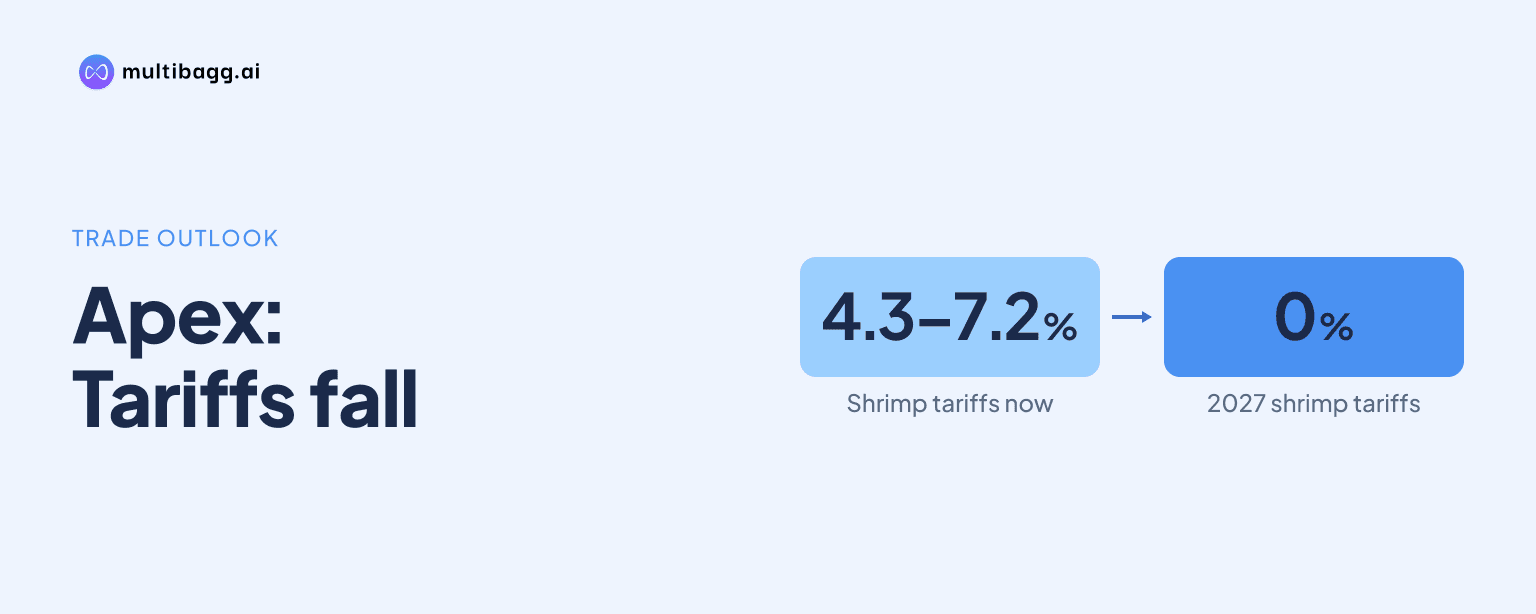
Apex Frozen Foods Limited expects a prospective India-EU arrangement to reduce EU shrimp import tariffs to 0% from early 2027, management said, versus customer-borne tariffs of 4.3% on ready-to-cook (RTC) products and about 7.2% on ready-to-eat (RTE) products. The EU and UK represented 32% of Apex's Q2 FY27 shrimp sales volume.
Know Apex Frozen Foods inside out
Results, valuation, peers and who's buying, in one view.
When will Apex get zero EU shrimp tariffs?
Apex expects zero tariffs on shrimp imports into the European Union from the effective date of the prospective arrangement, which management tentatively expects in early 2027. Management said it had been informed that the benefit could arrive by the end of FY27 or, more certainly, from the start of the following financial year, while noting that the final outcome was not known.
The expected tariff change is therefore a management view rather than a confirmed policy outcome. Apex said it hoped the arrangement would remove tariff barriers and that government authorities would also address non-tariff barriers. Management is planning product expansion in the same period, including a possible first RTE shipment to Japan in January or February 2027.
Why do EU shrimp tariffs matter to Apex?
EU shrimp tariffs matter to Apex because its importers or customers currently bear the 4.3% RTC tariff and the approximately 7.2% RTE tariff. Management said these charges put Apex in a difficult position against Vietnamese competition, meaning a zero-tariff outcome could affect customer pricing and volume opportunities.
The EU and UK remain Apex's second-largest regional market. They accounted for 32% of total shrimp sales volume in Q2 FY27 and 29% in H1 FY27, compared with 62% and 66%, respectively, for the U.S. EU and UK volume declined 33% year on year in Q2 FY27 because of earlier transportation disruption, but recovered 46% quarter on quarter as logistics conditions improved.
Shipping conditions had not fully normalised in Q2 FY27. Apex said vessels serving Europe were taking the Cape of Good Hope route, increasing sailing times and freight costs. Management linked the wider freight pressure to war-related route disruption and higher crude-oil prices, and said shipping lines had provided no positive indication of a near-term cost reduction.
How is Apex building its EU product mix?
Apex is seeking to expand EU sales beyond RTC shrimp by increasing its RTE business, and management said zero tariffs would support that plan. Management described RTE as having better realization and margin potential than more commoditised RTC products, although it did not disclose separate RTE revenue, volume or profitability figures.
Management said Apex is one of the larger exporters from India to Northwestern Europe, based on its understanding of market segments, and intends to grow regional volume rather than remain confined to RTC. The strategy also extends to Japan, where Apex is discussing RTE products with customers that management said have bought such products from Vietnam and Thailand.
Apex's average shrimp realization was Rs 874 per kilogram in Q2 FY27, compared with Rs 870 per kilogram in Q2 FY26. Yet earnings before interest, tax, depreciation and amortisation (EBITDA) were unchanged at Rs 18 crore, while the EBITDA margin fell to 6.4% from 7.2%, reflecting higher farm-gate prices and freight costs. The RTE mix shift is management's stated route to higher realizations and margins, not a quantified earnings forecast.
Got a follow-up? Ask IRIS
How dependent is Apex on Europe for growth?
Apex said it is betting heavily on the EU after the arrangement takes effect, while retaining the U.S. as its largest market and expanding into other geographies. Management said it had a “big expectation” from the EU market once the arrangement becomes effective, but its Q2 FY27 geographic mix shows that Europe was smaller than the U.S. at 32% versus 62% of volume.
The U.S. remained an important source of growth in Q2 FY27, with shrimp sales volume up 59% year on year and flat quarter on quarter. Management attributed the U.S. increase to stabilised tariff rates and healthier customer demand. Other markets, led mainly by Japan, grew approximately 1,000% year on year and 43% quarter on quarter, although management said the growth was from a small base.
Apex is also awaiting product listing approval in Russia and said it hoped to add Russian orders by the end of December and make shipments in Q4. Existing customers would continue to account for the major share of sales, management said, while markets including Eastern Europe and Japan would add new customers. That leaves the EU tariff plan as a diversification lever rather than Apex's only source of volume growth.
Can Apex meet its FY27 volume target while growing Europe?
Apex remained positive on reaching its FY27 target of 12,000 metric tons, although management said the outcome could be 11,500 to 12,000 metric tons if cyclone-related supply damage persists. H1 FY27 volume was about 5,500 metric tons, and management said available capacity and the order book supported its target subject to supply conditions.
The immediate supply risk is cyclone damage on India's east coast, particularly in Andhra Pradesh. Management said some farmers had lost crop and harvested shrimp prematurely at smaller sizes, while another cyclone was expected later that week. It said recent panic harvesting had temporarily lowered farm-gate prices, but expected that effect to be short-lived because premature harvesting reduces supply from that crop cycle.
Management described demand across markets as satisfactory because of diversification, but said dollar-denominated unit prices could face pressure from global inflation and subdued demand in some channels. Apex said it had passed some farm-gate price increases to overseas customers, while Ecuador, Vietnam and Indonesia also influence global pricing. A zero EU tariff would address one competitiveness issue, but would not remove supply, freight or pricing risks.
Conclusion
Apex's expected EU tariff change is central to its plan to deepen sales in its second-largest regional market and increase the share of RTE products. If the 0% rate begins in early 2027 as management expects, removing the 4.3% RTC and roughly 7.2% RTE customer-borne tariffs would address a stated disadvantage against Vietnam in a region that contributed 32% of Q2 FY27 volume.
The next items to watch are confirmation and timing of the prospective EU arrangement, plus Apex's FY27 volume outcome against its 11,500-to-12,000-metric-ton expectation. Management also expects a possible Japan RTE shipment in January or February 2027, awaits Russia listing progress, and faces unresolved cyclone effects on Andhra Pradesh supply and Europe-bound freight costs.