










Apex Frozen Foods has 34,240 MTPA with 10,000 RTE
Key highlights
- Apex Frozen Foods has 34,240 MTPA of shrimp-processing capacity across two Andhra Pradesh plants.
- G. Ragampeta has 10,000 MTPA of ready-to-eat capacity and 2,500 MT of cold storage.
- Apex Frozen Foods’ three hatcheries can produce 1.2 billion to 1.4 billion SPF shrimp seed.
- The United States and Europe accounted for 48% and 47% of Apex Frozen Foods’ FY26 export mix.
powered by IRIS
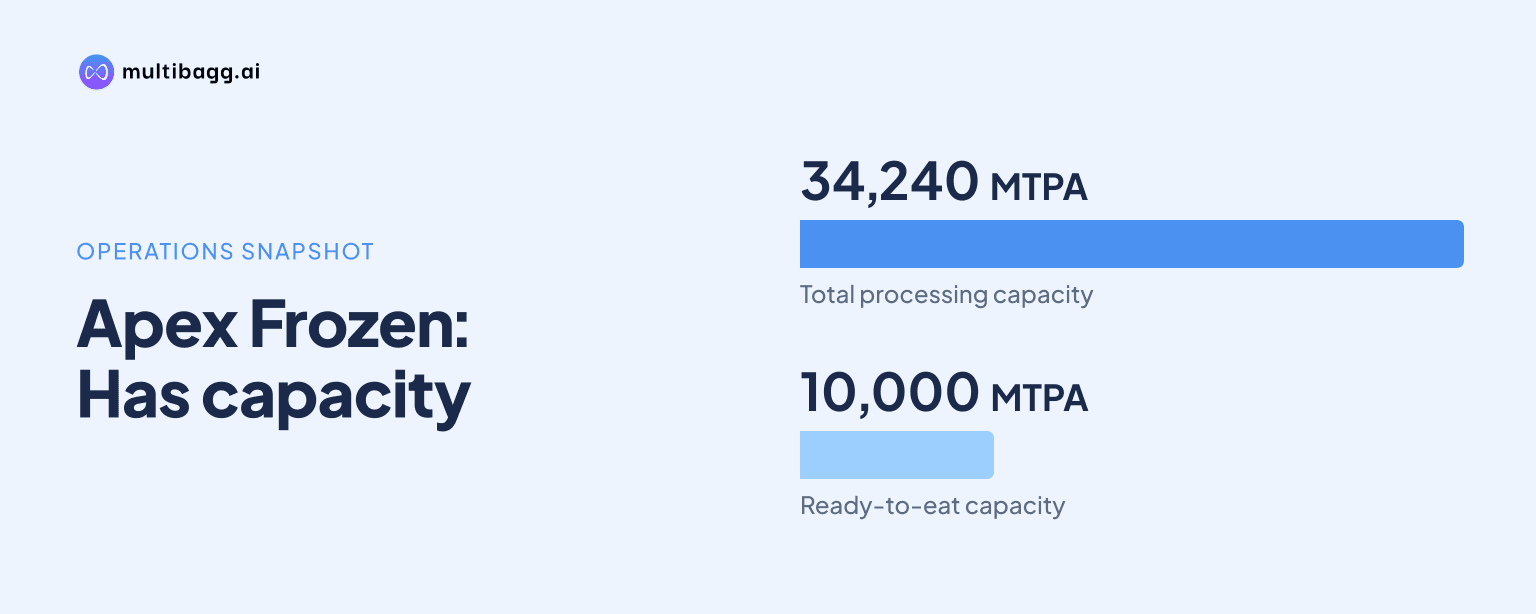
Apex Frozen Foods Ltd operates 34,240 metric tonnes per annum (MTPA) of shrimp-processing capacity, including 10,000 MTPA of ready-to-eat (RTE) products at G. Ragampeta. The two Andhra Pradesh plants also provide 3,500 metric tonnes (MT) of cold storage, while three hatcheries can produce 1.2 billion to 1.4 billion specific pathogen free shrimp seed.
Know Apex Frozen Foods inside out
Results, valuation, peers and who's buying, in one view.
What shrimp-processing capacity does Apex Frozen Foods operate?
Apex Frozen Foods operates 34,240 MTPA of shrimp-processing capacity across two Andhra Pradesh facilities. Its Kakinada unit has 9,240 MTPA of ready-to-cook capacity, while G. Ragampeta has 15,000 MTPA of ready-to-cook capacity and 10,000 MTPA of RTE capacity.
G. Ragampeta is the larger facility, with 25,000 MTPA of combined ready-to-cook and RTE capacity versus 9,240 MTPA at Kakinada. It also has 2,500 MT of cold storage, compared with 1,000 MT at Kakinada, concentrating the full 10,000 MTPA RTE capability and most of the company’s stated storage at one site.
The 34,240 MTPA total comprises 24,240 MTPA of ready-to-cook processing and 10,000 MTPA of RTE processing. Apex Frozen Foods states that 100% of finished frozen-shrimp product is exported, primarily to the United States, the European Union and China and other markets, making the capacity base oriented to overseas demand rather than domestic sales.
How is Apex Frozen Foods integrated across the shrimp supply chain?
Apex Frozen Foods is integrated in shrimp seed production, processing and logistics, while the farming stage is outsourced. Its three owned hatcheries have capacity for 1.2 billion to 1.4 billion specific pathogen free (SPF) shrimp seed, and its in-house processing covers sizing, grading, deheading, peeling, cooking and value addition.
The company’s value-chain map identifies pre-processing, processing and logistics as in-house activities. Its logistics infrastructure includes 3,500 MT of cold storage and owned refrigerated trucks, with products shipped as ready-to-cook and RTE shrimp. Farming is shown as outsourced, separating the hatchery operation from the cultivation of shrimp in ponds.
Apex Frozen Foods states that its facilities are about 20 kilometres from Kakinada port and about 150 kilometres from Vizag port. The company also says the facilities are within 20 kilometres to 200 kilometres of most farms supplying produce for processing, linking raw-material sourcing, plant operations, cold storage and export logistics within Andhra Pradesh.
How did Apex Frozen Foods build its ready-to-eat capacity?
Apex Frozen Foods built its 10,000 MTPA RTE capacity in two 5,000-MT stages at G. Ragampeta. The company entered the RTE category with 5,000 MT of capacity when the G. Ragampeta processing plant was established in March 2020, then commissioned an additional 5,000-MT RTE line at the end of May 2023.
The resulting 10,000 MTPA RTE capacity is separate from G. Ragampeta’s 15,000 MTPA ready-to-cook capacity. The facility therefore accounts for all RTE capacity disclosed by Apex Frozen Foods, whereas both G. Ragampeta and Kakinada produce ready-to-cook shrimp, with combined capacity of 24,240 MTPA.
The RTE offering includes cooked peeled and deveined tail-on shrimp, cooked-in-shell products, shrimp rings, dusted and breaded products, and par-fried products. The wider portfolio also includes base products such as head-on, whole headless, shell-on and easy-peel shrimp; peeled formats; and specialty products including butterfly, skewered and seasoned shrimp.
Got a follow-up? Ask IRIS
Where does Apex Frozen Foods sell its finished shrimp?
Apex Frozen Foods exported finished frozen shrimp primarily to the United States, Europe, China and other markets, with the United States accounting for 48% and Europe for 47% of its FY26 export mix. The remaining 5% was classified as other markets, leaving the two largest regions almost evenly split in the company’s reported sales geography.
Apex Frozen Foods serves food companies, retail chains, restaurants, club stores and distributors across these export geographies. Its FY26 non-US share was 52%, compared with the presentation’s stated non-US business share of about 45% in Q1FY26, indicating a higher non-US proportion in the FY26 regional mix reported on the company-at-a-glance page.
The company says European Union approval for its second facility was completed during the 2022 to 2025 period. That approval is disclosed alongside the May 2023 RTE expansion and an increased share of RTE products in overall sales, although the presentation does not give revenue by product format or by individual export destination.
What market conditions could affect Apex Frozen Foods' capacity use?
Apex Frozen Foods identifies demand slowdown in the United States, European Union and South-East Asia, disease outbreaks, global demand-supply imbalances and exchange-rate fluctuations as sector considerations. These mechanisms can affect export demand, raw-shrimp availability and pricing for a company directing 100% of finished frozen-shrimp products to export markets.
The presentation’s industry data show India’s frozen-shrimp export volume rose by 51,000 MT to 793,000 MT in FY26 from 742,000 MT in FY25. Total Indian seafood export volume increased by 274,000 MT to 1,972,000 MT in FY26 from 1,698,000 MT in FY25, while other seafood volume rose to 1,179,000 MT from 957,000 MT.
India’s FY26 shrimp export mix differed from Apex Frozen Foods’ reported regional mix. The United States accounted for 32% of India’s shrimp exports, China for 21% and the European Union for 17%, while Apex Frozen Foods reported 48% from the United States and 47% from Europe; the company presentation does not provide a separate China share for its own exports.
Conclusion
Apex Frozen Foods combines 34,240 MTPA of processing capacity, including 10,000 MTPA of RTE output, with 3,500 MT of cold storage, owned refrigerated trucks and hatchery capacity of 1.2 billion to 1.4 billion SPF seed. Ready-to-cook production is split across Kakinada and G. Ragampeta, while the full RTE platform is located at G. Ragampeta following the additional 5,000-MT line commissioned in May 2023.
What to watch next is the effect of the May 2023 RTE addition and European Union approval for the second facility on product and regional sales mix. Management reports that RTE’s sales share increased and non-US business was about 45% in Q1FY26, but the presentation provides neither capacity-utilisation data nor a numerical RTE sales target.