










Apex Frozen Foods H1FY27 operating cash flow turns negative
Key highlights
- Apex Frozen Foods reported negative operating cash flow of Rs 12.3 crore in H1FY27, versus Rs 95.8 crore generated in FY26.
- Cash and cash equivalents fell from Rs 18.5 crore at the start of H1FY27 to Rs 2.7 crore in the cash-flow statement.
- Trade receivables rose by Rs 21.2 crore and inventories increased by Rs 12.2 crore between March and September 2026.
- Short-term borrowings increased from Rs 4 crore at March 2026 to Rs 18.2 crore at September 2026.
powered by IRIS
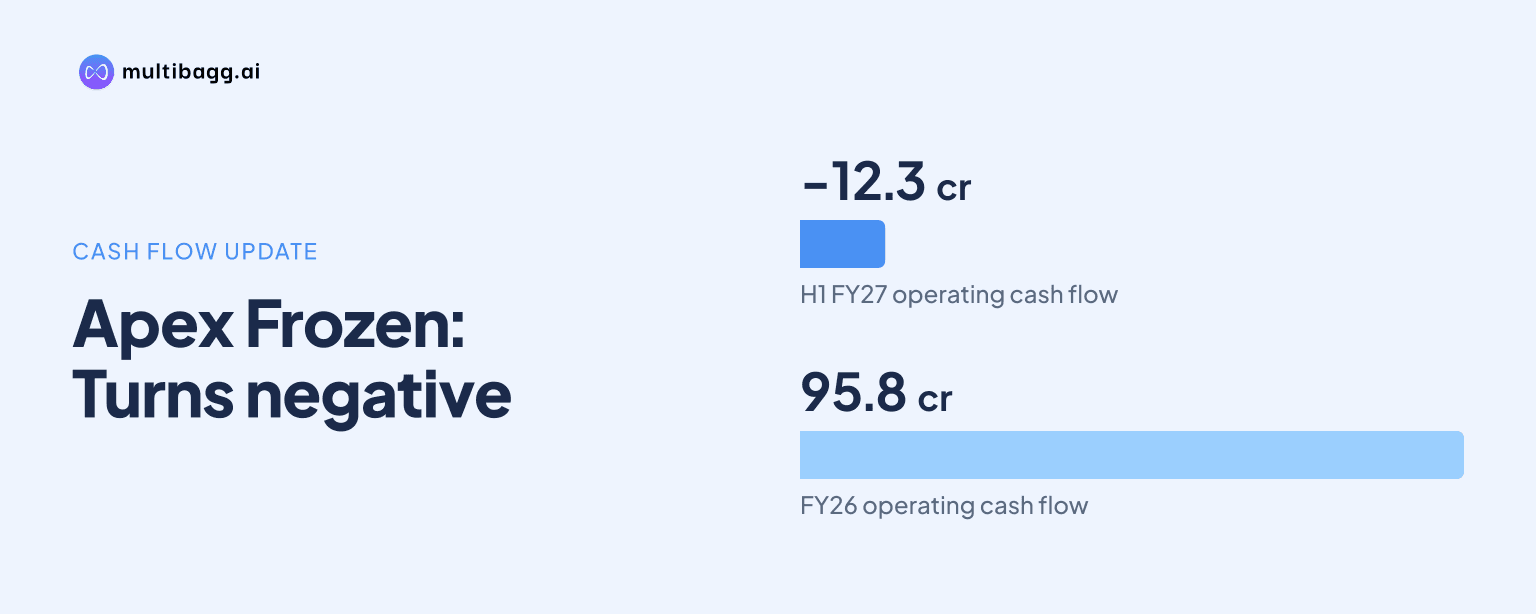
Apex Frozen Foods Ltd reported negative operating cash flow of Rs 12.3 crore in H1FY27, while cash and cash equivalents fell from Rs 18.5 crore at the start of the period to Rs 2.7 crore at its end. The reversal occurred despite profit after tax rising 13% year on year to Rs 23.8 crore.
Know Apex Frozen Foods inside out
Results, valuation, peers and who's buying, in one view.
Why did Apex Frozen Foods’ cash fall in H1FY27?
Apex Frozen Foods’ cash fell because a Rs 12.3 crore operating cash outflow and Rs 10.8 crore investing outflow exceeded the Rs 7.3 crore financing cash inflow. The resulting net decrease was Rs 15.8 crore in H1FY27, reducing the cash-flow statement’s closing cash balance to Rs 2.7 crore from its Rs 18.5 crore opening balance.
The half-year result contrasts with cash generation in the prior two full years. Net cash generated from operating activities was Rs 95.8 crore in FY26 and Rs 54.3 crore in FY25, compared with a negative Rs 12.3 crore in H1FY27. FY25 and FY26 are full-year periods, while H1FY27 covers six months, but the direction of operating cash flow changed.
Apex Frozen Foods reported no foreign-exchange effect on cash and cash equivalents in H1FY27. The Rs 15.8 crore decline in the cash-flow extract therefore reflects the reported operating, investing and financing flows rather than a foreign-exchange movement.
What changed in Apex Frozen Foods’ working-capital balances by September 2026?
Apex Frozen Foods had Rs 21.2 crore more trade receivables and Rs 12.2 crore more inventory at September 2026 than at March 2026. Trade receivables rose to Rs 129.7 crore from Rs 108.5 crore, while inventories increased to Rs 178.7 crore from Rs 166.5 crore during the six-month period.
Other current assets increased by Rs 10.2 crore to Rs 33.4 crore at September 2026 from Rs 23.2 crore at March 2026. Total current assets rose to Rs 346 crore from Rs 317.8 crore, while the balance-sheet cash figure declined to Rs 2.8 crore from Rs 18.5 crore.
Current liabilities also rose, reaching Rs 85.2 crore at September 2026 against Rs 53.3 crore at March 2026. Trade payables increased by Rs 5.3 crore to Rs 34.5 crore, other current liabilities rose by Rs 5.1 crore to Rs 21.3 crore, and short-term provisions increased to Rs 11.3 crore from Rs 0.7 crore.
The presentation does not provide an operating-cash-flow reconciliation that allocates the Rs 12.3 crore outflow to specific balance-sheet movements. It does, however, show higher receivables, inventories and other current assets in the same period that operating cash flow turned negative.
Got a follow-up? Ask IRIS
Did Apex Frozen Foods’ H1FY27 profits convert into operating cash?
No, Apex Frozen Foods reported Rs 23.8 crore of profit after tax, or PAT, in H1FY27 alongside a Rs 12.3 crore operating cash outflow. PAT increased from Rs 21 crore in H1FY26, but net cash generated from operating activities was negative in H1FY27.
Revenue increased 7% year on year to Rs 530.2 crore in H1FY27. Earnings before interest, tax, depreciation and amortisation, or EBITDA, rose 40% to Rs 50.7 crore, and EBITDA margin increased to 9.4% from 7.1%; PAT margin rose to 4.4% from 4.1%.
The second quarter contributed less reported profit than the first. Q2FY27 PAT was Rs 2.1 crore, against Rs 21.7 crore in Q1FY27, while EBITDA was Rs 17.7 crore in Q2FY27 compared with Rs 33 crore in Q1FY27.
Apex Frozen Foods recorded Rs 9.4 crore of exceptional items in Q2FY27, versus nil in Q1FY27. The profit and loss note cites a Rs 10.1 crore provision for incremental anti-dumping duty liability for earlier years after duty-rate revisions from 1.35% to 3.76% and subsequently 5.53%, but the presentation does not reconcile that figure with the Rs 9.4 crore exceptional-items line.
How was Apex Frozen Foods’ H1FY27 cash movement financed?
Apex Frozen Foods recorded Rs 7.3 crore of net cash from financing activities in H1FY27, compared with financing cash outflows of Rs 77.8 crore in FY26 and Rs 49.2 crore in FY25. The inflow partly offset the combined Rs 23.1 crore used in operating and investing activities, but did not prevent the Rs 15.8 crore decline in cash.
Short-term borrowings rose to Rs 18.2 crore at September 2026 from Rs 4 crore at March 2026, an increase of Rs 14.2 crore. Long-term borrowings increased to Rs 2.4 crore from Rs 1.7 crore over the same period.
Shareholders’ funds increased to Rs 544 crore at September 2026 from Rs 528 crore at March 2026, including reserves and surplus of Rs 512.7 crore. Apex Frozen Foods reported a debt-to-equity ratio of 0.04 times as of 30 September 2026.
Investing cash use was Rs 10.8 crore in H1FY27, against Rs 1.7 crore in FY26 and Rs 5.9 crore in FY25. Non-current assets increased to Rs 293.2 crore from Rs 274.8 crore between March and September 2026, including other non-current assets rising to Rs 48.7 crore from Rs 33.8 crore.
Conclusion
Apex Frozen Foods’ H1FY27 figures show a gap between reported earnings growth and cash generation. Higher receivables, inventories and other current assets coincided with negative operating cash flow, while financing inflows and increased short-term borrowings only partly offset operating and investing cash use.
The next disclosure should clarify whether the company reconciles the Rs 9.4 crore exceptional-items charge with the Rs 10.1 crore anti-dumping-duty provision cited in its note. It should also clarify the difference between Rs 2.7 crore of closing cash in the cash-flow statement and Rs 2.8 crore in the September 2026 balance-sheet highlights.