










Apex Frozen Foods says farm-gate prices, freight shape margins
Key highlights
- Apex Frozen Foods said farm-gate shrimp prices rose almost 15%-20% in August and September before a major October correction.
- Apex Frozen Foods said European Union shipments take 2 to 3 weeks after production, extending inventory-holding periods.
- Apex Frozen Foods said higher RTE volumes can improve realisations and margins, although high-end products have constrained certain production lines.
- Apex Frozen Foods hoped to add Russia to its order book by the end of December, with possible Q4 shipments.
powered by IRIS
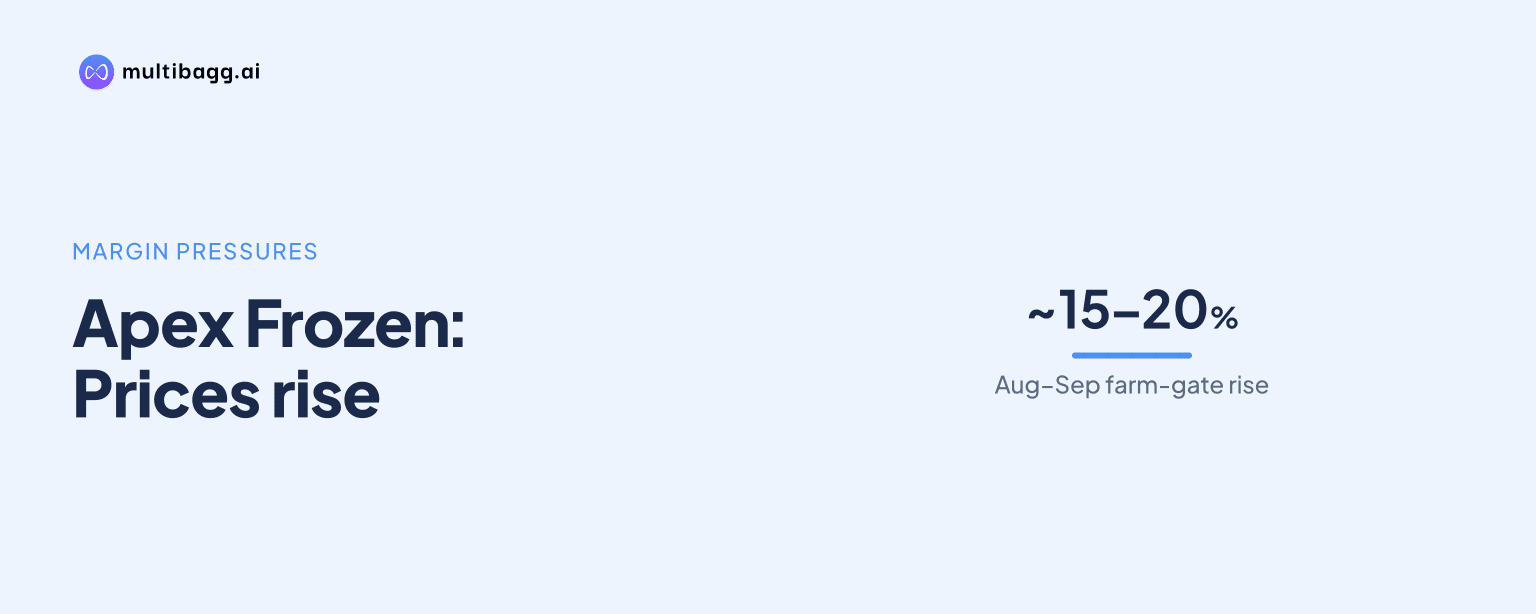
In Q2 FY27, Apex Frozen Foods Limited said its margin recovery depends on farm-gate shrimp prices staying lower after an almost 15%-20% rise in August and September, as well as its cost actions, value-added volumes and ocean freight costs. Management said an October price correction helped processors but its durability remains uncertain.
Know Apex Frozen Foods inside out
Results, valuation, peers and who's buying, in one view.
What will determine Apex Frozen Foods' margin recovery?
Apex Frozen Foods said farm-gate shrimp prices, cost measures, value-added product mix and ocean freight will determine margin recovery, rather than demand alone. Management identified farm-gate pricing as a major influence on earnings before interest, tax, depreciation and amortisation (EBITDA), because higher procurement costs can affect profitability before selling prices adjust.
The company said higher value-added volumes are its principal controllable route to more stable margins. Management did not provide an EBITDA margin target or call the Q2 FY27 result sustainable over the medium term; instead, it said the quarterly EBITDA outcome was below its earlier expectation because of commodity pricing, feed costs and farm-level supply conditions.
Ocean freight is another external factor. Management said freight had risen but was not at pandemic levels. It said buyers source from several geographies, so a rise in shipping costs from India that is not matched by freight from Ecuador can affect what customers are willing to pay.
Why did farm-gate prices pressure Apex Frozen Foods' Q2 FY27 margins?
Farm-gate prices pressured Q2 FY27 margins because they rose almost 15%-20% in August and September, with the effect extending into part of October. Apex Frozen Foods linked the increase to stagnant farm-level supply in India, alongside feed and wider commodity-cost pressures.
Management said export markets influence farm-gate prices after export realisations are converted into Indian rupees. It also said stronger domestic demand can raise farm-gate prices and affect selling prices later, creating a timing gap between a processor's higher input cost and a potential sales-price response.
The October correction was needed after the Q2 FY27 increase and was favourable for processors, according to management. However, Apex Frozen Foods said cyclones or flooding can remove shrimp supply from an affected region, influencing the company and the broader industry, so the duration of the correction remains unresolved.
Got a follow-up? Ask IRIS
Can value-added products offset Apex Frozen Foods' input-cost volatility?
Value-added products can improve realisations and margins, but Apex Frozen Foods said they do not remove exposure to farm-gate prices and freight. Management identified ready-to-eat (RTE) shrimp as offering better realisation and margin scope when the company can build meaningful volume.
Apex Frozen Foods is pursuing RTE business beyond the United States and European Union, including Asian markets. It also cited ready-to-cook (RTC) opportunities in Japan, where management said customers source mainly from Thailand and Vietnam, with some supply from Indonesia; no revenue contribution or timetable was disclosed.
Management said high-end products have created capacity-utilisation limitations on certain production lines in FY27. It added that the company must make different products for different customers during different parts of the year, meaning diversification and cost measures, rather than RTE growth alone, underpin the margin plan.
United States demand also changes through the year. Management described the period from Labor Day to Thanksgiving as generally slower, while Christmas and New Year are important consumption periods; sustained sales of new products ultimately depend on distributor promotion and end-customer acceptance.
What could improve Apex Frozen Foods' export execution and sales mix?
Management said quicker implementation of free-trade agreements and removal of non-tariff barriers could improve Apex Frozen Foods' export conditions. It said government negotiations affect the sales environment, while agreements can take roughly 9 months to 1 year to become effective after signing.
European Union shipments currently take 2 to 3 weeks after production because of non-tariff barriers and issues involving Indian regulatory agencies, according to management. Apex Frozen Foods said the delay extends its inventory-holding period, while shipments to the United States and other countries do not take as long.
Existing customers are expected to contribute the major part of sales. These customers are distributors holding inventory for retail and food-service end users, while Apex Frozen Foods said it has added customers in East Europe and Japan and hoped to add Russia to its order book by the end of December, with shipments potentially starting in Q4.
Conclusion
Apex Frozen Foods' Q2 FY27 comments show that value-added mix can support realisations, but margin recovery relies on wider cost and supply conditions. The almost 15%-20% farm-gate price rise in August and September weighed on EBITDA expectations, while the October correction provides relief only if it holds despite weather-related supply risks and freight differences across origins.
The next indicators are whether the October farm-gate correction persists, whether ocean freight changes relative to competing origins, and whether RTE and RTC volumes grow without adding line-capacity constraints. Management also hoped to add Russia to the order book by the end of December and expected potential Q4 shipments, while European Union shipping procedures and trade-agreement implementation may take longer.