










Apex books Rs 30 crore provision after U.S. duty rate increase
Key highlights
- Apex recognised a Rs 10.10 crore Q2 FY27 provision toward an approximately Rs 30 crore U.S. antidumping-duty liability.
- The applicable U.S. antidumping-duty rate rose from 1.35% to 3.76% and then 5.53%.
- Q2 FY27 profit after tax fell to Rs 2 crore from Rs 12 crore, while revenue rose 15% to Rs 274 crore.
- H1 FY27 EBITDA increased 40% to Rs 51 crore and profit after tax rose 13% to Rs 24 crore.
powered by IRIS
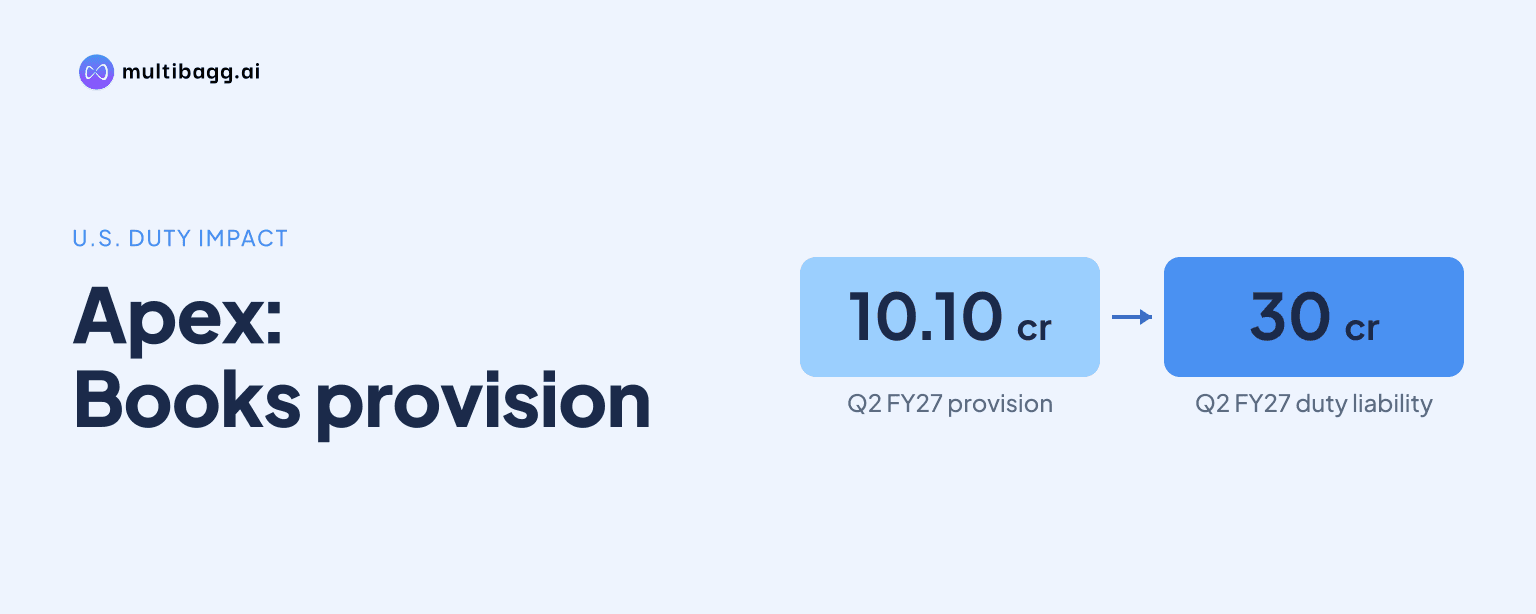
Apex Frozen Foods Limited recorded a Rs 10.10 crore provision in Q2 FY27 toward an approximately Rs 30 crore incremental U.S. antidumping-duty liability after the applicable rate rose from 1.35% to 5.53%; Apex has appealed the determination before the U.S. Court of International Trade.
Know Apex Frozen Foods inside out
Results, valuation, peers and who's buying, in one view.
Why did Apex record an approximately Rs 30 crore provision?
Apex recorded the provision because final determinations by the U.S. Department of Commerce raised its antidumping-duty rate first from 1.35% to 3.76% and subsequently to 5.53%. Management said the approximately Rs 30 crore liability relates to earlier years and had previously been treated as a contingent liability rather than a charge in the profit and loss account.
The Rs 10.10 crore Q2 FY27 provision was made after discussions with the Audit Committee and auditors, according to management. Apex described the decision as a prudent accounting measure given uncertainty around the ultimate liability, while stating that it expects the applicable rates to be reduced through its appeal process.
The provision is an exceptional item, which separates it from underlying operating costs such as farm-gate shrimp prices and freight. That distinction matters in reading Q2 FY27 results: profit before tax and exceptional items was Rs 13 crore, unchanged from Q2 FY26, but reported profit after tax fell to Rs 2 crore from Rs 12 crore.
How did the U.S. duty provision affect Apex's quarterly profit?
The U.S. duty provision reduced Apex's Q2 FY27 reported profit after tax to Rs 2 crore, versus Rs 12 crore in Q2 FY26, despite a 15% increase in net revenue to Rs 274 crore. Management identified the exceptional antidumping-duty charge as the primary reason for the decline in quarterly profit after tax.
Operating profit did not rise with revenue in the quarter. Earnings before interest, tax, depreciation and amortisation, or EBITDA, remained Rs 18 crore year on year, while the EBITDA margin declined to 6.4% from 7.2%. Management attributed the margin change to higher farm-gate prices amid subdued supply conditions in August and September, as well as higher freight costs.
The comparison shows that revenue increased by Rs 36 crore while EBITDA and profit before tax before exceptional items were flat. The provision therefore coincided with a Rs 10 crore year-on-year reduction in reported quarterly profit after tax, alongside a cost environment that management said included elevated freight and raw-material prices.
Did Apex's half-year performance offset the Q2 charge?
Apex's H1 FY27 profit after tax increased 13% to Rs 24 crore from Rs 21 crore in H1 FY26 even after the Q2 exceptional charge, because first-half operating performance improved. Net revenue rose 7% to Rs 530 crore, EBITDA increased 40% to Rs 51 crore, and the EBITDA margin expanded to 9.4% from 7.1%.
Profit before tax and exceptional items rose 60% to Rs 42 crore in H1 FY27 from Rs 26 crore in H1 FY26. Management linked the half-year result to higher realisations, a recovery in sales volume during Q2 and continuing cost-efficiency measures, while noting that the duty provision was recognised in Q2.
The contrast between Q2 and H1 shows the effect of timing. Q2 FY27 reported profit after tax was Rs 2 crore after the provision, but first-half profit after tax still exceeded the prior-year period by Rs 3 crore. Apex also reported a debt-to-equity ratio of 0.04 times as of September 2026, which management described as reflecting prudently managed debt.
Got a follow-up? Ask IRIS
What changed in Apex's U.S. and European shrimp sales?
Apex's shrimp sales volume reached 2,973 metric tons in Q2 FY27, up 14% year on year and 13% sequentially, while average shrimp realisation increased to Rs 874 per kilogram from Rs 870 per kilogram in Q2 FY26. U.S. sales volume increased 59% year on year and was flat quarter on quarter, supported by what management called improving trade visibility and healthy customer demand.
The U.S. remained Apex's largest destination, accounting for 62% of Q2 FY27 shrimp-sales volume and 66% in H1 FY27. Management said the improvement in U.S. demand followed stabilisation of tariff rates from the beginning of the year, although Apex continued to pursue geographic diversification amid changing global trade conditions.
Europe showed opposite year-on-year and sequential trends. Sales volume to the European Union and United Kingdom declined 33% year on year in Q2 FY27 because of earlier transportation disruption, but recovered 46% quarter on quarter as logistics conditions improved. The EU and UK represented 32% of Q2 volume and 29% of H1 volume, compared with 6% and 5%, respectively, for other markets.
Management said vessels travelling around the Cape of Good Hope have extended sailing times to Europe and that freight costs have risen amid war-related route disruption and higher crude-oil prices. Other markets, supported mainly by Japan, grew approximately 1,000% year on year and 43% quarter on quarter in Q2 FY27, though management said this growth came from a small base.
What is Apex doing to contest the U.S. duty rate?
Apex has filed an appeal with the U.S. Court of International Trade against the U.S. Department of Commerce determination that lifted its rate to 5.53%. Management did not provide a timetable for a court outcome, but said it expects the rate to be reduced and nevertheless recognised the Rs 10.10 crore Q2 FY27 provision because of the uncertainty.
Alongside the appeal, management said Apex is seeking a greater share of value-added and ready-to-eat shrimp products, which it said carry higher realisations and margins than more commoditised products. It is discussing ready-to-eat products with Japanese customers and expects a first shipment in January or February 2027, subject to ongoing customer discussions.
Apex also said the U.S. remains a key market despite its diversification effort. The company reported that higher farm-gate prices and freight costs pressured Q2 FY27 margin, while the antidumping-duty provision was specific to earlier-year U.S. liability and was recognised as an exceptional accounting item rather than part of ordinary product costs.
Conclusion
Apex's approximately Rs 30 crore U.S. antidumping-duty provision materially changed the presentation of Q2 FY27 earnings: revenue rose to Rs 274 crore and profit before tax and exceptional items remained Rs 13 crore, yet reported profit after tax fell to Rs 2 crore. At the half-year level, however, EBITDA rose to Rs 51 crore and profit after tax reached Rs 24 crore, above Rs 21 crore a year earlier.
The next disclosures to watch are the progress of Apex's appeal in the U.S. Court of International Trade and whether the rate set at 5.53% is reduced. Management also expects a potential ready-to-eat shipment to Japan in January or February 2027, while continued shipping disruption, freight costs and farm-gate shrimp supply remain unresolved factors for subsequent quarters.