








APL Apollo Tubes Options Reprice as ₹1,800 Put Reaches ₹135.85
MAX Plan at ₹4,999/yr

Find your next multibaggerBe a Pro Investor
Research stocks and track your picks on the go. Download the app.
Key highlights
- The APL Apollo Tubes ₹1,800 put closed at ₹135.85 on 23 November 2026, versus ₹0.15 previously.
- APL Apollo Tubes derivatives open interest rose by as much as 24.9% in the reported updates.
- The ₹1,500 call recorded 10,329 contracts traded and open interest of 2,792.
- APL Apollo Tubes delivery volume reached ₹3.61 crore on 23 November, up 5,805% over the recent average.
powered by IRIS
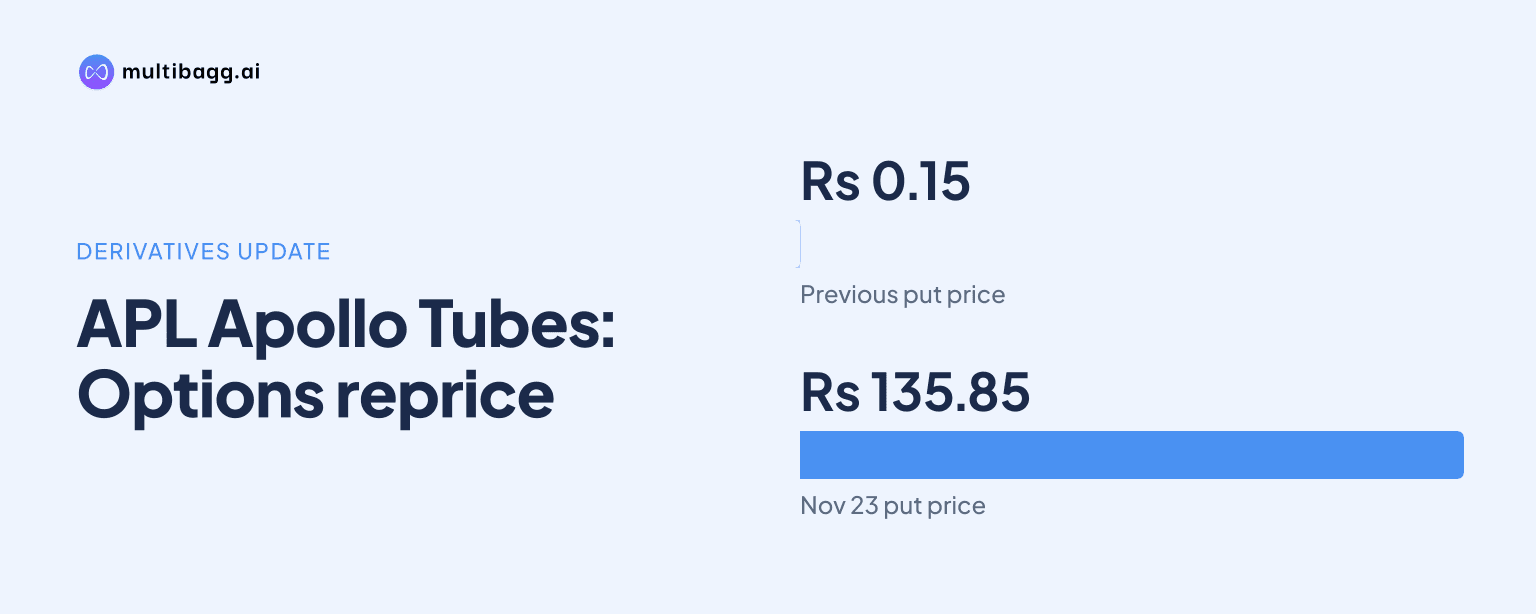
APL Apollo Tubes Limited saw a sharp options repricing on 23 November 2026, when its ₹1,800 put closed at ₹135.85 after a previous close of ₹0.15, amid intense selling pressure in the cash market. The move coincided with rising derivatives participation, delivery activity and uncertainty over near-term direction.
Why did APL Apollo Tubes options reprice sharply?
APL Apollo Tubes options repriced as the underlying share faced severe pressure, with selected put contracts recording an unusually large change in premium. The clearest example in the available data is the ₹1,800 put, which rose from ₹0.15 at the previous close to ₹135.85 on 23 November 2026.
A put option can gain value when the underlying share price declines or when traders assign a higher probability to a decline before expiry. However, the reported premium move alone cannot establish whether every trade represented a fresh bearish bet, a hedge against an existing holding, or the closing of an earlier position. It does show that participants were paying far more for downside-linked exposure than in the preceding session.
What does the open interest rise in APL Apollo Tubes mean?
The rise in open interest means more derivative contracts were outstanding while APL Apollo Tubes shares were declining. Reported derivatives open interest increased by 24.9% in one update, while other updates showed increases of 19.3%, 19.82% and 20.95%, reflecting heightened participation across different observations.
Open interest does not independently identify the direction of each position. A new contract has both a buyer and a seller, so it cannot by itself confirm broad long or short positioning. In the context of a falling share price and increased put activity, the data is consistent with elevated bearish positioning or protective hedging, but it is not conclusive proof of either explanation.
Which APL Apollo Tubes option strikes saw activity?
The 29 December 2026 expiry showed trading and open interest across several call and put strikes, with activity concentrated around prices relevant to the recent decline. The ₹1,500 call had 10,329 contracts traded and open interest of 2,792, while the ₹1,800 call was identified as the most active call option on 25 November, with 6,734 contracts traded.
The gap between notable call activity and weakness in the cash market adds complexity to the signals. Calls can be bought for a rebound view, sold to generate premium, or used as part of multi-leg strategies. For that reason, contract volume at a strike should not be treated as a standalone directional forecast.
Got a follow-up? Ask IRIS
How weak was the APL Apollo Tubes share price?
APL Apollo Tubes was reported to have fallen 16.95% over six trading sessions in one update, while another said the share had declined 16.29% to ₹1,776.50. A separate report placed the stock at a 52-week low of ₹1,419.50 on the day of an open-interest surge.
The supplied context also says the stock breached all major moving averages, a technical sign that aligned with the period of falling prices. Delivery volume rose to ₹3.61 crore on 23 November, stated as a 5,805% increase over the recent average. Higher delivery participation during a decline can indicate strong investor involvement, but it does not reveal whether that participation was driven by accumulation or distribution.
What does the options activity indicate for volatility?
The options data indicates elevated expectations for price movement rather than a certain outcome for the share price. The expected move is estimated through the at-the-money straddle premium, combining the ₹1,480 call and ₹1,480 put, which reflects what traders are paying for movement in either direction before expiry.
The nearest listed expiry in the supplied data is 29 December 2026, making the remaining period to expiry important for option premiums. Time decay, changes in the underlying share price and shifts in implied volatility can all alter premiums quickly. Retail investors should therefore distinguish between a visible options-price surge and a confirmed signal about the next cash-market move.
Conclusion
APL Apollo Tubes experienced a period of unusual derivatives activity alongside a steep share-price decline. The ₹1,800 put's move to ₹135.85 from ₹0.15 was the strongest sign of repricing, while rising open interest, higher delivery participation and activity across calls and puts pointed to a market focused on volatility and risk management.
The next point to watch is positioning into the 29 December 2026 expiry, particularly whether open interest remains elevated and how the ₹1,480 at-the-money straddle premium changes. The available data does not resolve whether the prominent call activity reflects bullish speculation, premium selling or hedged strategies, so changes in strike-wise open interest remain material.

