










Apollo Cash disburses over Rs 65 crore in seven months
Key highlights
- Apollo Cash disbursed more than Rs 65 crore across almost 1.6 lakh loans in six to seven months.
- Apollo Cash recorded more than 5 lakh downloads as of the November 6, 2026 earnings call.
- Management said Apollo Cash had scaled almost 60-fold since February.
- Apollo aims to grow Apollo Cash 10 times over coming quarters and about a year, subject to execution.
powered by IRIS
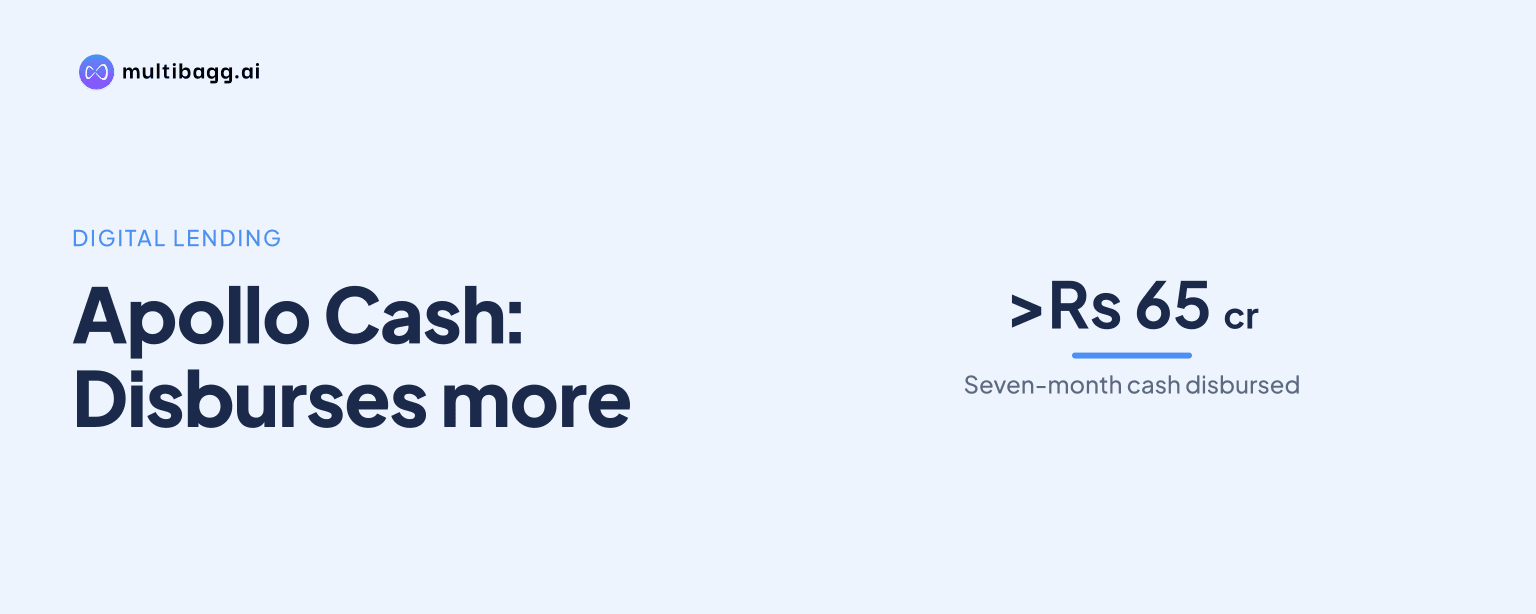
Apollo Finvest (India) Limited said Apollo Cash had disbursed more than Rs 65 crore through almost 1.6 lakh loans within six to seven months from February, alongside more than 5 lakh downloads. Management said the digital-lending product had scaled almost 60-fold despite using virtually no Google or Facebook advertising so far.
Know Apollo Finvest (India) inside out
Results, valuation, peers and who's buying, in one view.
What has Apollo Cash achieved since February?
Apollo Cash has disbursed more than Rs 65 crore across almost 1.6 lakh loans and recorded more than 5 lakh downloads since its journey began in February. Managing Director and Chief Executive Officer Mikhil Innani presented those metrics on the November 6, 2026 earnings call for the quarter and half year ended September 30, 2026. Apollo described the six-to-seven-month build-out as an early-stage product rather than a mature lending operation.
Apollo said scale had increased by almost 60 times from February to the November 2026 call. This is the main period comparison disclosed by management: the prior quarter represented a much earlier stage for Apollo Cash, while the latest quarter showed a larger effect on the wider business. Innani said disbursement volumes, revenue and profit had all risen, principally because Apollo Cash had become older and was gaining traction.
The company also distinguished Apollo Cash from its existing partnership business. According to Innani, processing fees, interest and every customer revenue line from Apollo Cash are booked by Apollo, making the product’s contribution more visible in revenue and profit and loss accounts. That was management’s explanation for the increase in fees and commission in the second quarter compared with the first quarter of financial year 2026-27. The call did not provide absolute quarterly fees, commission or profit figures.
Why does Apollo see demand for Apollo Cash?
Apollo sees more than Rs 65 crore of disbursements, almost 1.6 lakh loans and over 5 lakh downloads as early evidence of demand and product-market fit. Management said the results were notable because Apollo Cash had used “pretty much no” Google or Facebook ads at that point. This is management’s assessment of organic traction, rather than a disclosed measure of customer-acquisition cost, conversion or marketing return.
The company said demand was visible through borrower activity and its capacity to serve that activity during the first six to seven months. Innani described the progress as a solid start but said Apollo had not yet captured all the opportunity management had identified. Apollo therefore plans a series of smaller operating changes before seeking a bigger scale-up, separating the reported 60-fold growth from the future expansion effort.
The call presented downloads and loans as separate metrics. It did not disclose the number of unique borrowers, average loan size, loan tenure, repeat-loan share, borrower geography or collections performance. It also did not provide a February disbursement base or quarterly Apollo Cash disbursements. Those omissions limit comparisons beyond the management-reported 60-fold increase from February.
What must Apollo change before expanding marketing?
Apollo says it must strengthen platform security and stability, release an updated underwriting model and add product telemetry before pursuing broader marketing scale. Innani said almost 100% of engineering bandwidth was being directed to securing the platform and preparing it to scale. Management’s stated goal is to grow Apollo Cash 10 times from its then-current level over the coming quarters and about a year, without providing a dated disbursement target.
Security and scalability are linked in Apollo’s plan because a larger digital-lending platform would need to handle more borrower activity without compromising its technology. Management said the cybersecurity environment requires deliberate software development because vulnerabilities can be discovered across a technology stack. This was an explanation of engineering priorities, not a report of a cybersecurity incident at Apollo.
The underwriting initiative is based on data gathered from Apollo Cash borrowers during its first six to seven months. Management said it had seen enough borrowers and borrower data to evolve the underwriting model and hoped to release its next version in coming months. Its stated aims are better approval rates, better risk rates and smarter loan-amount allocation, especially for borrowers Apollo identifies as higher quality.
Got a follow-up? Ask IRIS
How could Apollo’s new underwriting model affect growth?
Apollo expects the next underwriting model to differentiate more clearly among new borrowers using loan-level data and to allocate larger amounts selectively. In response to an analyst’s question, Innani said Apollo had generally been conservative with new borrowers, with some differentiation but not an extremely dramatic one. Management hopes that distinction will become clearer over the next few months and quarters as Apollo gains more product-specific data.
Management explained the intended risk mechanism with a hypothetical example of 100 borrowers. If 20 borrowers default, the loss rate could be 20% if their loans represented that share of the book, or 1% if their loans represented 1% of assets under management, or AUM. The illustration was not Apollo’s reported loss experience, but showed why loan-size allocation can affect portfolio losses alongside approval decisions.
Apollo links improved underwriting to more efficient marketing because higher approvals, better risk outcomes and more tailored loan amounts could improve acquisition economics, according to management. The company said telemetry and data analysis would be added to the product before the marketing team scales activity. However, the November 6 call disclosed no marketing budget, campaign date, customer-acquisition-cost target or unit-economics measure.
How is Apollo building capacity for the next phase?
Apollo is adding fintech-experienced staff as it prepares Apollo Cash for a larger operating scale. Whole Time Director and Chief Financial Officer Diksha Nangia said Head of Marketing Swaujas Chatterjee had joined during the quarter, while a Head of Engineering was expected to join soon. Management said its senior hires come from fintech and have at least five years of digital-lending experience.
Technology roles made up close to 43% of Apollo’s team at the time of the call, and the engineering team had grown three times in one quarter. Nangia said most current hiring was in engineering, data science and quality assurance, or QA. The company described this hiring programme as part of the foundation for its next phase, alongside the technology, underwriting and marketing work disclosed for Apollo Cash.
Conclusion
Apollo Cash has established an initial operating base of more than Rs 65 crore of disbursements, almost 1.6 lakh loans and over 5 lakh downloads in six to seven months. Management said the product had scaled almost 60-fold since February and was becoming more visible in Apollo’s financial results because processing fees, interest and other customer revenue are recorded on Apollo’s books.
The next issue is execution of Apollo’s disclosed plan to improve platform security and stability, release a revised underwriting model, expand telemetry and prepare marketing for scale. Management aims to grow Apollo Cash 10 times over the coming quarters and about a year, while the expected engineering leadership hire and the model’s eventual rollout remain developments to watch.