










Apollo Finvest plans underwriting upgrade before paid growth
Key highlights
- Apollo Cash has disbursed more than Rs 65 crore through nearly 1.6 lakh loans.
- Apollo plans to use six to seven months of live borrower and collections data in its revised underwriting model.
- Apollo Cash lending was running at about Rs 20 crore to Rs 22 crore a month when management discussed funding capacity.
- Close to 43% of Apollo's team is in technology, and its engineering team grew threefold in one quarter.
powered by IRIS
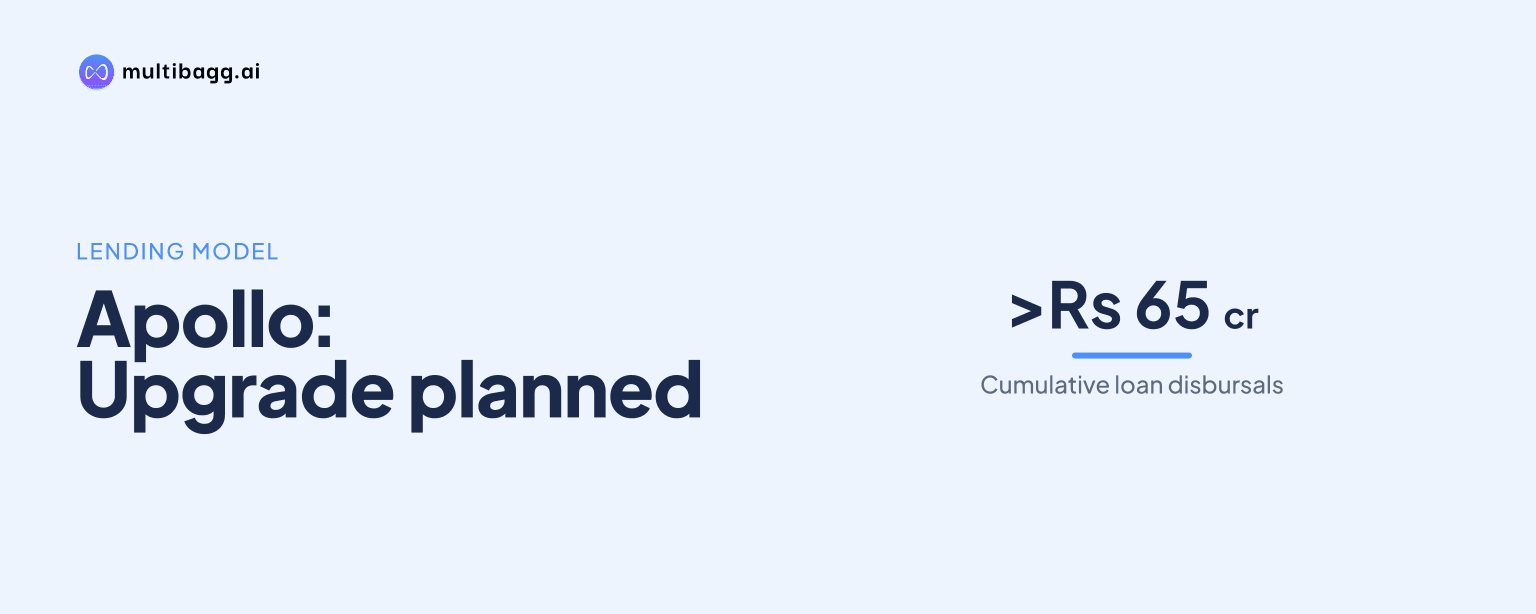
Apollo Finvest plans to test a revised Apollo Cash underwriting model before materially increasing paid customer acquisition, using six to seven months of live borrower and collections data. After disbursing more than Rs 65 crore through nearly 1.6 lakh loans, Apollo aims to raise approvals, improve risk outcomes and tailor loan amounts before scaling marketing.
Know Apollo Finvest (India) inside out
Results, valuation, peers and who's buying, in one view.
How will Apollo change underwriting before paid growth?
Apollo will build and test a next version of its underwriting model in the coming months before using marketing to scale Apollo Cash more aggressively. Management said the model will use data generated specifically by Apollo Cash, including the borrower profiles attracted to the product and Apollo's collections experience, rather than relying only on its eight to nine years in lending.
The intended changes are higher approval rates, better risk rates and more differentiated loan-amount allocation. Apollo said it has generally been conservative with new borrowers and had some differentiation in offers, but wants that differentiation to become clearer over the next few months and quarters as more product-specific data becomes statistically significant.
Apollo said the model will examine multiple underwriting data sources to distinguish among good, average and bad borrowers. Management's expectation is that a better classification process can allow Apollo to approve more suitable applicants while giving higher-quality borrowers loan amounts that better match their assessed repayment capacity.
How can Apollo approve more borrowers while managing losses?
Apollo's thesis is that machine learning can improve approval, loan-sizing and loss decisions at the same time by separating borrower quality more precisely. Management said the objective is not simply to lend more, but to make different lending decisions for borrowers with different observed risk and repayment characteristics.
Management illustrated the point with a hypothetical group of 100 borrowers in which 20 borrowers default. The loss rate could be 20% by borrower count, but only 1% of assets under management, or AUM, if the money lent to those borrowers accounted for 1% of the total portfolio. The example shows why Apollo is focusing on loan amount allocation as well as approval rates.
Apollo has disbursed nearly 1.6 lakh loans and recorded more than 5 lakh downloads since Apollo Cash began. Management said this operating history gives it materially more data than it had at launch, but it did not present improved loss outcomes as achieved results because the revised model still needs to be launched and tested.
Apollo currently offers equated monthly instalment loans with three-month and six-month tenures and may explore nine-month and 12-month products. Management said a meaningful share of customers repays before the due date, although it expects that behaviour may not persist as ticket sizes rise because repeated foreclosure may become less economical for borrowers.
How will Apollo spend on customer acquisition?
Apollo will prioritise targeted acquisition with measurable returns rather than broad brand advertising or publicity spending. Management said it wants to prove that the organic customer funnel works before paying to attract users, including confirming that pricing, loan amounts and product design produce low customer drop-offs without compromising risk controls or compliance.
The company plans to analyse each product gate, including know-your-customer, or KYC, checks, offers and underwriting. Management described a low-leakage funnel as the condition for spending even Rs 1 on external acquisition, because the company wants marketing expenditure to have a clearly demonstrable effect on the bottom line in either the short or long term.
Apollo said Apollo Cash had seen practically no Google or Facebook advertising so far, making its early traction largely organic. It has hired Swaujas Chatterjee as head of marketing, and management said growth marketing will be a key driver in coming quarters once the product, underwriting and data-analysis systems are ready.
Platform readiness is also part of that sequence. Apollo said close to 43% of its team is in technology, while its engineering team grew threefold in one quarter; it is investing in platform security, scalability, telemetry and data analysis as it targets the capacity to expand 10 times over coming quarters and about a year.
Got a follow-up? Ask IRIS
Which customers will Apollo target first?
Apollo will first focus on customer cohorts that have already arrived organically, then test the product experimentally with segments that have little awareness of Apollo Cash. Management said it is too early to identify one ideal borrower type because it sees resonance across three or four different borrower groups.
Management expects that about 12 months of some marketing activity could produce a clearer picture of which segments respond most consistently. Apollo plans to begin by spreading awareness among organically acquired users, while also placing the product before new cohorts on a limited experimental basis to measure demand and performance.
The early common traits cited by management are digital familiarity and prior use of digital lending. Apollo said customers finding value in the product appear technologically savvy, understand how the lending ecosystem works and have taken digital loans before, but these observations are not a published eligibility rule or final customer-segmentation target.
Apollo Cash scaled almost 60 times over six to seven months from February, according to management, but the company said it is now consolidating processes across technology, data science, collections, marketing and finance. That work is intended to ensure that paid customer acquisition begins after the underwriting model and operating platform can handle a larger flow of applications.
What funding capacity does Apollo have for growth?
Apollo said it can potentially double or triple current lending without requiring substantial external capital, although management described doubling as the more straightforward near-term outcome. Apollo Cash lending was running at about Rs 20 crore to Rs 22 crore a month when management discussed its funding capacity.
Management said it would consider engaging lenders when it reaches roughly 80% to 90% of the capital available to it, possibly in a couple of quarters. Apollo has made provision for the ability to borrow about Rs 100 crore from the debt market if required, but management said debt funding was not an immediate objective.
Apollo also attributed higher fees and commission in the second quarter compared with the first quarter to Apollo Cash becoming more prominent in its financial statements. Processing fees, interest and other revenue paid by Apollo Cash customers are recorded on Apollo's own books, which management contrasted with its partnership business.
Conclusion
Apollo's strategy is to sequence growth behind product evidence rather than begin with broad customer acquisition. The more than Rs 65 crore of Apollo Cash disbursals, nearly 1.6 lakh loans and six to seven months of borrower and collections information form the basis for management's proposed underwriting revision, while the targeted-marketing approach is intended to keep acquisition tied to observed customer and portfolio performance.
The next developments to watch are the launch and testing of the revised underwriting model, experimental marketing across new customer cohorts and the evolution of loan terms beyond three and six months. Management also identified the 80% to 90% capital-use level as the point at which it may engage lenders, and said a clearer view of its target borrower segments could emerge after about 12 months of marketing activity.