










ESDS Targets Mid-December Cluster Start, Rs 288 Crore Monthly
Key highlights
- ESDS expects the 8,200-GPU Sydney AI cluster to be ready for service by 17 December at the latest.
- Management estimates about Rs 288 crore of monthly revenue from the Sydney AI factory after it goes live.
- Management cited monthly Sydney PAT of Rs 50 crore to Rs 60 crore, later narrowing the estimate to Rs 50 crore to Rs 52 crore.
- ESDS reported H1 FY27 revenue from operations of Rs 271.9 crore, up 24.6% from Rs 218.37 crore in H1 FY26.
powered by IRIS
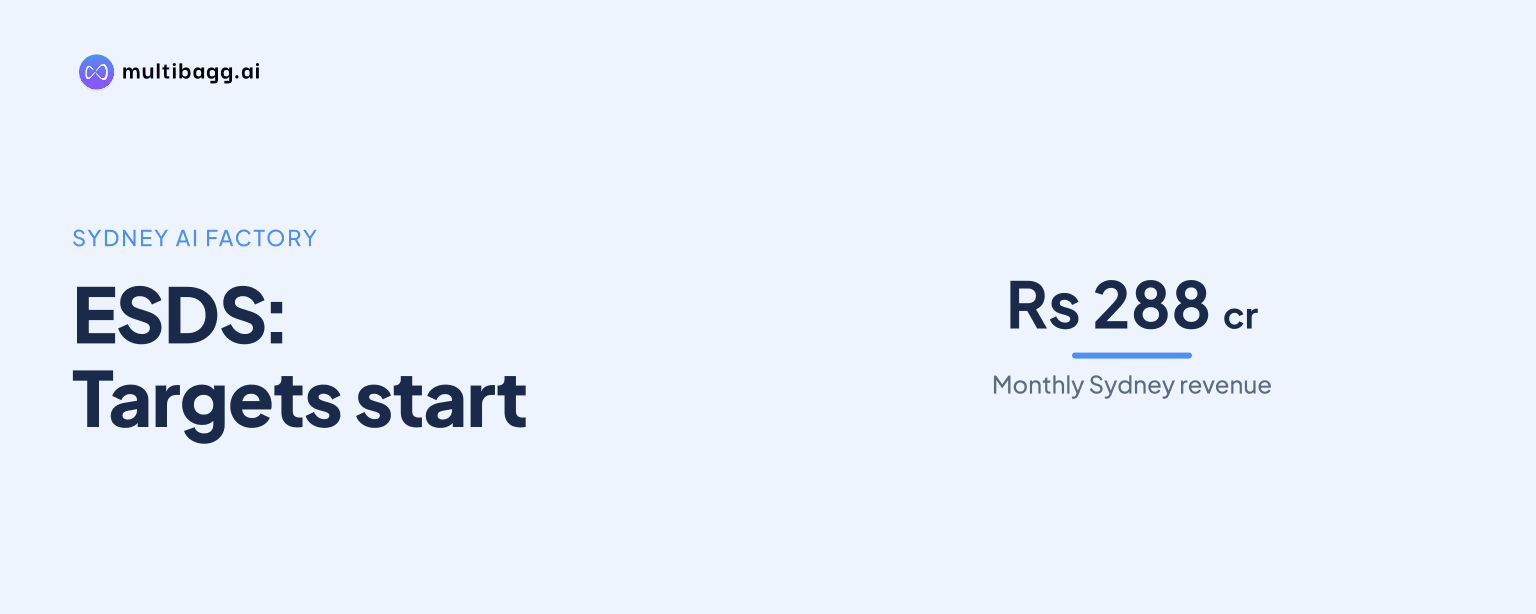
ESDS Software Solution Limited expects its fully contracted 8,200-graphics processing unit (GPU) Sydney AI factory to be ready for service by 17 December at the latest, with management estimating monthly revenue of about Rs 288 crore after launch. Management also estimated profit after tax (PAT) of Rs 50 crore to Rs 60 crore a month from the project.
Know ESDS Software Solution inside out
Results, valuation, peers and who's buying, in one view.
When will ESDS's Sydney AI cluster become ready for service?
ESDS expects the Sydney AI cluster to be ready for service in the first week of December at the earliest and by 17 December at the latest. During the Q2 FY27 call, management said NVIDIA was conducting cluster testing and could hand the system over by 27 November on the longer end of its two-to-three-week estimate.
The proposed schedule includes 20 days of testing by ESDS's customers after the NVIDIA handover. Management therefore described 17 December as an upper-end ready-for-service estimate, not a completed operating milestone. It said it hoped to record one month of revenue and profit in the current quarter, followed by three months of contribution in the next quarter.
How much revenue and PAT does ESDS expect from Sydney?
ESDS management estimated approximately Rs 288 crore of monthly revenue once all 8,200 GPUs are operating. It initially cited PAT of Rs 50 crore to Rs 60 crore a month from the project, then gave a narrower range of Rs 50 crore to Rs 52 crore in a later response about customer rental economics.
These are management estimates rather than reported revenue or earnings. An analyst described the opportunity as around Rs 3,000 crore in annual revenue and management agreed, while clarifying that Rs 3,000 crore a year was ESDS's liability to Sharon AI and Rs 288 crore a month was the expected billing to customers. The call did not reconcile that annual figure with a simple 12-month annualisation of the monthly estimate.
Management contrasted the AI factory's expected PAT margin of 16% to 18% with a 26% to 27% range for the domestic business. It also said prevailing B300 GPU pricing could have supported more than Rs 150 crore of monthly PAT, but ESDS could not increase prices because it had already committed rates to customers.
Is the Sydney capacity contracted and what are the contract terms?
ESDS said Sharon AI has fully contracted all 8,200 GPUs to ESDS on a dedicated basis, with no shared capacity in this AI factory. Management added that ESDS had in turn committed the capacity to a number of customers, which limits its current ability to revise customer prices despite changes in GPU market rates.
The commitment with Sharon AI is for five years, while the rate is locked for seven years, according to management. If ESDS renews after the initial five-year period, management said its Sharon AI price would be 30% to 40% below the first-five-year rate. ESDS said its own customer billing can either rise or remain unchanged after the five-year period.
Management described the Sharon AI contract value as ESDS's liability to its supplier rather than customer revenue. It also said customer advances mirror its advance arrangement with Sharon AI: half will be amortised over three months from go-live and the remaining half in months 34, 35 and 36. This timing makes the accounting treatment after commissioning relevant alongside the stated revenue run rate.
Got a follow-up? Ask IRIS
How does the Sydney project compare with ESDS's reported business?
The estimated Rs 288 crore monthly Sydney revenue run rate exceeds ESDS's reported Rs 271.9 crore of revenue from operations for all of H1 FY27. This is not a like-for-like comparison because the Sydney number is a future monthly management estimate whereas the reported figure covers six months, but it indicates the potential scale of the proposed revenue addition.
ESDS reported Q2 FY27 revenue from operations of Rs 138.34 crore, compared with Rs 133.66 crore in Q1 FY27, an increase of 3.5%. The potential Sydney contribution would therefore change the revenue base materially if the cluster meets the 17 December timetable and reaches management's estimated run rate. Management cautioned that quarterly performance can vary with project execution and revenue recognition.
The company raised Rs 720 crore in its initial public offering and said it had used Rs 46.913 crore as of the call, leaving Rs 673.087 crore unutilised. Management said close to Rs 650 crore of that balance was in fixed deposits, while cash and cash equivalents stood at Rs 1,636.831 crore as of 30 September 2026.
What is ESDS planning after the Sydney AI factory?
ESDS said it has an Indian pipeline of Rs 3,000 crore, primarily for Infrastructure as a Service AI infrastructure work. Management identified demand from defence public-sector undertakings, the central government defence department and enterprises, while describing the planned domestic facilities as smaller AI factories than the 8,200-GPU Sydney project.
Management plans capital expenditure of Rs 1,500 crore from initial public offering proceeds and customer advances for an Indian AI factory expected to go live by June of the following year. It also said it was pursuing similar arrangements with American, South Korean, Taiwanese and Swedish partners, including a memorandum of understanding with a Swedish partner, but disclosed no signed revenue value for those discussions.
Management said large AI factories of 8,000 or 16,000 GPUs can take time because negotiating a master services agreement may take nearly two months. It said its stated approach is to secure firm master services agreements and customer advance commitments before delivery, making the conversion of the pipeline into contracted projects a key unresolved step.
Conclusion
The Sydney AI factory could become a significant addition to ESDS's reported business if it enters service by 17 December and reaches management's projected Rs 288 crore in monthly revenue. Its economics differ from the domestic business, with management estimating a 16% to 18% PAT margin for the AI factory versus 26% to 27% for domestic operations, while committed customer pricing prevents immediate upside from higher GPU market rates.
The next event to watch is completion of NVIDIA testing, followed by the 20-day customer-testing process and the ready-for-service date. Management's next disclosed development plan is the Rs 1,500 crore Indian AI-factory investment, for which it expects a smaller facility to go live by June of the following year.