










ESDS SaaS revenue rises 48.3% as managed services decline
Key highlights
- ESDS SaaS revenue rose 48.3% year on year to Rs 49.77 crore in H1FY27.
- ESDS managed-services revenue declined 10.3% year on year to Rs 84.94 crore in H1FY27.
- Combined SaaS and managed-services revenue increased by Rs 6.46 crore to Rs 134.71 crore in H1FY27.
- ESDS reported IaaS revenue of Rs 137.28 crore in H1FY27, compared with Rs 90.12 crore in H1FY26.
powered by IRIS
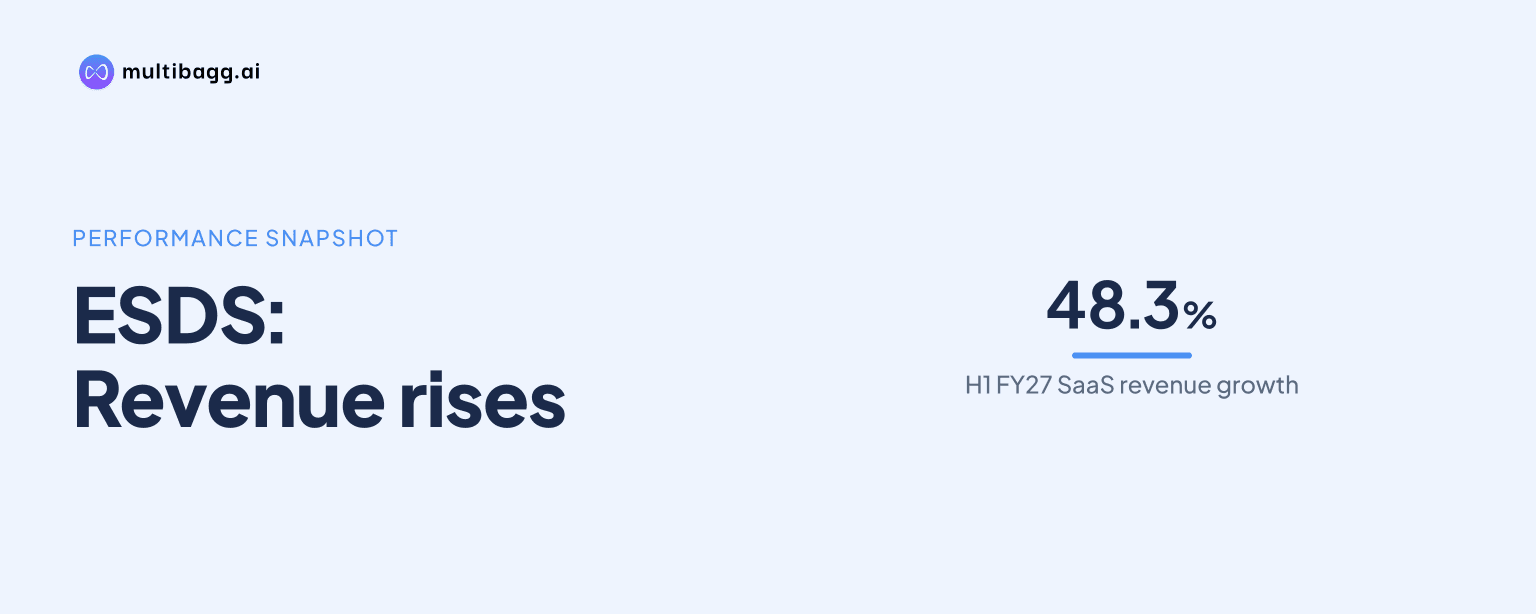
ESDS Software Solution Limited reported SaaS revenue of Rs 49.77 crore in H1FY27, up 48.3% from Rs 33.56 crore in H1FY26, while managed-services revenue declined 10.3% to Rs 84.94 crore from Rs 94.69 crore. The two reported service lines therefore moved in opposite directions during the first half.
Know ESDS Software Solution inside out
Results, valuation, peers and who's buying, in one view.
Why did ESDS’s service mix change in H1FY27?
ESDS’s service mix changed mechanically because SaaS added Rs 16.21 crore of revenue year on year while managed services declined by Rs 9.75 crore. SaaS was the smaller of the two lines in both H1FY26 and H1FY27, but its contribution to their combined reported revenue increased as managed-services revenue fell.
The combined revenue of the two lines was Rs 134.71 crore in H1FY27, compared with Rs 128.25 crore in H1FY26, an increase of Rs 6.46 crore. SaaS represented about 36.9% of the combined total in H1FY27, against about 26.2% in H1FY26, based on the reported half-year revenue figures.
Managed services remained the larger reported line at Rs 84.94 crore in H1FY27, exceeding SaaS revenue of Rs 49.77 crore by Rs 35.17 crore. The presentation does not state why managed-services revenue declined or identify customer, pricing, renewal or contract factors behind the movement.
What does ESDS include in managed services?
ESDS defines managed services as cloud, data-centre, security, IT infrastructure and network, backup and disaster recovery, database, and DevOps and automation services. The portfolio includes 24/7 IT support, migration, data backup and recovery, security operations centre services, and SAP Basis and SAP HANA administration.
The managed-services model is presented as a one-stop offering for small and medium sized businesses, or SMBs, with limited in-house information-technology teams. ESDS describes the model as pay-per-use and tailored to the Indian SMB market, although H1FY27 revenue of Rs 84.94 crore was Rs 9.75 crore below the Rs 94.69 crore reported a year earlier.
Within H1FY27, managed-services revenue was Rs 41.84 crore in Q1FY27 and Rs 42.88 crore in Q2FY27. That was a sequential increase of Rs 1.04 crore in the reported quarterly figures, despite the lower H1FY27 total versus H1FY26.
What products supported ESDS’s SaaS revenue growth?
ESDS’s SaaS portfolio includes a data-centre management and monitoring suite, vulnerability scanners, web access firewalls and virtual private network connectivity. Its proprietary offerings also include the internally developed SPOCHUB digital marketplace and the SWARA GPU Monitoring Tool, which provides real-time visibility into an organisation’s graphics processing units.
The SaaS portfolio also includes G-SaaS collaborations with government and public-sector organisations. The cited applications include smart metering with a government energy service company, e-governance projects with certain government ministries, smart-city data hosted on ESDS’s cloud platform, smart-farming initiatives, and work with Software Technology Parks of India, or STPI.
SaaS revenue reached Rs 49.77 crore in H1FY27, compared with Rs 33.56 crore in H1FY26. The Rs 16.21 crore increase was larger than the Rs 9.75 crore managed-services decline, resulting in a Rs 6.46 crore rise in the combined revenue of the two lines.
Got a follow-up? Ask IRIS
Do ESDS’s quarterly figures match its H1FY27 totals?
ESDS’s reported quarterly SaaS figures do not add up to its stated H1FY27 SaaS total. The presentation lists Rs 23.46 crore for Q1FY27 and Rs 29.84 crore for Q2FY27, together amounting to Rs 53.30 crore, which is Rs 3.53 crore above reported H1FY27 SaaS revenue of Rs 49.77 crore.
The same issue appears on a smaller scale in managed services. Q1FY27 revenue of Rs 41.84 crore plus Q2FY27 revenue of Rs 42.88 crore equals Rs 84.72 crore, which is Rs 0.22 crore below the reported H1FY27 managed-services total of Rs 84.94 crore.
The reported half-year figures are the basis for the 48.3% SaaS increase and 10.3% managed-services decline. ESDS provides no reconciliation in the presentation for either the Rs 3.53 crore SaaS difference or the Rs 0.22 crore managed-services difference.
How does the shift compare with ESDS’s IaaS business?
ESDS reported Infrastructure as a Service, or IaaS, revenue of Rs 137.28 crore in H1FY27, compared with Rs 90.12 crore in H1FY26. The H1FY27 IaaS total comprised Rs 29.88 crore from colocation and data-centre services and Rs 107.40 crore from cloud services and cloud computing.
Cloud services and cloud computing rose by Rs 39.28 crore, from Rs 68.12 crore in H1FY26 to Rs 107.40 crore in H1FY27. Colocation and data-centre services increased by Rs 7.87 crore, from Rs 22.01 crore to Rs 29.88 crore over the same periods.
ESDS describes its delivery model as integrating IaaS, managed services and SaaS across cloud adoption, migration and post-delivery support. Its community-cloud client base as of June 30, 2026 included 104 Government Cloud clients, 115 banking and financial institutions across 1,045 branches, and 113 SAP HANA Community Cloud organisations.
Conclusion
The H1FY27 figures show SaaS adding Rs 16.21 crore while managed services declined by Rs 9.75 crore, shifting a larger share of the two-line total toward SaaS. Managed services nevertheless remained the bigger line by Rs 35.17 crore, while IaaS generated Rs 137.28 crore, above both service lines individually.
The next disclosed milestone is ESDS’s targeted September 2026 delivery of infrastructure for its Australia-based AI cloud agreement, with revenue generation expected to begin in Q3FY27. The presentation also leaves unresolved the differences between the stated H1FY27 totals and the sums of the quarterly SaaS and managed-services figures.