










ESDS targets Rs 1,000 crore annual India GPU revenue
Key highlights
- ESDS targets 1,150 to 1,200 additional GPUs in India by June-July next year.
- Management targets Rs 1,000 crore of annual revenue from the planned India GPU business.
- ESDS said its existing Indian data centres are operating at close to 85% utilisation.
- Management described the domestic cloud and colocation opportunity as about Rs 3,000 crore, majorly cloud.
powered by IRIS
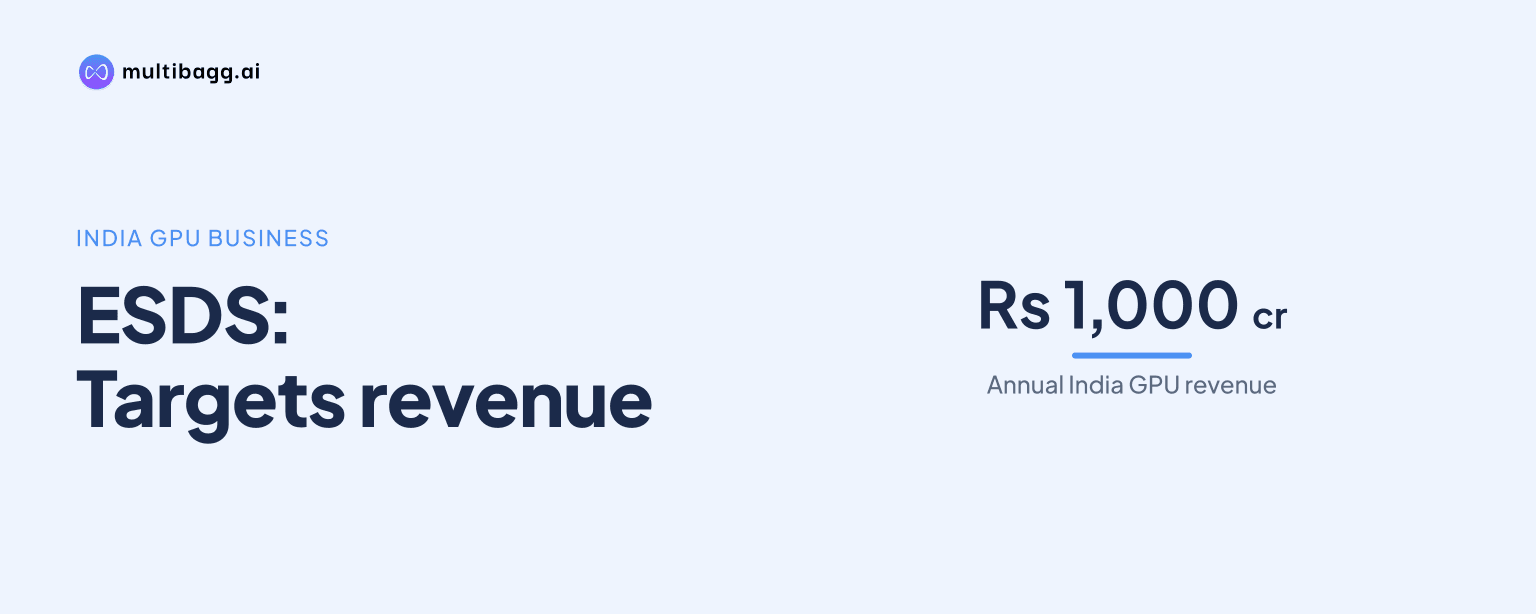
ESDS said during its Q2 FY27 earnings call that it targets June-July next year for adding 1,150 to 1,200 graphics processing units, or GPUs, in India, with management targeting Rs 1,000 crore in annual revenue from that business. Management also indicated that further Indian GPU additions may follow in August-September next year.
Know ESDS Software Solution inside out
Results, valuation, peers and who's buying, in one view.
When will ESDS launch the new Indian GPUs?
ESDS targets June-July next year to bring 1,150 to 1,200 additional GPUs into operation in India. Management called this the immediate addition and confirmed that further capacity could be added in August-September next year, although it did not quantify that subsequent deployment.
The June-July range remains a management target rather than a reported installation. ESDS did not disclose a specific go-live date, equipment supplier allocation, Indian site, customer list or contracted power requirement for the 1,150-to-1,200-GPU plan.
The planned Indian capacity is separate from the 8,202-GPU artificial intelligence, or AI, factory in Sydney discussed on the same call. Management said the Sydney cluster consumes 16 megawatts of power in one data centre, while ESDS gave no power figure for the Indian GPU rollout.
ESDS also said its existing Indian data centres were operating at close to 85% utilisation. It is increasing capacity at three other data centres that management expects to be running within two to three months, but did not quantify those additions or link them directly to the June-July GPU target.
How much revenue does ESDS expect from the India expansion?
ESDS management targets Rs 1,000 crore of revenue per year from the planned India GPU business, rather than Rs 1,000 crore per month. Management gave that clarification after an analyst asked whether the amount referred to a monthly or annual contribution to the India business.
The Rs 1,000 crore figure is a target associated with planned capacity, not revenue reported in Q2 FY27. ESDS did not disclose the utilisation required to reach it, GPU pricing, expected margins, capital expenditure, customer commitments or the time needed after go-live to reach that annual level.
Management placed the revenue target alongside a domestic cloud and colocation opportunity of about Rs 3,000 crore, which it said was majorly cloud. That opportunity is not disclosed as contracted revenue for the new GPU plan, and ESDS did not state what portion, if any, would convert into the Rs 1,000 crore annual target.
ESDS said the current domestic funnel is more promising for AI infrastructure than for managed services and software-as-a-service. It described Infrastructure-as-a-Service as the principal current model, but did not specify how much of the annual revenue target would come from infrastructure, cloud, government or enterprise workloads.
Got a follow-up? Ask IRIS
Which Indian demand segments is ESDS targeting?
ESDS is targeting AI-infrastructure workloads from government, defence public-sector undertakings, the central government defence department, enterprises and banks. Management said these customers are seeking smaller AI factories, in contrast with international factories that can involve 8,000 or 16,000 GPUs.
The company said it was speaking with domestic and international customers simultaneously for GPU capacity. Management said the allocation would depend on who offered better pricing and a better advance because a final delivery date had not then been established.
Power availability is part of ESDS's stated domestic expansion approach. Management said it was pursuing data centres with 50-megawatt or 100-megawatt power capabilities and described securing powered land as a priority, but did not disclose a completed acquisition, location, price or power contract tied to the India GPU buildout.
Management said India could have 40 gigawatts to 50 gigawatts of surplus power for AI factories over the next four to five years. This was management's view of the market, not a disclosed power allocation to ESDS, and the call gave no government approval, incentive or contract for the proposed deployment.
What could affect ESDS's delivery timeline?
ESDS said future AI-factory delivery depends on power, data-centre readiness, GPU supply and technical testing being prepared before the GPUs arrive. Management said it was working with NVIDIA, Supermicro, Dell, new cloud companies and data centres with power, aiming to reduce future delivery timelines to less than six months.
The 8,202-GPU Sydney factory illustrates the testing process cited by management. ESDS said NVIDIA's auditors tested the cluster at 100% power, central processing unit, GPU and random-access memory utilisation for one continuous hour; management said the toughest tests had been cleared and it was awaiting the report before customer testing for 20 days.
Contract execution can also affect delivery. Management said a master services agreement, or MSA, for a large AI factory can take almost two months because several legal counsels may be involved, and said it was pursuing firm MSAs and customer advances for its wider pipeline.
ESDS reported no major customer advances in Q2 FY27 because it had not signed major contracts in that quarter. For the Sydney facility, management said customer pricing was fixed for five years and the arrangement was take-or-pay, but it did not disclose whether the proposed India GPU customers would have the same terms.
Conclusion
ESDS has set measurable targets for its next domestic AI-infrastructure expansion: 1,150 to 1,200 GPUs by June-July next year and Rs 1,000 crore in annual revenue from that business. The plan sits alongside close to 85% utilisation at existing Indian data centres and management's view that domestic demand is currently concentrated in AI infrastructure.
The next disclosures to watch are customer commitments, power arrangements and a final delivery date for the June-July deployment. Management has flagged further additions in August-September next year and is seeking to shorten later AI-factory delivery cycles to less than six months.