










Aptus Value Housing Finance Declares ₹2 Interim Dividend
Key highlights
- Aptus declared a ₹2 per-share interim dividend for FY27, with November 13, 2026, as the record date.
- Consolidated Q2 FY27 profit after tax was ₹135 crore, up 18% year-on-year.
- Q2 FY27 disbursements rose 20% year-on-year to ₹1,153 crore.
- Assets under management increased 20% year-on-year to ₹14,177 crore as of September 30, 2026.
powered by IRIS
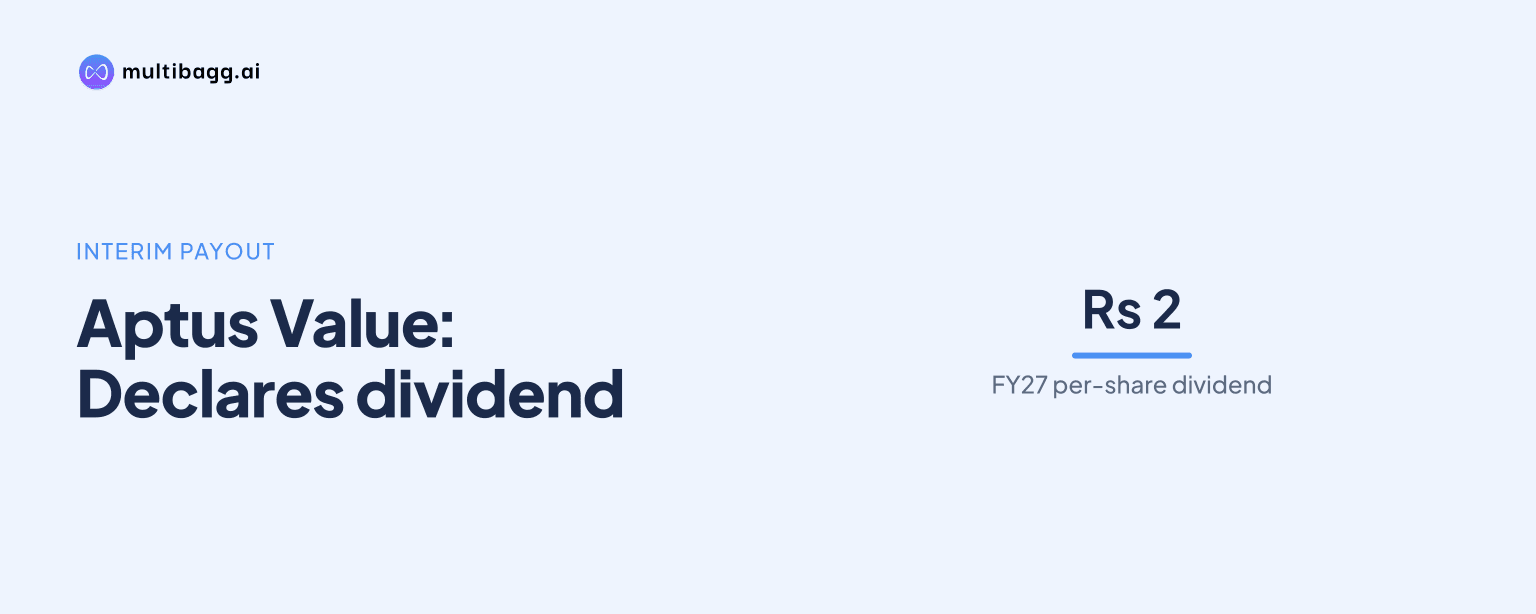
Aptus Value Housing Finance India Limited approved its Q2 FY27 results and declared a ₹2 interim dividend per equity share after reporting consolidated profit after tax of ₹135 crore, up 18% year-on-year, for the quarter ended September 30, 2026. The board decision sets November 13, 2026, as the dividend record date.
Know Aptus Value Housing Finance India inside out
Results, valuation, peers and who's buying, in one view.
What did Aptus Value Housing Finance approve for Q2 FY27?
Aptus Value Housing Finance India Limited approved unaudited standalone and consolidated financial results for the quarter and half year ended September 30, 2026, at its board meeting on November 4, 2026. The board also approved the reappointment of the Chief Compliance Officer, according to the company update.
The company declared a first interim dividend of ₹2 per equity share for FY27. This equals 100% of the ₹2 face value per share. Shareholders whose names appear in the company records on Friday, November 13, 2026, will be eligible for the payout, which is scheduled to be made on or before November 30, 2026.
The results were accompanied by a limited review report from statutory auditors Sundaram & Srinivasan, Chartered Accountants. Aptus also furnished disclosures on security cover, related-party transactions and other information required under relevant SEBI Listing Regulations.
How did Aptus perform in the September 2026 quarter?
Aptus reported consolidated profit after tax of ₹135 crore for Q2 FY27, an 18% increase from the corresponding quarter a year earlier. Consolidated profit before tax was ₹172 crore, up 11% year-on-year, based on the investor presentation.
Consolidated interest income for the quarter was ₹331 crore, compared with ₹306 crore in Q2 FY26, representing growth of about 8%. On the standalone housing finance company basis, interest income for the first half of FY27 was ₹753 crore, against ₹650 crore in the year-earlier period, an increase of about 16%.
The reported numbers show continued growth in lending activity and earnings. However, the available information does not disclose the detailed Q2 FY27 comparison for every income-statement line, including the full set of operating expenses and credit-cost metrics. Investors will therefore need to assess the detailed financial statements and management discussion alongside the headline figures.
Got a follow-up? Ask IRIS
What do disbursements and AUM indicate about Aptus growth?
Aptus disbursed ₹1,153 crore during Q2 FY27, compared with ₹963 crore in Q2 FY26, a 20% year-on-year increase. Assets under management reached ₹14,177 crore as of September 30, 2026, also 20% higher than ₹11,767 crore a year earlier.
These figures indicate that loan origination and the outstanding loan portfolio continued to expand at a similar rate. For a housing finance company, disbursements are a measure of new lending activity, while AUM measures the overall value of loans being managed. The growth in both measures is relevant because it supports future interest income, subject to borrowing costs and loan collections.
The company reported a yield range of 17.2% to 17.4%. Its net income margin for the first half of FY27 was 13.2%, marginally below 13.4% in the previous-year period. This movement is important because margins reflect the relationship between income generated from loans and funding, operating and credit-related costs.
What should investors monitor after the Q2 FY27 results?
Investors should monitor asset quality and collection performance as Aptus expands its loan book. The company update flags rising delinquencies in its NBFC business as an area requiring close attention, although it does not provide delinquency ratios or provisioning figures in the supplied information.
Borrowings stood at ₹8,386 crore as of September 30, 2026, compared with ₹7,284 crore a year earlier. Higher borrowings are consistent with a larger lending portfolio, but funding costs and liquidity remain important for lenders because they influence net interest income and profitability.
Aptus reported capital adequacy of 69.2% as of September 30, 2026. The reported liquidity position was ₹1,984 crore in Q4 FY27, compared with ₹1,815 crore in Q3 FY27. While these reported liquidity periods require investors to refer to the company presentation for context, the capital and liquidity disclosures remain relevant indicators of balance-sheet capacity.
When will management discuss the quarterly results?
Aptus rescheduled its earnings conference call to November 4, 2026, at 5:30 PM IST. The call is intended to discuss the Q2 and H1 FY27 financial results, and the company issued updated dial-in details for participants.
The discussion may provide further information on loan demand, funding conditions, collection trends, asset quality and the outlook for margins. No management guidance or earnings-call transcript for this quarter was available in the supplied material, so the investor presentation remains the stated source for the reported operating figures.
Conclusion
Aptus approved its Q2 FY27 results alongside a ₹2 per-share interim dividend, combining shareholder distribution with continued lending growth. Disbursements and AUM each rose 20% year-on-year, while consolidated Q2 profit after tax increased 18% to ₹135 crore. The results also show that borrowing growth and asset-quality performance need to be considered alongside earnings growth.
The next scheduled point for additional detail is the November 4 earnings call, where management is expected to discuss the quarter and first-half results. Investors can also watch the November 13 record date and the planned dividend payment on or before November 30, 2026, as well as any subsequent disclosure on collections, delinquencies and margins.