










Aptus Value Housing Finance India Limited Q3 Profit Rises 26%
Key highlights
- Aptus reported Q3 FY26 net profit of ₹239 crore, up 26% year-on-year.
- AUM stood at ₹12,330 crore on December 31, 2025, a 21% year-on-year increase.
- Q3 FY26 total income rose 22% year-on-year to ₹569 crore.
- Aptus operated 335 branches after adding 37 locations during calendar year 2025.
powered by IRIS
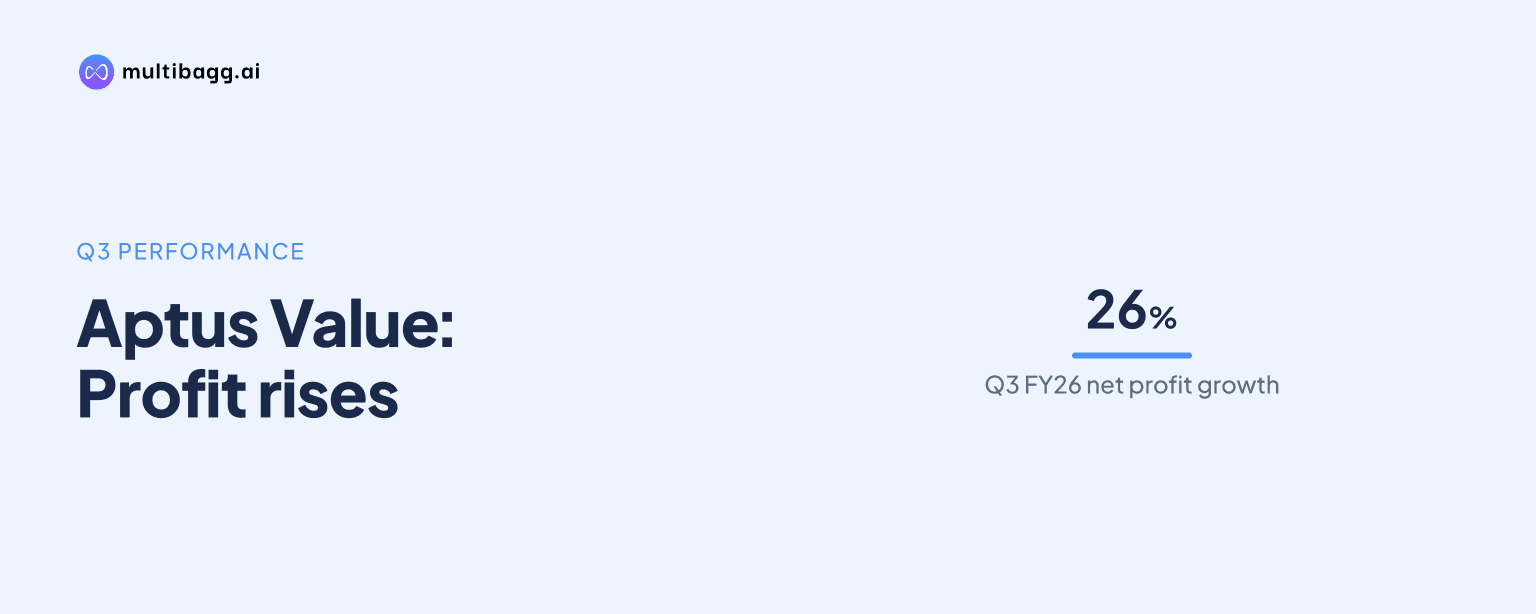
Aptus Value Housing Finance India Limited reported a 26% year-on-year increase in net profit to ₹239 crore for Q3 FY26, while assets under management rose 21% to ₹12,330 crore as of December 31, 2025. The results matter because they show continued growth in lending to low- and middle-income borrowers across semi-urban and rural markets.
Know Aptus Value Housing Finance India inside out
Results, valuation, peers and who's buying, in one view.
What did Aptus report for Q3 FY26?
Aptus Value Housing Finance India Limited reported total income of ₹569 crore in Q3 FY26, up 22% year-on-year, and net profit of ₹239 crore, up 26%. The company disclosed these results on February 4, 2026, alongside its financial and operational performance for the quarter and nine months ended December 31, 2025.
Aptus reported quarterly disbursements of ₹1,030 crore, representing 11% year-on-year growth. Its AUM stood at ₹12,330 crore at the end of December 2025, up 21% from a year earlier. AUM is a key measure for housing finance companies because it represents the outstanding loan book from which they generate interest income.
For the first nine months of FY26, total income rose 27% year-on-year to ₹1,652 crore. Net profit for the same period increased 26% to ₹685 crore, while disbursements grew 9% to ₹2,768 crore. The company reported return on assets of 7.9% and return on equity of 20.2% for the December quarter.
How did Aptus expand its operating network?
Aptus expanded to 335 branches by December 2025 after adding 37 locations during the calendar year. The branch additions support its stated focus on serving customers in Tamil Nadu, Telangana, Andhra Pradesh, Karnataka, Odisha and Maharashtra.
The company operates as a retail-focused housing finance business headquartered in Chennai, Tamil Nadu. Its target customers are primarily self-employed people from low- and middle-income households in semi-urban and rural areas. The lending model is centred on residential-property-backed credit, including home loans, quasi-home loans and business loans.
Aptus has also indicated that its operating model is supported by an in-house team and a digital loan origination system. Its Q1 FY27 investor presentation, filed on July 31, 2026, referred to contiguous branch expansion as an operating focus. That approach is consistent with the branch growth disclosed in the December-quarter release.
Which financial metrics were reported by Aptus?
Aptus reported growth across its loan book, income and profit metrics in Q3 FY26, with net profit growth of 26% exceeding the 21% expansion in AUM. The company also maintained return on assets of 7.9% and return on equity of 20.2% during the quarter.
The nine-month data gives additional context to the quarterly performance. Aptus generated ₹1,652 crore of total income and ₹685 crore of net profit in the first nine months of FY26. Disbursements of ₹2,768 crore for that period were 9% above the corresponding period a year earlier.
The disclosed figures do not provide a detailed breakdown of loan yields, borrowing costs, asset quality or credit-loss provisions. As a result, the release establishes the reported scale of growth but does not, by itself, explain each factor behind the movement in profitability.
Got a follow-up? Ask IRIS
What does the performance mean for investors and borrowers?
The Q3 FY26 numbers show that Aptus grew its loan book, income and profit while continuing to add branches in its chosen markets. For investors, the reported 7.9% return on assets and 20.2% return on equity are central measures of profitability, while AUM and disbursement growth indicate the pace of lending activity.
For borrowers, the company offers financing for purchase or construction of homes, renovation and extension work, as well as loan-against-property and business requirements. Quasi-home loans are offered for refinancing construction investment or house purchases, with a stated upper limit of ₹25 lakh. Business loans are backed by self-occupied property and can extend up to 60% of the property's value.
The branch network remains important for a lender focused on self-employed borrowers in smaller cities and rural areas, where customer acquisition, property assessment and loan servicing often require local operations. Aptus stated that its network served more than 1.79 lakh customers across its six operating states as of the December-quarter announcement.
How does Aptus fit into the affordable housing finance market?
Aptus operates in the affordable housing finance segment, addressing borrowers who may seek formal credit for first-time home purchases or self-construction. Its customer focus on low- and middle-income, self-employed households differentiates its operating model from lenders concentrated on salaried urban borrowers.
The company uses self-occupied residential property as collateral across its main lending products. This includes housing loans, quasi-home loans and small-ticket business loans. It also works with insurance companies to offer Credit Shield Insurance and Property Insurance, according to its investor materials.
Aptus' filings also show continuing engagement with the market through investor presentations and earnings calls. It filed an investor presentation related to unaudited Q1 FY27 financial results under Regulation 30 of the SEBI Listing Obligations and Disclosure Requirements Regulations, 2015. The company has also issued an intimation regarding an earnings conference call.
Conclusion
Aptus delivered higher Q3 FY26 income, profit and AUM, with net profit reaching ₹239 crore and its loan book rising to ₹12,330 crore. The results were accompanied by continued branch additions, reinforcing the company's distribution-led approach to affordable housing and property-backed lending in South and Central India.
Investors will next watch subsequent financial disclosures for the pace of AUM and disbursement growth, profitability measures and branch expansion. The company has also disclosed an earnings conference call intimation, although the supplied information does not specify the call date or further operational targets.