










Arman cuts incremental borrowing cost to 11.3% as leverage rises
Key highlights
- Arman’s incremental borrowing cost declined to 11.3% in Q2FY27 from 12.0% in Q2FY26.
- Debt-equity rose to 1.9 times at September 2026 from 1.2 times a year earlier.
- Total borrowings increased to Rs 2,659 crore in Q2FY27 from Rs 1,695 crore in Q2FY26.
- Arman reported Rs 334 crore of liquidity and Rs 145 crore of undrawn lender sanctions.
powered by IRIS
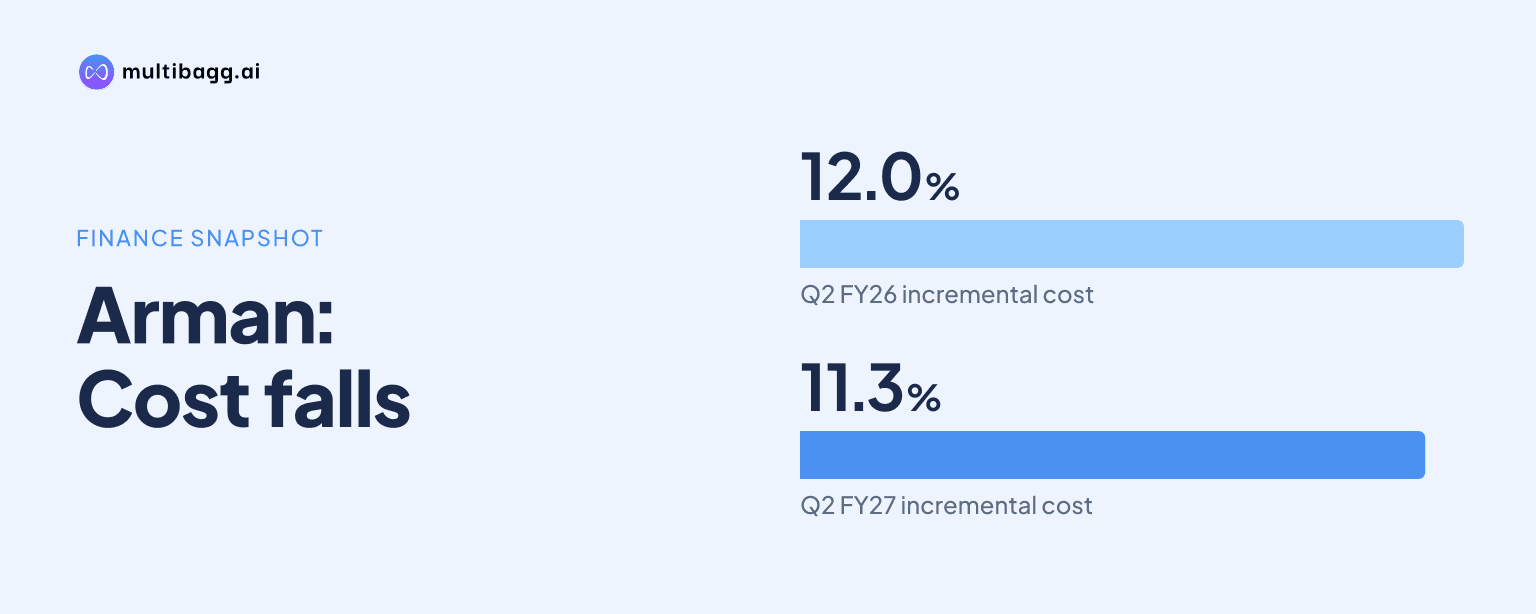
Arman reduced its incremental borrowing cost to 11.3% in Q2FY27 from 12.0% in Q2FY26, while debt-equity increased to 1.9 times at September 2026 from 1.2 times a year earlier. Total borrowings reached Rs 2,659 crore and reported liquidity was Rs 334 crore before the stated overdraft adjustment.
Know Arman Financial Services inside out
Results, valuation, peers and who's buying, in one view.
Why did Arman’s debt-equity ratio reach 1.9 times?
Arman’s debt-equity ratio reached 1.9 times at September 2026 as the ratio rose at every reported balance-sheet date from 1.2 times at September 2025. It increased to 1.4 times in December 2025, 1.7 times in March 2026 and 1.8 times in June 2026, representing a 0.7-times rise over 12 months.
Arman’s net worth increased to Rs 1,033 crore at September 2026 from Rs 872 crore at September 2025, a rise of Rs 161 crore. On a standalone basis, Arman’s capital adequacy ratio was 36.3% at 30 September 2026, compared with 33.6% at 30 June 2026 and 38.7% at 30 September 2025. Namra’s ratio was 37.2% at 30 September 2026, down from 57.8% a year earlier.
How did Arman lower its incremental borrowing cost?
Arman lowered its incremental borrowing cost by 0.7 percentage points over five reported quarters, reaching 11.3% in Q2FY27. The cost was 12.0% in Q2FY26 and Q3FY26, then declined to 11.8% in Q4FY26 and 11.7% in Q1FY27 before falling again in Q2FY27.
The reduction occurred as Arman’s borrowing base expanded from Rs 1,695 crore in Q2FY26 to Rs 2,659 crore in Q2FY27, an increase of Rs 964 crore. In Q2FY27, non-convertible debentures, or NCDs, made up 32.0% of borrowings, banks and small finance banks, or SFBs, accounted for 31.3%, and direct-assignment, or DA, transactions accounted for 19.6%.
What changed in Arman’s borrowing mix?
Arman increased the funding shares of NCDs, banks and SFBs between Q2FY26 and Q2FY27, while DA transactions and securitization accounted for lower shares. NCDs rose by 14.0 percentage points to 32.0%, while banks and SFBs rose by 1.1 percentage points to 31.3%. DA transactions declined by 9.2 percentage points to 19.6%, and securitization declined by 4.2 percentage points to 0.2%.
The mix also moved during FY27. NCDs had peaked at 38.0% of borrowings in Q4FY26, then eased to 35.7% in Q1FY27 and 32.0% in Q2FY27. Banks and SFBs rose from 23.8% in Q4FY26 to 29.1% in Q1FY27 and 31.3% in Q2FY27, while non-banking financial companies and financial institutions represented 16.4% in Q2FY27 against 14.6% in Q2FY26.
Got a follow-up? Ask IRIS
How much liquidity and maturity cover did Arman report?
Arman reported Rs 334 crore in cash and bank balances, liquid investments and undrawn cash-credit limits at September 2026. It also disclosed Rs 145 crore of undrawn sanctions from existing lenders. After adjusting for bank overdrafts that were 100% secured against fixed deposits, the presentation stated a liquidity amount of Rs 169 crore.
Arman reported a positive asset-liability management, or ALM, position, with average active borrowing tenure one month longer than average active asset tenure in every reported quarter. In Q2FY27, active assets averaged 18 months and active borrowings averaged 19 months, compared with 15 months and 16 months, respectively, in Q2FY26. The longest disclosed average tenures were 19 months for assets and 20 months for borrowings in Q1FY27.
How diversified was Arman’s lender base at Q2FY27?
Arman’s five largest lending partners individually accounted for 4.37% to 13.74% of borrowings in Q2FY27. The largest lender, through term loans and DA transactions, represented 13.74%, while the next four represented 6.05%, 5.73%, 5.08% and 4.37%. The presentation identifies their facility types but does not name the five lenders.
Arman listed bank relationships including Federal Bank, State Bank of India, HDFC Bank, ICICI Bank and Bank of Baroda, alongside non-bank sources including SIDBI, Bajaj Finance, Tata Capital and NABARD. Its long-term bank facilities were rated ACUITE A- with a Positive Outlook and CARE A- with a Stable Outlook. Namra Finance Limited was assigned an MFI-1 grading by CARE Advisory Research & Rating Limited.
Conclusion
Arman’s Q2FY27 funding data show a lower incremental borrowing cost of 11.3% alongside higher debt-equity of 1.9 times and total borrowings of Rs 2,659 crore. The funding mix shifted toward NCDs and banks and SFBs, while reported liquidity included Rs 334 crore before the specified overdraft adjustment and Rs 145 crore of undrawn lender sanctions.
The presentation does not disclose a borrowing-cost target or a timetable for future funding changes. The next funding update will therefore show whether the Q2FY27 mix of 32.0% NCDs, 31.3% banks and SFBs and 19.6% DA transactions changes, and whether debt-equity, liquidity and incremental borrowing cost move from their September 2026 and Q2FY27 levels.